
Jupiter
Jupiter is the giant of the family — a striped, storm-wracked ball of gas so massive it outweighs every other planet combined — two and a half times over. It rules a court of dozens of moons, wields the fiercest magnetic field of any planet, and hosts a storm, the Great Red Spot, that has raged for centuries.
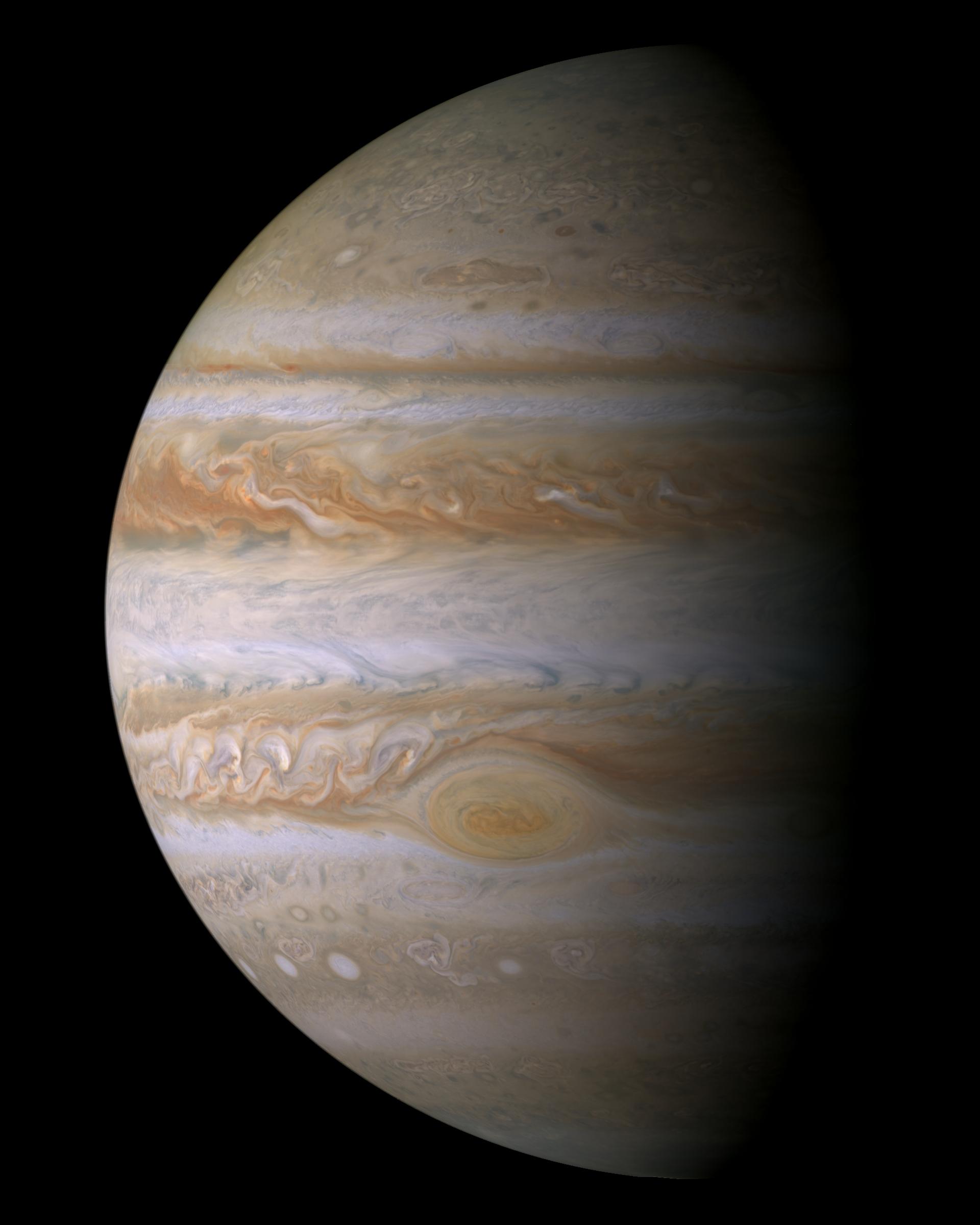
Image credit: NASA/JPL-Caltech/Space Science Institute. Jupiter in true color from Cassini — the most detailed global portrait of the planet at the time. The oval at lower right is the Great Red Spot, a storm wider than Earth.
Type
Gas giant — the largest planet
Size
~11 Earths across; 1,300+ Earths would fit inside
Day
Under 10 hours — the fastest spin
Moons
90+, including the four Galilean moons
A world of storms with no ground to land on
Jupiter is a gas giant: overwhelmingly hydrogen and helium, with no solid surface. Descend into it and the gas simply gets thicker and hotter until, deep down, the pressure crushes hydrogen into an exotic metallic liquid that generates the planet's colossal magnetic field — the strongest of any planet, and a source of intense radiation belts. Its swirling clouds are drawn into the familiar bands of light zones and dark belts by fast winds and its blistering rotation (a day on Jupiter is under ten hours, the fastest in the Solar System).
Its signature feature is the Great Red Spot, a high-pressure storm wider than the whole Earth that has been observed for at least 150 years and shows no sign of fully stopping, though it has been slowly shrinking. Jupiter also commands a vast retinue of moons — more than ninety, led by the four giant Galilean moons — and even a faint, dusty ring. So dominant is its gravity that Jupiter helps shepherd the asteroid belt and deflects or captures comets, acting as a kind of gravitational guardian for the inner Solar System.
The best first planet for a telescope
Jupiter is a showpiece and a superb first target. To the naked eye it is a brilliant, steady, creamy-white "star," often the brightest point in the night sky after Venus. But the magic begins with even a modest telescope. At low power you'll see the disc flanked by up to four tiny points of light — the Galilean moons, whose positions shift night to night. Steady the view and the planet's cloud belts emerge as parallel stripes across the disc.
A 4-inch or larger telescope on a calm night reveals the Great Red Spot as a pale oval (it's more salmon than fire-engine red), and you can watch it rotate out of view over an hour or two as fast-spinning Jupiter turns. Patient observers catch the moons casting inky shadows on the cloud tops, or vanishing into eclipse behind the planet. No other planet packs this much visible drama into a small scope.
New to stargazing? See how to observe the night sky, and if you're choosing gear, the no-hype telescope buying guide.
Not a failed star, and named for the king of the gods
A common misconception is that Jupiter is a "failed star" that just missed igniting. It didn't come close. Although it shares a star's basic ingredients, Jupiter would need to be roughly 80 times more massive to fuse hydrogen and shine as even the faintest red dwarf. It is emphatically a planet. Another myth is that a spacecraft (or a person) could "land" on Jupiter; there is nothing solid to land on — you would simply sink into ever-denser gas until you were crushed. And the Great Red Spot, often imagined as a permanent fixture, is in fact slowly changing and shrinking before our telescopes.
Jupiter is named, fittingly for the largest planet, after the Roman Jupiter (Jove), king of the gods and lord of the sky and thunder. His Greek counterpart is Zeus, ruler of Olympus — and it is no accident that Jupiter's four great moons carry the names of Zeus's loves and companions.
Primary sources: NASA — Jupiter and NASA/JPL Photojournal PIA04866 (Jupiter in true color, Cassini). Image credit: NASA/JPL-Caltech/Space Science Institute.
A striped colossus of cloud and storm, more massive than every other planet combined and then some — ruling its own miniature solar system of moons, and turning a single storm, wider than our whole world, for centuries on end.
More astronomy notes
Continue through the astronomy section for beginner-friendly notes, image credits, viewing tips, history, and the stories behind the night sky.
Galilean Moons · Saturn · The Planets · Astronomy · Interests