
Mars
Mars is the rusty, wind-scoured Red Planet — smaller and colder than Earth, yet home to the tallest volcano and the deepest canyon in the Solar System, marked everywhere by the dried-up rivers of a warmer, wetter past. No other world has drawn us to imagine life, or a second home, more insistently.
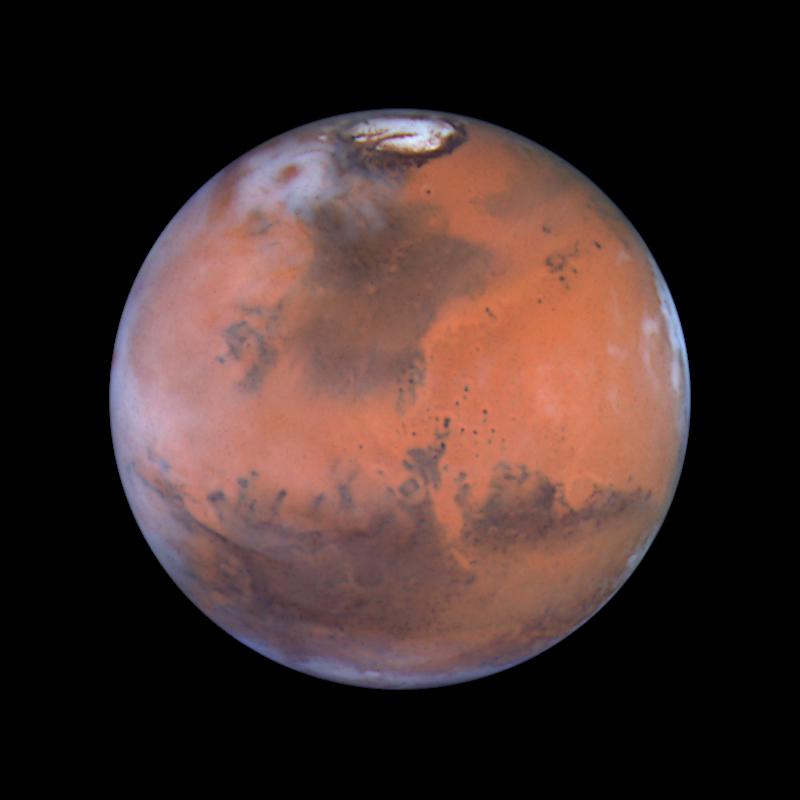
Image credit: NASA/Hubble/STScI. A full-globe view of Mars from the Hubble Space Telescope, showing the planet's rust-colored plains, darker rocky regions, and a bright cap of ice at the pole.
Type
Rocky (terrestrial) — about half Earth's size
Why it's red
Iron oxide — rust — in the dust
Records
Olympus Mons (tallest volcano); Valles Marineris (deepest canyon)
Moons
Two — Phobos and Deimos
A cold desert that used to run with water
Mars is about half Earth's diameter, cold (averaging around −60 °C), and wrapped in a thin atmosphere of carbon dioxide barely 1% the density of ours. Its famous color comes from iron oxide — rust — coating the surface and tinting even the sky a dusty pink. For its size, Mars carries outsized geology: Olympus Mons, a volcano nearly three times the height of Everest and the size of a US state, and Valles Marineris, a canyon system that would stretch across the entire United States and plunge four times deeper than the Grand Canyon.
The most compelling story Mars tells is about water. Its surface is etched with ancient river channels, deltas, and lakebeds, and littered with minerals that only form in water — clear evidence that billions of years ago Mars was warmer, wetter, and possibly friendlier to life. Today most of that water is locked as ice at the poles and underground. A fleet of rovers and orbiters is still reading the planet's history, and Mars remains the leading candidate both for past life and for future human footprints. It keeps two tiny, lumpy moons, Phobos and Deimos, likely captured asteroids.
The unmistakable red "star"
Mars is an easy and rewarding naked-eye planet — a distinctly reddish-orange point that, near its best, outshines almost everything in the night sky. Its brightness swings dramatically because its distance from Earth varies so much: every 26 months Mars reaches opposition, when Earth passes between it and the Sun and Mars blazes at its biggest and brightest. Those are the months to look.
Through a telescope around opposition, Mars finally shows detail: a bright white polar ice cap, darker rocky markings like the wedge-shaped Syrtis Major, and occasionally a global dust storm that veils the whole disc in tan. It takes a steady night and patience — Mars is small even at its closest — but watching the polar cap and dark features rotate into view is one of planetary observing's great pleasures.
New to stargazing? See how to observe the night sky, and if you're choosing gear, the no-hype telescope buying guide.
The canals that weren't, and the god of war
Mars is the home of one of astronomy's most famous mistakes. In the 1870s the Italian astronomer Giovanni Schiaparelli reported canali — Italian for "channels" — on Mars. Mistranslated into English as "canals," the word implied deliberate construction, and Percival Lowell built an entire vision of a dying Martian civilization irrigating its deserts. It was all illusion: faint, disconnected features at the very edge of what the eye can resolve, strung into straight lines by the brain. Spacecraft found no canals at all. (The related myth of a giant carved "Face on Mars" met the same fate — a trick of light and low resolution.)
Mars is named, aptly for its blood-red color, after the Roman Mars, the god of war. His Greek counterpart is Ares, the brutal, warlike deity — and Mars's two moons carry the names of Ares's sons, Phobos ("fear") and Deimos ("dread"), who rode into battle beside their father.
Primary sources: NASA — Mars and NASA/JPL Photojournal PIA01589 (Hubble view of Mars). Image credit: NASA/Hubble/STScI.
A rusted desert half the size of Earth, crowned by the tallest volcano and split by the deepest canyon we know — and written all over with the ghosts of rivers, the promise of a world that once, briefly, might have lived.
More astronomy notes
Continue through the astronomy section for beginner-friendly notes, image credits, viewing tips, history, and the stories behind the night sky.
Jupiter · Asteroid Belt · The Planets · Astronomy · Interests