
Planetary Ring Systems
Every one of the four giant planets wears a ring system — bands of ice, rock, and dust circling the equator. Saturn's are a showpiece visible from your backyard; Jupiter's, Uranus's, and Neptune's are dark, faint, and nearly invisible. Here's why the difference is so extreme.
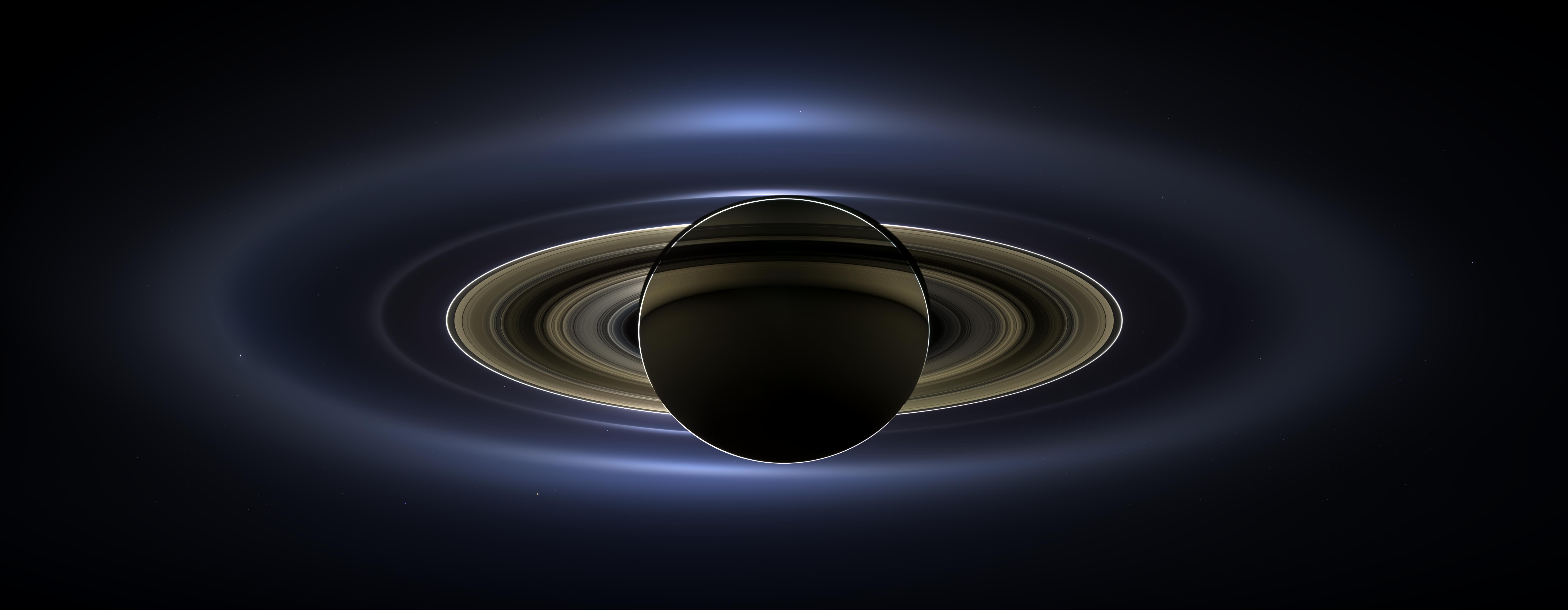
Image credit: NASA/JPL-Caltech/Space Science Institute. Saturn eclipsing the Sun, its rings lit from behind, in the Cassini mosaic known as "The Day the Earth Smiled" (2013). Backlighting reveals faint dusty rings that are invisible in ordinary views — and, as a pale dot in the distance, Earth itself.
Ringed planets
All four giants: Saturn, Jupiter, Uranus, Neptune
Made of
Water ice, rock, and dust particles
Solid?
No — countless separate orbiting particles
Thinnest dimension
Saturn's main rings: often only ~10 m thick
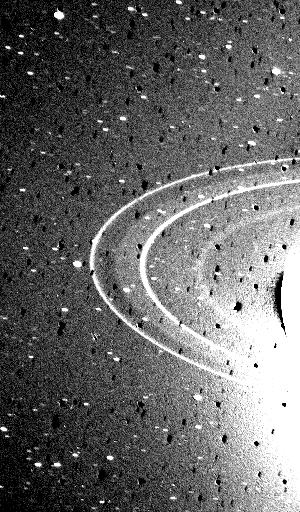
Not solid bands — swarms of orbiting particles
A planetary ring is not a solid hoop. It is a swarm of countless individual particles — from dust grains to boulders — each on its own orbit around the planet, packed into a disk so thin that Saturn's main rings, though nearly 280,000 km across, are in places only about ten meters thick. Seen from far away that swarm blurs into what looks like a smooth, solid band. Up close it is a river of tumbling ice and rock.
Rings form and are replenished from debris: shattered moons, captured comets, and material knocked off small inner moons by micrometeorite impacts. Tiny "shepherd" moons orbiting within and beside the rings gravitationally herd the particles, carving sharp edges and gaps. And rings may be temporary — Saturn's bright ring system could be a geologically recent and fleeting feature, slowly raining down into the planet over tens of millions of years.
All four giants, wildly unequal
The great puzzle is not who has rings — all four giant planets do — but why Saturn's are so incomparably better. The answer is ice and quantity. Saturn's rings are made largely of bright water ice and contain a huge amount of material, so they blaze in reflected sunlight. The other three are made of darker, dustier, rockier debris and contain far less of it, leaving them faint and elusive.
| Planet | Rings | Made of | Discovered |
|---|---|---|---|
| Saturn | Bright, broad, spectacular | Mostly bright water ice | Galileo 1610; identified 1655 |
| Jupiter | Faint, dusty | Fine dust from small moons | Voyager 1, 1979 |
| Uranus | Narrow, dark rings | Dark rock and dust | 1977 (stellar occultation) |
| Neptune | Faint, clumpy arcs | Dark dust and debris | 1984; imaged by Voyager 2, 1989 |
The single most jaw-dropping sight in a small telescope
This is the payoff page of the whole section. Saturn's rings are, for most people, the moment astronomy becomes real. Almost any telescope — even a modest 60–70 mm beginner scope at about 30× — will show the rings as a distinct, separate structure around the globe. It is a genuinely startling first view: a thing you have seen in pictures your whole life, suddenly hanging there in the eyepiece, unmistakably three-dimensional. Newcomers routinely gasp.
A few tips. The rings' tilt toward Earth changes over Saturn's 29-year orbit; when they are wide open the view is glorious, and when they are edge-on they briefly vanish. A 4-inch or larger scope on a steady night will reveal the Cassini Division, the dark gap dividing the rings. The other giants are a different matter: Jupiter's, Uranus's, and Neptune's rings are effectively invisible to amateur equipment — they are the domain of spacecraft.
Best target
Saturn — rings visible in almost any telescope at 30× and up. The showpiece of the night sky.
Look for
The Cassini Division (a 4-inch scope on a steady night) and the changing ring tilt year to year.
The others
Jupiter's, Uranus's, and Neptune's rings are beyond backyard gear — enjoy them through spacecraft images.
New to stargazing? See how to observe the night sky, and if you're choosing gear, the no-hype telescope buying guide.
Solid hoops, lonely Saturn, and Galileo's "ears"
The most stubborn myth is that the rings are solid — a smooth, flat disc you could set a marble rolling across. They are not: they are swarms of separate particles, and the "solid" look is an illusion of distance. The second myth is that Saturn is the only ringed planet. It isn't — all four giants have rings; Saturn's are simply the only ones bright enough to have been obvious before the space age. A third, subtler misconception is that the rings are ancient and permanent; growing evidence suggests Saturn's may be young and slowly disappearing, meaning we happen to live at a lucky moment to see them.
The history has its own charm. When Galileo first turned a telescope on Saturn in 1610, his optics were too crude to resolve the rings; he saw bumps on either side and wrote that Saturn had "ears," or that it was a triple body. He was baffled when the "ears" later vanished (an edge-on ring crossing). Not until 1655 did Christiaan Huygens, with a better telescope, correctly describe a thin, flat ring encircling the planet.
Saturn takes its name from the Roman god of agriculture and time, honored at the midwinter festival of Saturnalia — the ancestor of many of our winter holiday customs. His Greek counterpart is Cronus (Kronos), the Titan who ruled before the Olympian gods and was said to have devoured his own children. It is a heavy name for the Solar System's most beautiful planet.
Primary sources: NASA — Saturn's Rings, NASA — Planets overview, and NASA/JPL Photojournal images PIA17172 (The Day the Earth Smiled) and PIA02224 (Neptune's Rings, Voyager 2). Image credits: NASA/JPL-Caltech/Space Science Institute (Saturn); NASA/JPL (Neptune).
Four giant worlds each wear a ring, but only one caught the light just so — and for the price of a modest telescope on a clear night, that one will hand you the single most astonishing sight the sky has to offer.
Explore the structure of the Solar System
Planetary rings are one stop in a tour of the Solar System's belts, rings, and clouds — the leftover architecture between and beyond the planets.
The Solar System (hub) · Asteroid Belt · Kuiper Belt · Scattered Disk & Oort Cloud · Planetary Rings · Zodiacal Cloud
More astronomy notes
Continue through the astronomy section for beginner-friendly notes, image credits, viewing tips, history, and the stories behind the night sky.
The Solar System · Zodiacal Cloud · Asteroid Belt · Astronomy · Interests