
Dwarf Planets
They are round like planets, they orbit the Sun like planets — but they never swept their lanes clear, so they belong to a class of their own. Meet the five: Ceres in the Asteroid Belt, and Pluto, Eris, Haumea, and Makemake in the icy dark beyond Neptune.
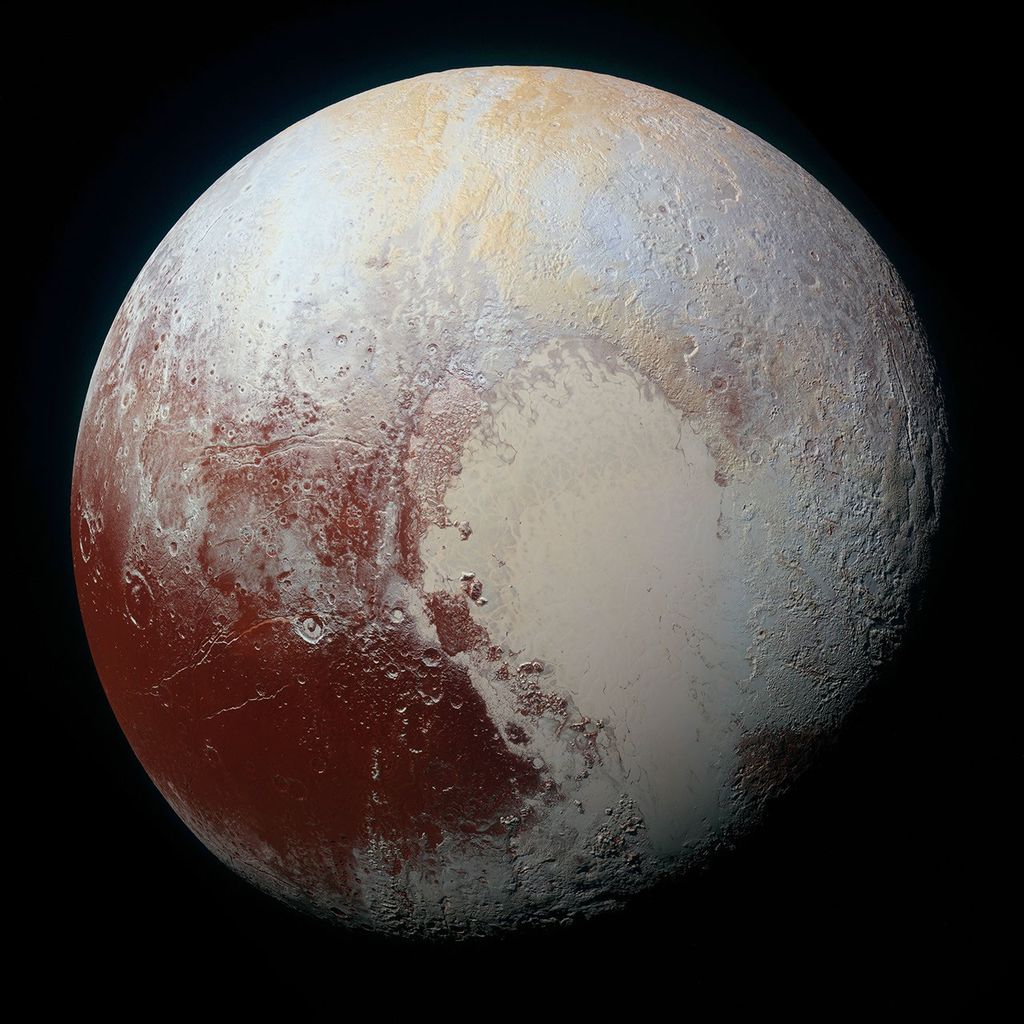
Image credit: NASA/Johns Hopkins APL/Southwest Research Institute. Pluto — the most famous dwarf planet, and the one whose 2006 reclassification created the whole category.
Round, orbiting, but not the boss of its neighborhood
In 2006 the International Astronomical Union settled a long argument with a three-part test. A planet must (1) orbit the Sun, (2) be massive enough that its own gravity pulls it round, and (3) have cleared its orbital neighborhood of other bodies. A dwarf planet passes the first two tests but fails the third — it is round and Sun-orbiting, but it shares its zone with many similar objects rather than dominating them. That single rule is why Pluto changed categories, and why Ceres, the biggest object in the Asteroid Belt, was promoted into this class at the same moment.
Pluto
The former ninth planet — a surprisingly complex world of nitrogen-ice plains and mountains, five moons, and the demotion that started it all.
Ceres
The only dwarf planet in the inner Solar System, ruling the Asteroid Belt — with bright salt deposits and a briny past.
Eris
The scattered-disk world nearly Pluto's twin — more massive, more distant, and the discovery that forced the "planet" question.
Haumea
The strangest of the five — spinning so fast it is shaped like an egg, with two moons and its own ring.
Makemake
A bright, frozen, methane-covered world of the Kuiper Belt, named for the creator god of Easter Island.
Back to the Solar System
The master hub — belts, rings, clouds, comets, and the wider structure these worlds belong to.
The five, compared
| Dwarf planet | Where | Diameter (approx.) | Moons | Named for |
|---|---|---|---|---|
| Ceres | Asteroid Belt | 940 km | 0 | Roman goddess of the harvest |
| Pluto | Kuiper Belt | 2,377 km | 5 | Roman god of the underworld |
| Eris | Scattered disk | 2,326 km | 1 | Greek goddess of discord |
| Haumea | Kuiper Belt | ~1,560 km (elongated) | 2 | Hawaiian goddess of fertility |
| Makemake | Kuiper Belt | ~1,430 km | 1 | Rapa Nui creator god |
Return to Michael Paycer
Explore Michael Paycer's professional SQL Server, cloud, ETL, API, automation, and consulting pages, or continue browsing the personal interests section.