
Moons
The planets are not alone. Circling them are hundreds of moons — some barren and cratered like our own, others hiding oceans beneath their ice, spewing geysers into space, or wrapped in atmospheres thicker than Earth's. Here are the ones worth knowing, and the ones you can find for yourself.
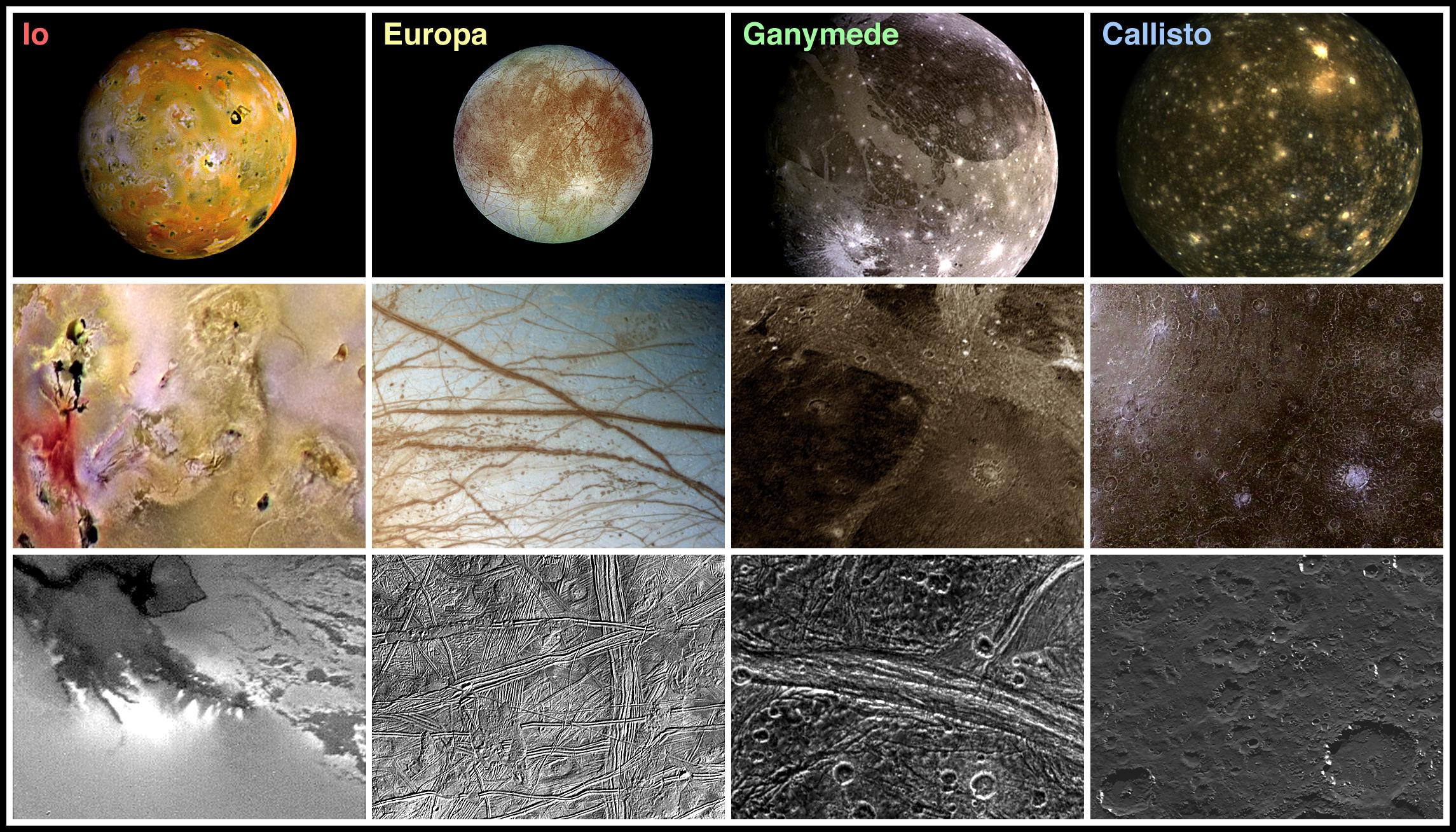
Image credit: NASA/JPL. Jupiter's four Galilean moons — Io, Europa, Ganymede, and Callisto — as imaged by the Galileo spacecraft. Four worlds you can spot yourself with a pair of binoculars.
The moons worth knowing
Some moons are geologically dead; others are among the most exciting places in the Solar System to search for life. These pages cover our own Moon and the standouts among the rest.
Our Moon
The one everyone knows — phases, tides, the far side, how it formed from a giant impact, and why the same face always looks our way.
The Galilean Moons
Io, Europa, Ganymede, and Callisto — Jupiter's four giant moons, from volcanic Io to ocean-bearing Europa. The discovery that moved the Earth from the center of everything.
Titan
Saturn's giant moon — a hazy orange world with a thick atmosphere, rivers and seas of liquid methane, and the most Earth-like weather beyond Earth.
Enceladus
Saturn's little snowball that shoots fountains of water into space from a hidden ocean — one of the best places to look for life.
Triton
Neptune's big moon that orbits backwards, erupts nitrogen geysers, and was almost certainly captured from the Kuiper Belt.
Back to the Solar System
The master hub — planets, belts, rings, comets, the Sun, and the wider structure these moons belong to.
A few record-holders
| Moon | Orbits | Claim to fame |
|---|---|---|
| Ganymede | Jupiter | Largest moon in the Solar System — bigger than Mercury |
| Titan | Saturn | Only moon with a thick atmosphere; liquid methane seas |
| Io | Jupiter | Most volcanically active body in the Solar System |
| Europa | Jupiter | Global ocean under ice — a prime search for life |
| Enceladus | Saturn | Erupts water geysers from a subsurface ocean |
| Triton | Neptune | Orbits backwards; a captured Kuiper Belt world |
Return to Michael Paycer
Explore Michael Paycer's professional SQL Server, cloud, ETL, API, automation, and consulting pages, or continue browsing the personal interests section.