
The Galilean Moons
Four worlds circle Jupiter that Galileo first saw in 1610 — and in seeing them, he helped move the Earth from the center of the cosmos. Io burns with volcanoes, Europa hides an ocean, Ganymede outsizes a planet, and Callisto keeps a record of the Solar System's violent youth.
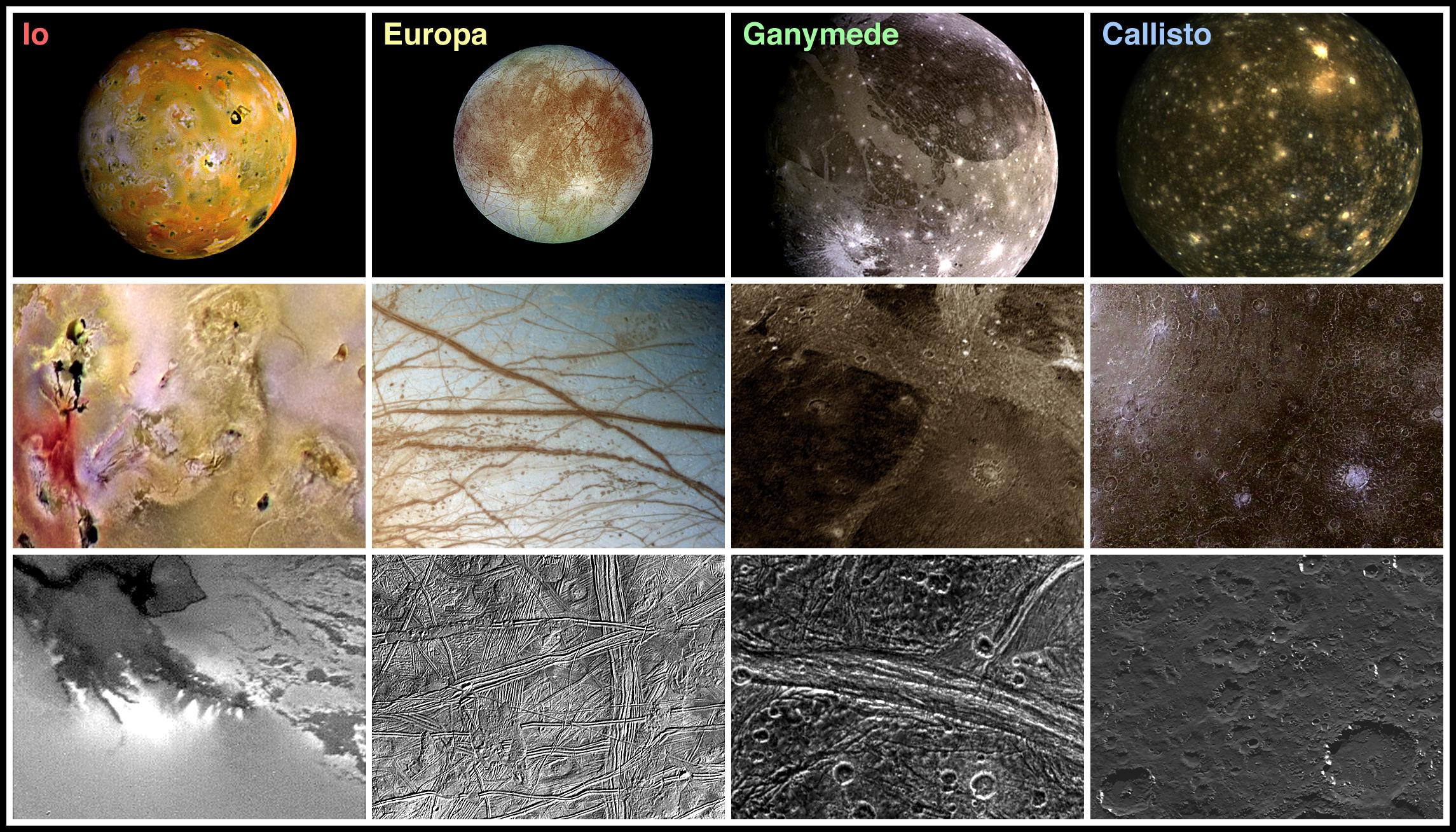
Image credit: NASA/JPL. The four Galilean moons to scale, from the Galileo spacecraft: from left, Io, Europa, Ganymede, and Callisto — each a distinct and remarkable world.
Discovered
1610, by Galileo Galilei
Number
Four — of Jupiter's 90+ known moons
Largest
Ganymede — biggest moon in the Solar System
See them with
Ordinary binoculars
Four worlds that changed astronomy
In January 1610, Galileo pointed his new telescope at Jupiter and saw three, then four, little "stars" strung out beside it — and, night after night, watched them shift position, clearly circling the planet. It was the first time anyone had seen objects orbiting a world other than Earth, and it struck at the heart of the belief that everything revolved around us. The Galilean moons helped topple the Earth-centered cosmos and usher in modern astronomy. And they are not minor: all four are worlds in their own right.
| Moon | What it is |
|---|---|
| Io | The most volcanically active body in the Solar System — squeezed and heated by Jupiter's gravity, its surface constantly repaved by lava and sulfur, dotted with erupting plumes. |
| Europa | A smooth ball of ice cracked like an eggshell, hiding a global saltwater ocean beneath — with more liquid water than all of Earth's oceans, and one of the best places to search for life. |
| Ganymede | The largest moon in the Solar System, bigger than the planet Mercury — and the only moon with its own magnetic field, generated by a molten iron core. |
| Callisto | One of the most heavily cratered surfaces known — a dark, ancient world that has barely changed in billions of years, a frozen record of the early Solar System. |
The easiest "spacecraft view" you'll ever get
Here is one of the great joys of amateur astronomy: you can repeat Galileo's discovery yourself, tonight, with almost nothing. Point a pair of binoculars at bright Jupiter and steady them against a wall or railing — and there they are, up to four tiny star-like points strung in a line to either side of the planet. That's it. You are looking at four whole worlds circling another planet.
The real delight is that they move. Their arrangement changes from night to night and even over a single evening — a moon can slip behind Jupiter, cast its shadow across the cloud tops, or pop out from eclipse. Sketch their positions an hour apart and you'll see the shift; watch across a week and you'll trace their orbits. A small telescope shows them crisply and reveals Jupiter's cloud belts alongside. No other four moons in the sky are this easy or this rewarding to follow.
Gear
Binoculars are enough to see all four as points beside Jupiter. A small telescope makes them obvious.
Watch them dance
Positions change hour to hour. Note them one night, then the next — you'll see the moons orbit.
Bonus events
Moons vanish into Jupiter's shadow, reappear, and cast tiny shadows on the planet — all visible in a modest scope.
New to stargazing? See how to observe the night sky, and if you're choosing gear, the no-hype telescope buying guide.
Named for the loves of Zeus — and a bear in the sky
The four moons carry the names of figures from the myths of Zeus (the Greek Jupiter), and the theme is deliberate: each is a companion or love of the king of the gods. Io was a priestess Zeus loved and transformed to hide her; Europa was a princess he carried off in the form of a white bull — and gave her name to the continent of Europe. Ganymede, the beautiful youth, was carried to Olympus to become cupbearer to the gods (and lends his name to the water-bearer, Aquarius). And Callisto was a nymph turned into a bear — and then, the myth says, set among the stars as Ursa Major, the Great Bear you can still find circling the pole tonight.
A common misconception is that these are small, minor moons. Far from it — Ganymede and Callisto rival the planet Mercury in size, Io is larger than our own Moon, and Europa is only slightly smaller. Another is that Galileo built the first telescope; he didn't (it was invented in the Netherlands), but he was among the first to turn one to the sky and grasp what he was seeing.
Primary sources: NASA — Jupiter's Moons, NASA — Europa, and NASA/JPL Photojournal PIA00743 (Galilean satellites montage). Image credit: NASA/JPL.
Four points of light beside a bright planet — a schoolchild can find them in binoculars — and yet they are the same four worlds that, four centuries ago, quietly pushed the Earth out of the center of creation.
More worlds around worlds
Moons (hub) · Our Moon · Galilean Moons · Titan · Enceladus · Triton
More astronomy notes
Continue through the astronomy section for beginner-friendly notes, image credits, viewing tips, history, and the stories behind the night sky.
Titan · Ursa Major · Moons · Astronomy · Interests