
The Asteroid Belt
The Asteroid Belt is the ring of rocky, metallic debris orbiting the Sun between Mars and Jupiter — millions of leftover bodies that never became a planet, holding the dwarf planet Ceres and far more empty space than any movie would have you believe.

Image credit: NASA/JPL-Caltech/UCLA/MPS/DLR/IDA. A full-disk color view of Ceres assembled from Dawn spacecraft images, processed to approximate the muted grey-brown hues of its surface — the largest object in the Asteroid Belt and the only dwarf planet in the inner Solar System. The small bright patch near the limb is Occator Crater, home to Ceres' famous salt deposits.
Location
Between Mars and Jupiter
Distance from Sun
2.2 – 3.2 AU (about 330–480 million km)
Largest object
Ceres (dwarf planet, ~940 km)
Total mass
~3% of the Moon's mass
The belt just after Mars
If you walk the planets outward from the Sun, the Asteroid Belt is the fifth stop — the wide gap between Mars, the last rocky planet, and Jupiter, the first giant. It is the boundary between the inner and outer Solar System.
Schematic by Michael Paycer — not to scale. The belt spans roughly 2.2 to 3.2 astronomical units from the Sun.
A planet that never came together
The Asteroid Belt is a ring-shaped region between Mars and Jupiter containing millions of rocky and metallic bodies, from Ceres at nearly 1,000 kilometers across down to countless boulders and dust grains. It is the leftover raw material of the early Solar System — the building blocks of a planet that never finished assembling.
The reason is Jupiter. As the giant planet formed, its enormous gravity stirred the neighboring region, pumping up the speeds of the small bodies there. Instead of gently sticking together the way the planets did, colliding fragments hit each other hard enough to shatter. The material was scattered before it could coalesce, and much of it was flung away entirely. What remains is startlingly little: if you gathered every asteroid in the belt into a single body, it would total only about three percent of the Moon's mass, and roughly a quarter of that is locked up in Ceres alone.
Jupiter's fingerprints are still visible in the belt's structure. At certain distances, an asteroid would orbit in a precise rhythm with Jupiter — say, three laps for every one of Jupiter's. Those resonances give the planet a repeated gravitational nudge that clears the zone, leaving Kirkwood gaps: narrow lanes swept nearly empty, named for Daniel Kirkwood, who explained them in 1866. They are the belt's own version of the gaps in Saturn's rings.
The Kirkwood gaps are inside the Asteroid Belt. They are often confused with the Kuiper Belt — a completely different, icy region far beyond Neptune. Same letter, opposite ends of the Solar System.
The two giants of the belt
Ceres
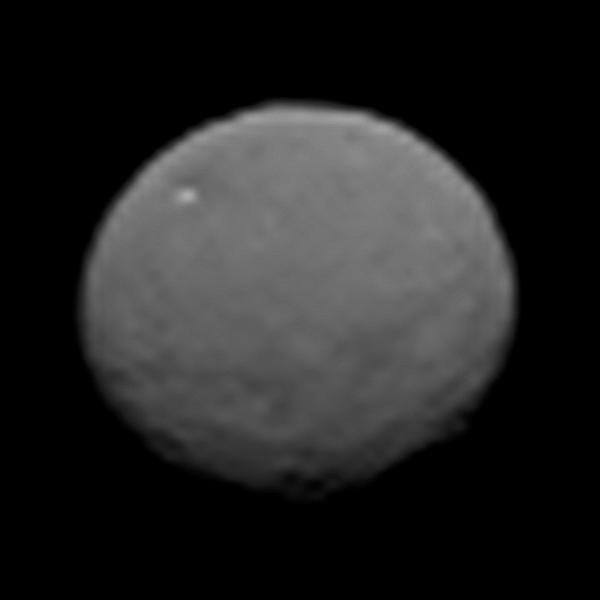
The only dwarf planet in the inner Solar System and the largest object in the belt. Dawn orbited it from 2015 to 2018 and found bright salt deposits and evidence of a briny subsurface layer.
Vesta
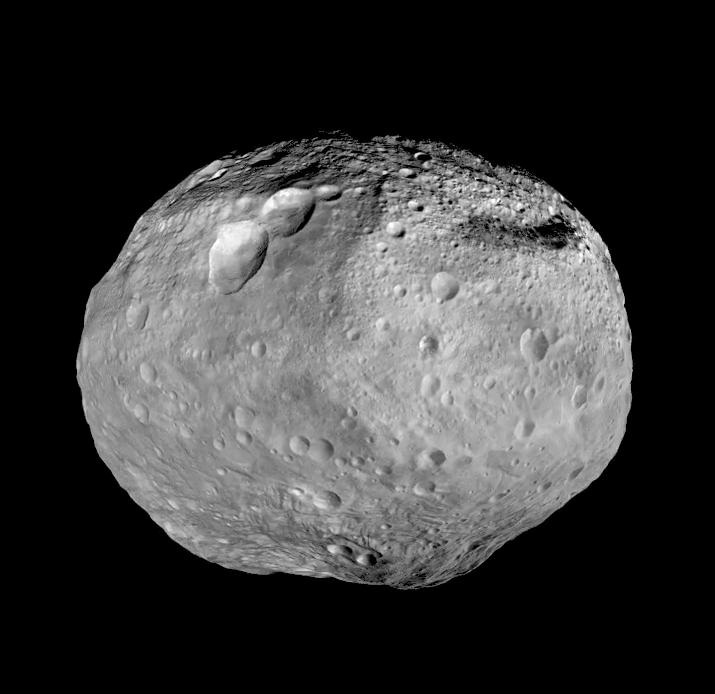
The second-largest body and the brightest asteroid in our sky. A colossal impact near its south pole carved a basin so deep it exposed the asteroid's interior — and scattered debris that reaches Earth as meteorites.
Yes, you can see the Asteroid Belt — one rock at a time
You will never see the belt as a band in the sky; its members are far too small and too scattered. But you can absolutely track down its brightest residents, and one of them is occasionally visible to the naked eye.
Vesta is the prize. Because its surface is unusually reflective, Vesta brightens to around magnitude 5.3 at its best oppositions — faintly visible without any equipment from a dark site, and an easy target in binoculars. It looks exactly like a star; the giveaway is that it moves. Sketch or photograph the same star field a night or two apart and you will catch it drifting against the fixed background.
Ceres reaches about magnitude 7 at opposition — beyond naked-eye range but a straightforward binocular object. Pallas and Iris are within reach of small telescopes. The pleasure here is not detail — all of them are points of light — but the act of identification: knowing that the "star" you just found is a whole world hundreds of kilometers wide, orbiting in the gap between Mars and Jupiter.
What to look for
A "star" that isn't on the chart, or one that shifts position over a night or two. That is your asteroid.
Best time
Opposition, when the asteroid is opposite the Sun in our sky and at its brightest. Astronomy apps and almanacs list the dates for Ceres and Vesta each year.
Gear
Vesta: naked eye from a dark site, easy in binoculars. Ceres: binoculars. Pallas and beyond: a small telescope.
New to stargazing? See how to observe the night sky, and if you're choosing gear, the no-hype telescope buying guide.
The most crowded place that is almost entirely empty
No region of the Solar System is more misrepresented than the Asteroid Belt, and the culprit is the movies. The classic image — a spacecraft weaving frantically through a dense hail of tumbling boulders — is pure fiction. In reality the belt is one of the emptiest places imaginable. The average distance between its large asteroids is measured in the hundreds of thousands to millions of kilometers. If you stood on one asteroid, you would very likely see no other with the naked eye. Every one of the dozen-plus spacecraft that has crossed the belt — Pioneer, Voyager, Cassini, New Horizons, Dawn — sailed through without ever being at risk. Navigating the belt is hard not because it is crowded but because it is so empty that hitting a target takes careful aim.
A second old idea is that the belt is the wreckage of an exploded planet — a lost world sometimes called Phaeton. It is a lovely story, and it is wrong. The total mass is far too small to have ever been a planet, and the asteroids are too chemically varied to have come from a single shattered body. The belt is not a planet that died; it is a planet that was never allowed to be born.
Ceres gave us an everyday word: the Roman goddess of the harvest is the root of cereal. When Giuseppe Piazzi discovered Ceres on the first night of the 19th century — 1 January 1801 — it was briefly hailed as a new planet, only to be demoted to "asteroid" as more belt objects turned up. Two centuries later, in 2006, the very same reclassification debate that stripped Ceres of planethood would promote it to "dwarf planet" — the same ruling that reshaped Pluto's status.
The goddess in the name
The belt's largest world carries the name of Ceres, the Roman goddess of agriculture, grain, and the harvest — a fitting title for the mother-lode of the belt. Her Greek counterpart is Demeter, whose grief for her daughter Persephone was said to bring the barren months of winter to the world. It is a story worth telling in full, but it belongs to mythology rather than astronomy.
Primary sources: NASA — Ceres, NASA — Asteroids overview, and NASA/JPL Photojournal images PIA21079 (Ceres in color from Dawn), PIA19172 (Ceres from Dawn, January 2015 approach), and PIA15678 (Full View of Vesta). Image credit for both: NASA/JPL-Caltech/UCLA/MPS/DLR/IDA.
It is the belt's quiet paradox: a place remembered as a crowded gauntlet of stone, which is in truth so vast and so empty that its millions of worlds could each spend an age without ever glimpsing another.
Explore the structure of the Solar System
The Asteroid Belt is one stop in a tour of the Solar System's belts, rings, and clouds — the leftover architecture between and beyond the planets.
The Solar System (hub) · Asteroid Belt · Kuiper Belt · Scattered Disk & Oort Cloud · Planetary Rings · Zodiacal Cloud
More astronomy notes
Continue through the astronomy section for beginner-friendly notes, image credits, viewing tips, history, and the stories behind the night sky.
The Solar System · Astronomy · Kuiper Belt · Greek Myths · Interests