
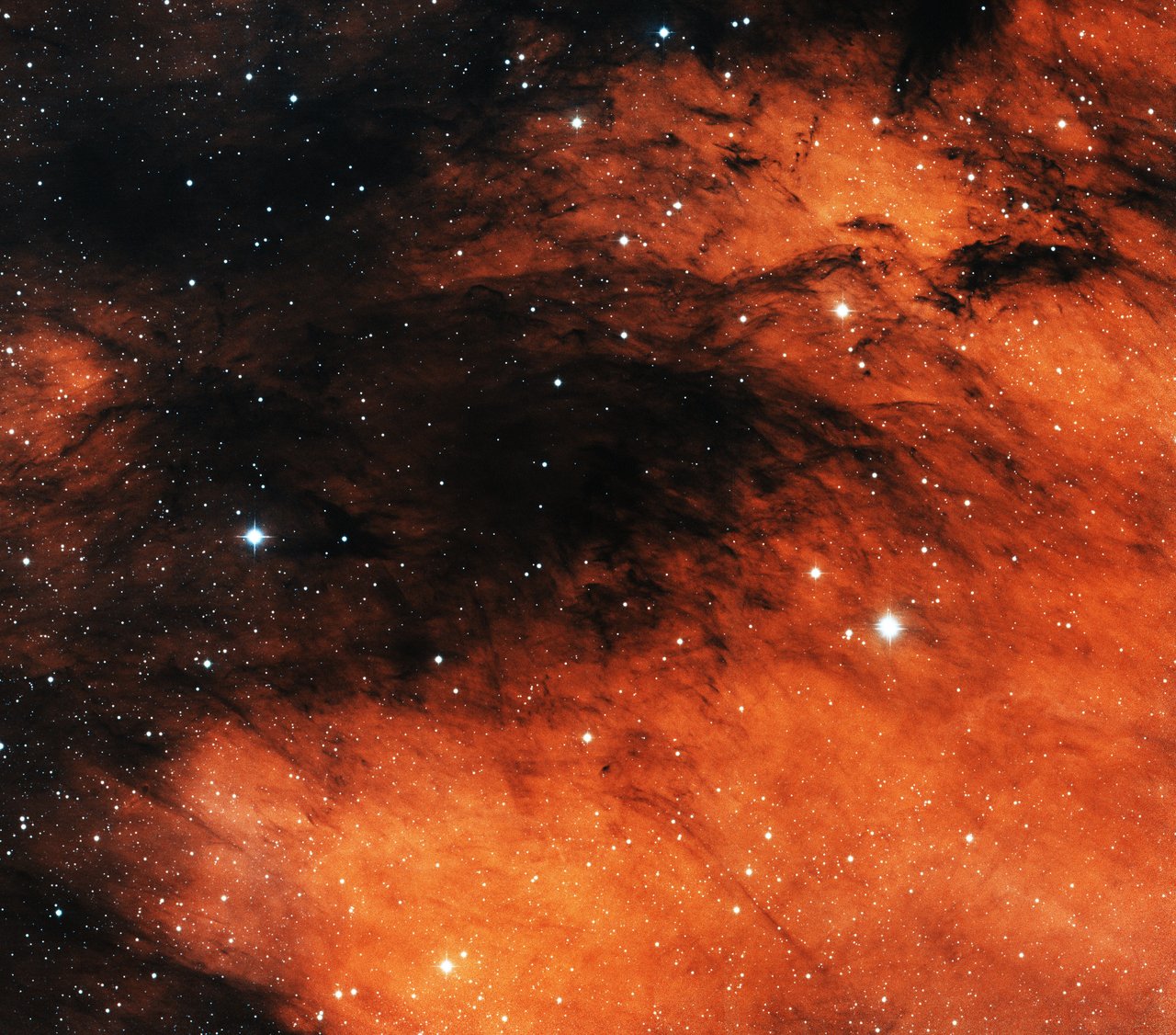
The North America Nebula (NGC 7000) in Cygnus, the great cloud near Deneb. Deneb is one of the leading candidates for the powerhouse star illuminating this region. Image credit: T. A. Rector (University of Alaska Anchorage) and NOIRLab/NSF/AURA.
The most luminous star you'll see tonight
Deneb — Alpha Cygni — marks the tail of Cygnus, the Swan, and the top of the asterism known as the Northern Cross. It looks like an ordinary bright star, but that ordinary appearance is deceptive: Deneb is one of the most intrinsically luminous stars visible to the naked eye anywhere in the sky.
The other two corners of the Summer Triangle, Vega and Altair, are close neighbors at 25 and 17 light-years. Deneb is in a completely different league of distance — estimates place it somewhere between roughly 1,400 and 2,600 light-years away. For it to shine just as brightly from hundreds of times farther off, it must be pouring out the energy of tens of thousands of Suns. If Deneb sat where Vega does, it would cast shadows on the ground.
Vega, Deneb, and Altair look like equals in the Summer Triangle. They aren't even close: Deneb is so far away that its true power dwarfs the other two combined.
Deneb at a glance
Designation
Alpha Cygni (α Cyg)
Constellation
Cygnus (the Swan)
Spectral Type
A2 Ia — blue-white supergiant
Distance
Roughly 1,400–2,600 light-years (uncertain)
Massive, unstable, and short-lived
Deneb is a true supergiant — a star perhaps twenty times the mass of the Sun and roughly two hundred times its diameter. Stars this massive burn through their fuel in only a few million years, a cosmic eyeblink compared with the Sun's projected ten-billion-year life. Deneb is already past the prime of its life, having exhausted the hydrogen in its core, and is now swelling and shedding mass as it heads toward a dramatic end.
It is also the prototype of a class of pulsating stars called Alpha Cygni variables. Deneb's surface heaves with overlapping non-radial pulsations — different parts of the star expand and contract out of step with one another — producing small, irregular brightness changes. In the distant future, Deneb is expected to evolve into a red supergiant and ultimately explode as a supernova.
Color to look for
A clean blue-white, similar in tone to Vega but visibly fainter — a reminder that you're seeing an enormously powerful star across an enormous gulf of space.
A future pole star
Because of the slow precession of Earth's axis, Deneb will pass near the north celestial pole around 9,800 CE — never as close as Polaris, but a bright northern marker for a future age.
Finding Deneb in Cygnus
Deneb sits at the top of the Northern Cross and at the head of the Great Rift — the dark dust lane that splits the summer Milky Way down its length. From the tail of the Swan, the bird's body and outstretched wings spread across some of the richest star fields in the northern sky.
Best setup
Naked eye to appreciate its place in the Triangle and the Cross. Binoculars sweep up the dense Cygnus star clouds and nearby nebulae, including the North America Nebula a few degrees away.
Best season
Summer through autumn evenings in the Northern Hemisphere, when Cygnus flies nearly overhead. From Minnesota the Swan is beautifully placed on July and August nights.
The tail of the swan
The name Deneb comes from the Arabic dhanab al-dajājah, "the tail of the hen," marking exactly where the star rides on the bird's body. Greek myth gave that bird several identities. In one telling the swan is Zeus in disguise, gliding down to Leda. In another it is Cycnus, a devoted friend of Phaethon, who dove again and again into the river to recover the drowned youth until the gods pitied him and made him a swan. Some storytellers set the swan beside Lyra, the harp, so that Orpheus and his instrument could fly together through the summer sky.
However you read the figure, Deneb marks the most useful pattern inside it: the Northern Cross. That long upright of stars stands almost vertical above the western horizon on December evenings and lies nearly flat across the sky at summer dawn, a seasonal clock hiding in plain sight.
Sources & Image Credits
NOIRLab image used under a Creative Commons Attribution 4.0 license:
Deneb is the far lantern of the Swan — a star whose light set out before the Roman Empire fell, still arriving tonight, reminding us that the brightest points in the sky are not always the nearest, only the most generous with their fire.
Stories in the stars
Deneb marks the tail of Cygnus, the swan, one figure in a wider tapestry of constellation myths. Explore them all on the Greek mythology hub.
Greek Myths Hub · Cygnus · Veil Nebula · Lyra · Summer Triangle
New to stargazing? See how to observe the night sky, and if you're choosing gear, the no-hype telescope buying guide.
Deneb is a rare blue supergiant bound for a supernova — see the full life and death of stars.
All Astronomy Notes · Summer Triangle · Veil Nebula · Vega · Altair · Lyra