
A giant next to our Sun
Arcturus has about the same mass as the Sun, but having aged into a red giant it has swollen to roughly 25 times the Sun's diameter. If the Sun were a basketball, Arcturus would be the size of a small car.
An orange beacon over spring
Arcturus, Alpha Boötis, is the fourth-brightest star in the entire night sky and the brightest north of the celestial equator. Find it the classic way: follow the curve of the Big Dipper's handle and "arc to Arcturus." Its warm orange colour is obvious to the naked eye, a clear sign that this is an aging star rather than a hot young one.
The name comes from the Greek Arktouros, "guardian of the bear," because the star rises behind Ursa Major and seems to herd it around the pole as part of the constellation Boötes, the Herdsman.
Arcturus is our nearest bright red giant, a working model of the Sun's distant future sitting just 37 light-years away.
Arcturus at a glance
Designation
Alpha Boötis (α Boo)
Constellation
Boötes (the Herdsman)
Type
Orange-red giant (K-type)
Distance
About 37 light-years
Passing through, from the old galaxy
In 1718 Edmond Halley compared the positions of Arcturus, Sirius, and Aldebaran with the records of ancient Greek astronomers and found they had shifted. This was the discovery of proper motion: the realization that the "fixed stars" are not fixed at all. Arcturus is one of the fastest-moving bright stars, sliding across the sky and racing through our region at well over 100 kilometres a second.
That speed is a clue to its origin. Arcturus belongs to a stream of dozens of stars that all move together and differently from the Sun, an older, metal-poorer population that may have drifted up from the galaxy's thick disk or been pulled in from a small galaxy the Milky Way swallowed long ago. Arcturus is a tourist from a different part of our galaxy's history, and in a few tens of thousands of years it will move on and begin to fade from naked-eye view.
The star that opened a World's Fair
On the evening of May 27, 1933, the organizers of the Chicago World's Fair wanted a dramatic way to begin. They reasoned that the light of Arcturus, then believed to be about 40 light-years away, had left the star around the time of Chicago's previous World's Fair in 1893. So they gathered that ancient light at four observatories, focused it on photoelectric cells, and used the resulting current to switch on the floodlights of the fair. A beam of starlight that had crossed forty years of space threw the switch.
Arcturus carries older meaning too. To Polynesian wayfinders it is Hōkūleʻa, the "Star of Joy," the zenith star that passes directly over the Hawaiian Islands and helped guide voyaging canoes across the open Pacific. The same orange point of light has been a clock, a compass, and a curtain-raiser.
The closest thing to a photograph
Arcturus is too far away and too small on our sky to show a disk, even to Hubble, so there is no close-up portrait of the star. The most revealing real image of Arcturus is its spectrum: its light spread into a rainbow and stacked in strips, crossed by thousands of dark lines where atoms in the star's atmosphere swallow specific colours.
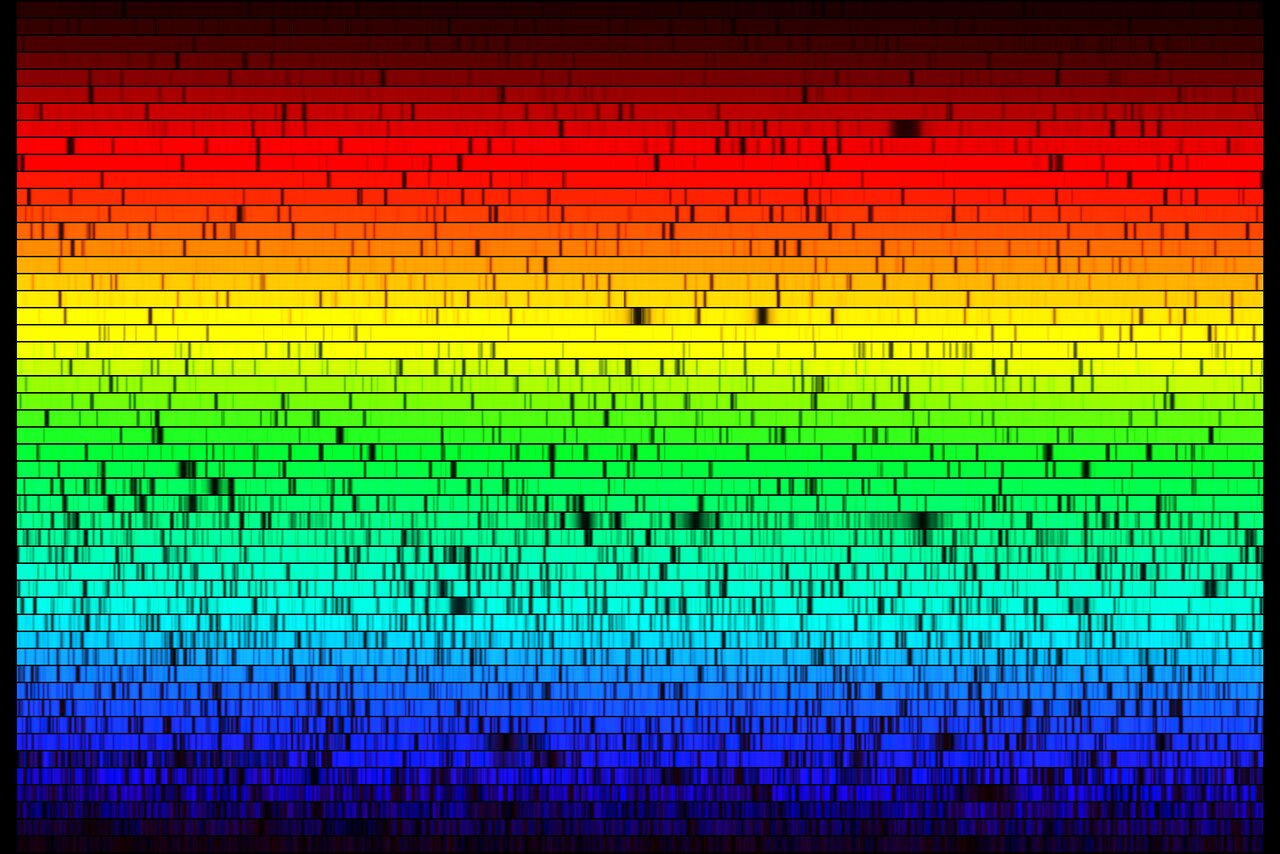
The high-resolution visible spectrum of Arcturus, from a digital atlas made at Kitt Peak National Observatory. Each dark line marks an element absorbing light in the star's cooler outer layers. Image credit: N. A. Sharp / NOIRLab / NSF / AURA.
This is how astronomers actually "see" Arcturus. The pattern of lines reveals its surface temperature near 4,300 K, its chemical makeup, and the tell-tale shortage of heavy elements that marks it as an old star from a different population of the galaxy. Reading starlight this way is exactly what the 1933 World's Fair dramatized when it focused Arcturus's beam onto photoelectric cells.
Sources & Credits
Scale diagram above is an original by Michael Paycer. Reference data:
Arcturus is the warm orange guardian of the spring sky, a giant racing through our corner of the galaxy on its way to somewhere else. Look at it and you are watching the Sun's own future, lit early, passing by close enough to guide a canoe or open a fair.
Stories in the stars
Arcturus, the bear guardian, anchors Boötes the Herdsman, one figure in a wider tapestry of constellation myths. Explore them all on the Greek mythology hub.
Boötes · Greek Myths Hub · Ursa Major · Polaris
New to stargazing? See how to observe the night sky, and if you're choosing gear, the no-hype telescope buying guide.
Arcturus is an aging red giant — see the full life and death of stars.
All Astronomy Notes · Boötes Constellation · Betelgeuse · Vega · Greek Mythology in the Night Sky