
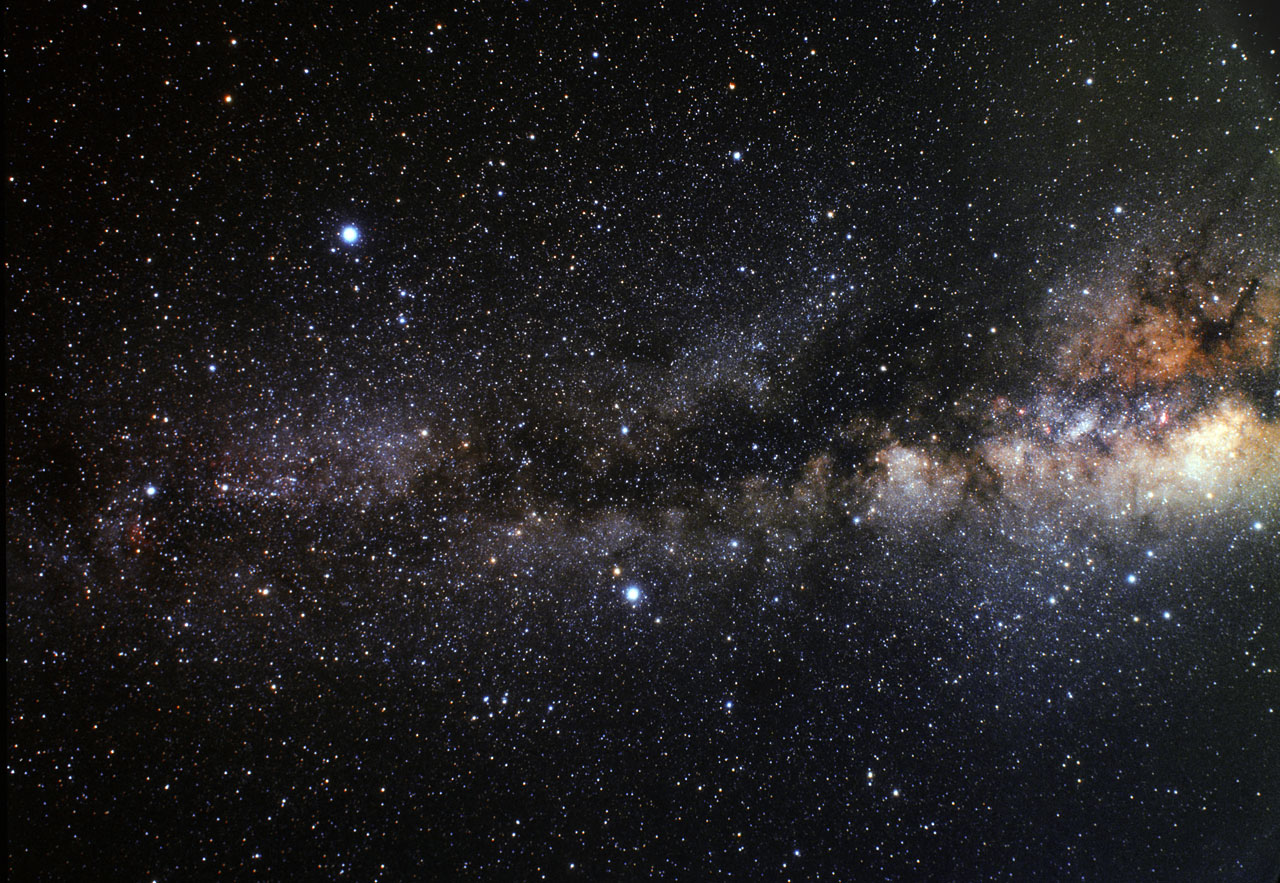
A wide-field view of the Summer Triangle region, with Vega, Deneb, and Altair marking the three corners against the rich star fields of the Milky Way. Image credit: A. Fujii / ESA/Hubble.
Three stars, three constellations, one shape
The Summer Triangle is an asterism — a memorable pattern that isn't one of the 88 official constellations, but is borrowed from three of them. Each corner is the brightest star of its own constellation:
Vega
The top corner — brightest star of Lyra, the Harp. A hot, blue-white near neighbor at 25 light-years.
Deneb
The far corner — the tail of Cygnus, the Swan. A blue-white supergiant over a thousand light-years away.
Altair
The southern corner — brightest star of Aquila, the Eagle. A fast-spinning white star just 17 light-years away.
Learn the Summer Triangle and you've unlocked three constellations and a guided tour of the Milky Way's brightest summer star clouds in one move.
They look like equals. They aren't.
The three stars appear similar in brightness, which fools the eye into assuming they are similar stars at similar distances. They are nothing of the sort. This is one of the sky's clearest lessons in perspective, the same lesson the Draco Triplet teaches with galaxies, written here across three stars:
| Star | Constellation | Distance | True nature |
|---|---|---|---|
| Altair | Aquila | ~16.7 light-years | A modest white star, very close — bright mainly because it's near |
| Vega | Lyra | ~25 light-years | A hot blue-white star, ~40× the Sun's output |
| Deneb | Cygnus | ~1,400–2,600 light-years | A supergiant — tens of thousands of times the Sun's output |
Altair and Vega are practically next door. Deneb is roughly a hundred times farther away — and shines just as brightly only because it is monstrously more powerful. Three points that look like a neat triangle on the dome of the sky are, in three dimensions, scattered across thousands of light-years.
The Milky Way runs right through it
From a dark site, the most breathtaking part of the Summer Triangle isn't the three stars at all — it's the luminous band of the Milky Way that flows between Vega and Altair and straight down through Cygnus. You are looking edgewise into the disk of our own galaxy, toward some of its densest visible star clouds.
Splitting that glow is the Great Rift — not empty space, but a long lane of cold interstellar dust silhouetted against the stars behind it. The same dust is the raw material of future stars. Sweep this region with binoculars on a clear, moonless night and the field fills with more stars than you can count.
Treasures within the three corners
The area bounded by the Triangle is one of the richest hunting grounds in the sky for binocular and small-telescope observers:
Ring Nebula (M57)
A dying star's smoke-ring shell in Lyra, tucked between two stars of the little Harp just south of Vega.
Veil Nebula
The lacework wreckage of an ancient supernova in Cygnus, glowing in red and teal filaments near the Swan's wing.
Albireo
The Swan's beak — one of the loveliest double stars in the sky, a gold-and-blue pair that splits beautifully in a small telescope.
Dumbbell Nebula (M27) & the Coathanger
A bright planetary nebula and a whimsical little star pattern, both easy binocular targets in the Triangle's lower half.
Finding the Summer Triangle
On summer evenings in the Northern Hemisphere, look high toward the east and overhead after dark. Vega is usually the first brilliant star to appear nearly straight up — start there.
- Find Vega — the dazzling blue-white star high overhead.
- Drop down and east to Altair — the bright star flanked by two fainter companions.
- Complete the triangle with Deneb — at the top of the Northern Cross, toward the Milky Way.
Despite the name, the Triangle is visible across much of the year from northern latitudes — rising in late spring, riding overhead in summer, and lingering into autumn evenings.
New to stargazing? See how to observe the night sky, and if you're choosing gear, the no-hype telescope buying guide.
A modern name for an old pattern
Skywatchers linked these three stars long before anyone settled on a name. Johann Bode drew a line connecting them on a map in 1816 without labelling it, and Joseph Johann von Littrow called them a "conspicuous triangle" in his 1866 atlas. The Austrian astronomer Oswald Thomas named the figure the Sommerliches Dreieck, the summerly triangle, in 1934.
The English name spread in the 1950s through two popular writers. Hans Augusto Rey, the author behind the Curious George books, laid the triangle out in his sky guides, and the British broadcaster Patrick Moore used it on his television program The Sky at Night. Moore liked to claim he coined it; Rey had it in print first. Neither really owns it now. The Summer Triangle belongs to every beginner who has ever used it to find their way around a July sky.
The Summer Triangle is the warm season's quiet clock — three lights that look like neighbors but span thousands of light-years, framing the river of our own galaxy and reminding us that the sky's simplest shapes hide its deepest distances.
All Astronomy Notes · Vega · Deneb · Altair · Lyra · Veil Nebula · Ring Nebula · Draco