
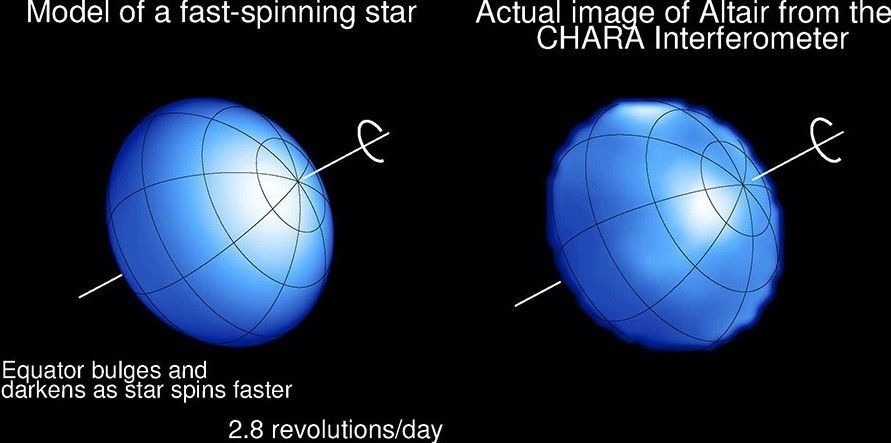
Left: a model of a rapidly spinning star, bulging and darkening at the equator. Right: an actual image of Altair's surface from the CHARA interferometer — the first main-sequence star besides the Sun to be imaged directly. Image credit: NASA / NSF / Center for High Angular Resolution Astronomy / Zina Deretsky.
A near neighbor in a hurry
Altair — Alpha Aquilae — is the brightest star in Aquila, the Eagle, and the southern corner of the Summer Triangle. At just under 17 light-years away, it is one of the closest stars visible to the naked eye, which is a big part of why it appears so bright: it is a fairly modest white star, only about 11 times the Sun's luminosity, that happens to be very near.
What makes Altair remarkable is its spin. It rotates once every roughly nine hours — compared with the Sun's leisurely 25 days — whipping its equator around at some 280 kilometers per second, a good fraction of the speed at which it would fly apart. That violent rotation flings the star's material outward, leaving it noticeably wider at the equator than across its poles.
Altair isn't a perfect sphere. It's an egg — the spin is so fast that the star's own shape is the headline.
Altair at a glance
Designation
Alpha Aquilae (α Aql)
Constellation
Aquila (the Eagle)
Spectral Type
A7 V — white main sequence
Distance
About 16.7 light-years
The first main-sequence star imaged beyond the Sun
In 2007, astronomers using the CHARA Array — a set of telescopes combined through a technique called interferometry — produced the first direct image of the surface of a normal star other than the Sun. That star was Altair, and the picture confirmed a striking prediction: it really is squashed, bulging at the equator like a beach ball someone is sitting on.
The image also revealed an effect called gravity darkening. Because the rapid spin pushes the equator outward, the equatorial regions sit farther from the star's center, where gravity and density are lower — so the equator is cooler and dimmer, while the poles are hotter and brighter. The equator isn't actually dark; it's just dimmer in comparison to the brilliant poles, much like a sunspot only looks dark against the blazing surface around it.
Color to look for
A clean white, slightly warmer than Vega's icy blue-white. Altair is flanked by two fainter stars (Tarazed and Alshain) that frame it in a short, distinctive line.
The eagle's mark
Altair anchors Aquila, the Eagle, flying along the Milky Way. The little line of three stars makes it one of the easiest naked-eye stars to identify with certainty.
The cowherd, the eagle, and a famous computer
Altair carries some of the richest folklore of any star. In the East Asian tale behind the Tanabata and Qixi festivals, Altair is the cowherd and Vega the weaver girl, two lovers separated by the river of the Milky Way and allowed to meet just once a year. Around the Mediterranean and among the Koori people of Australia, Altair was seen as part of an eagle. And in 1975, one of the first personal computers borrowed its name — the Altair 8800, the machine that helped launch the microcomputer era (and Microsoft's first product).
One night a year across the Milky Way
The oldest story attached to Altair runs the length of East Asia. A weaver girl, Orihime in Japan and Zhinü in China, wove cloth for the heavens at the edge of the celestial river. She fell in love with the cowherd Hikoboshi, who is Altair. The two married and grew so lost in each other that her loom went quiet and his cattle wandered loose. The sky god split them to opposite banks of the Milky Way and let them meet only once a year, on the seventh night of the seventh month, when a bridge of magpies carries the weaver across the river to her husband.
People still keep the date. Japan marks it as Tanabata and China as Qixi, writing wishes on strips of paper and hanging them out beneath Vega and Altair. The same two stars that pin two corners of the Summer Triangle have carried this love story for well over a thousand years, which is a long time for a point of light to keep a promise.
Sources & Image Credits
NASA and CHARA Array material used under NASA's image-use policy:
Altair is the swift white eagle of the summer sky — near enough to feel like a neighbor, spinning fast enough to reshape itself, and woven into the oldest love story humans ever told to the stars.
Stories in the stars
Altair leads Aquila, the eagle of Zeus, one figure in a wider tapestry of constellation myths. Explore them all on the Greek mythology hub.
Greek Myths Hub · Cygnus · Lyra · Summer Triangle · Orion
New to stargazing? See how to observe the night sky, and if you're choosing gear, the no-hype telescope buying guide.
Altair is a fast-spinning main-sequence star — see the full life and death of stars.
All Astronomy Notes · Summer Triangle · Vega · Deneb · Lyra · Betelgeuse