
Betelgeuse
Betelgeuse is the orange-red star marking Orion's left shoulder — a dying red supergiant roughly 700 times the diameter of the Sun, prone to mysterious dimming episodes, and destined to end as a supernova visible in daylight.
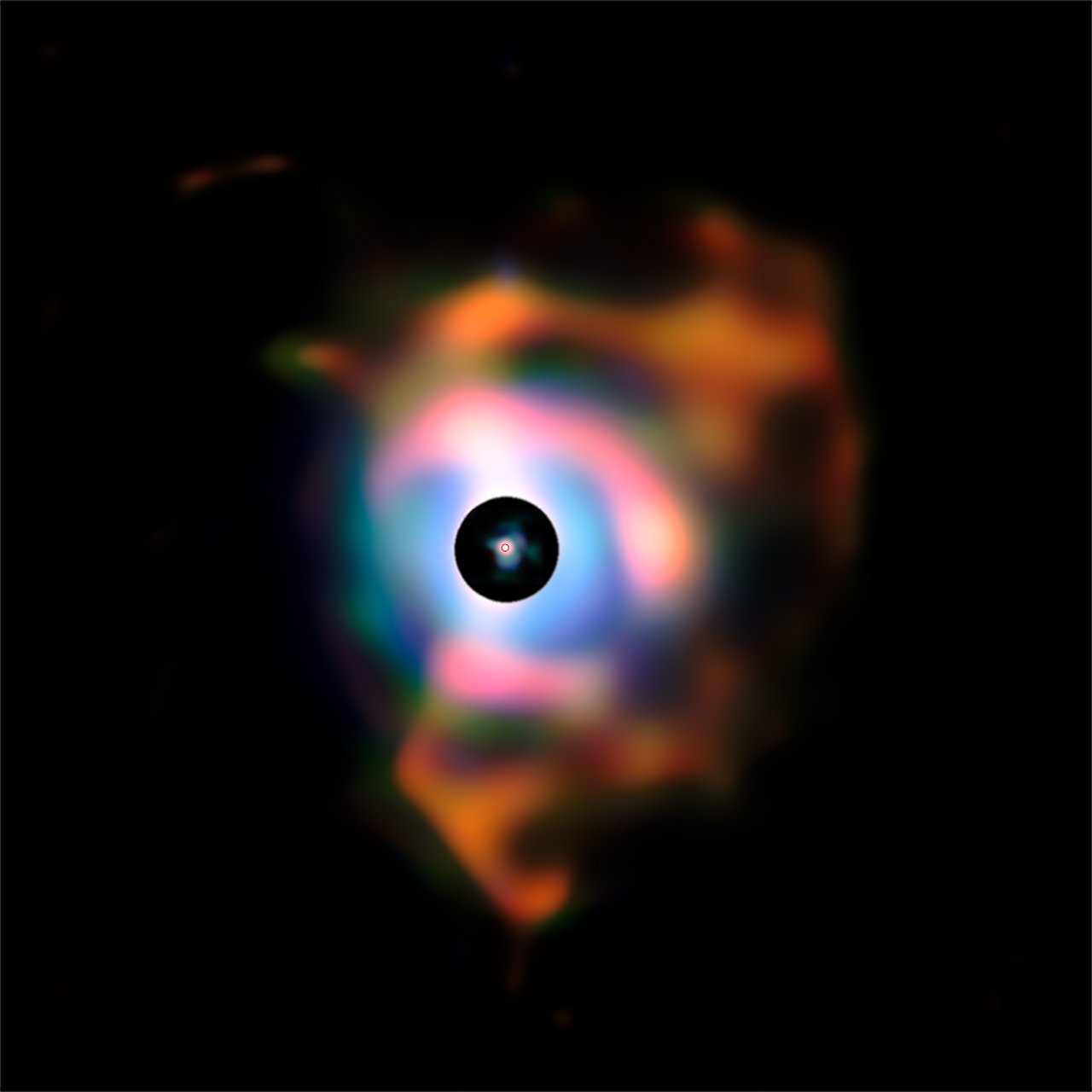
Image credit: ESO/P. Kervella. ESO Very Large Telescope VISIR infrared image of Betelgeuse showing the flame-like nebula extending around the red supergiant star from material the star is shedding into space.
Designation
Alpha Orionis
Constellation
Orion
Object Type
Red supergiant (semi-regular variable)
Distance
Approximately 700 light-years
A stellar giant near the end of its life
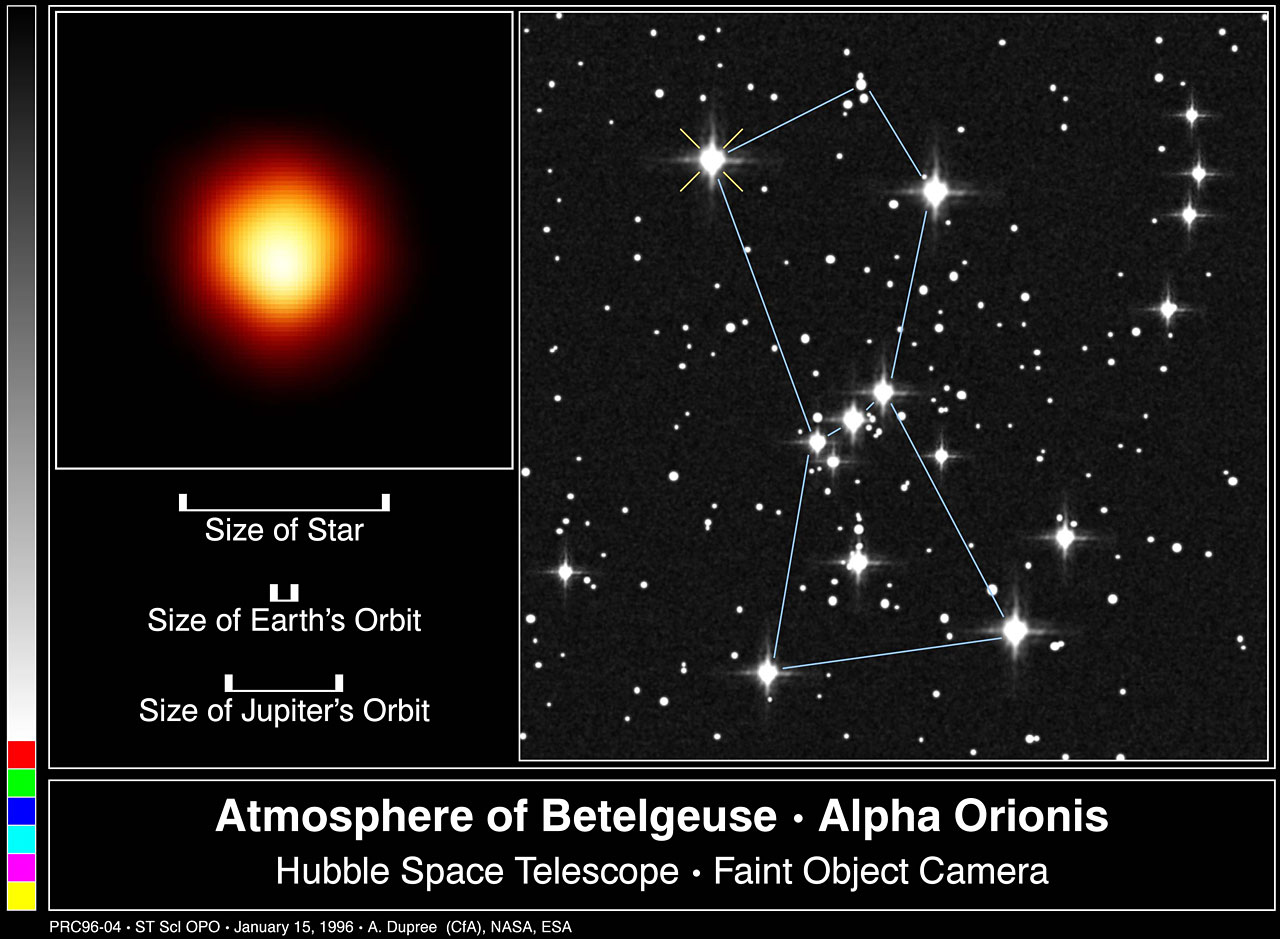
Betelgeuse is a red supergiant — a star in the final stages of stellar evolution, having exhausted the hydrogen in its core and now burning heavier elements in a series of shells. At roughly 700 times the diameter of the Sun, it is so large that if it replaced our Sun, its outer atmosphere would extend beyond the orbit of Jupiter. Its surface is not uniform: unlike the Sun's relatively smooth photosphere, Betelgeuse has enormous convection cells creating bright and dark patches that shift over time.
It is also a semi-regular variable star. Its brightness changes noticeably on a roughly 400-day pulsation cycle, supplemented by shorter and longer secondary cycles. The star is literally pulsating — expanding and contracting — as it exhausts its remaining fuel. That variability is visible to the naked eye over months: Betelgeuse can shift noticeably in brightness relative to its nearby neighbors.
Three views of Betelgeuse
The Great Dimming
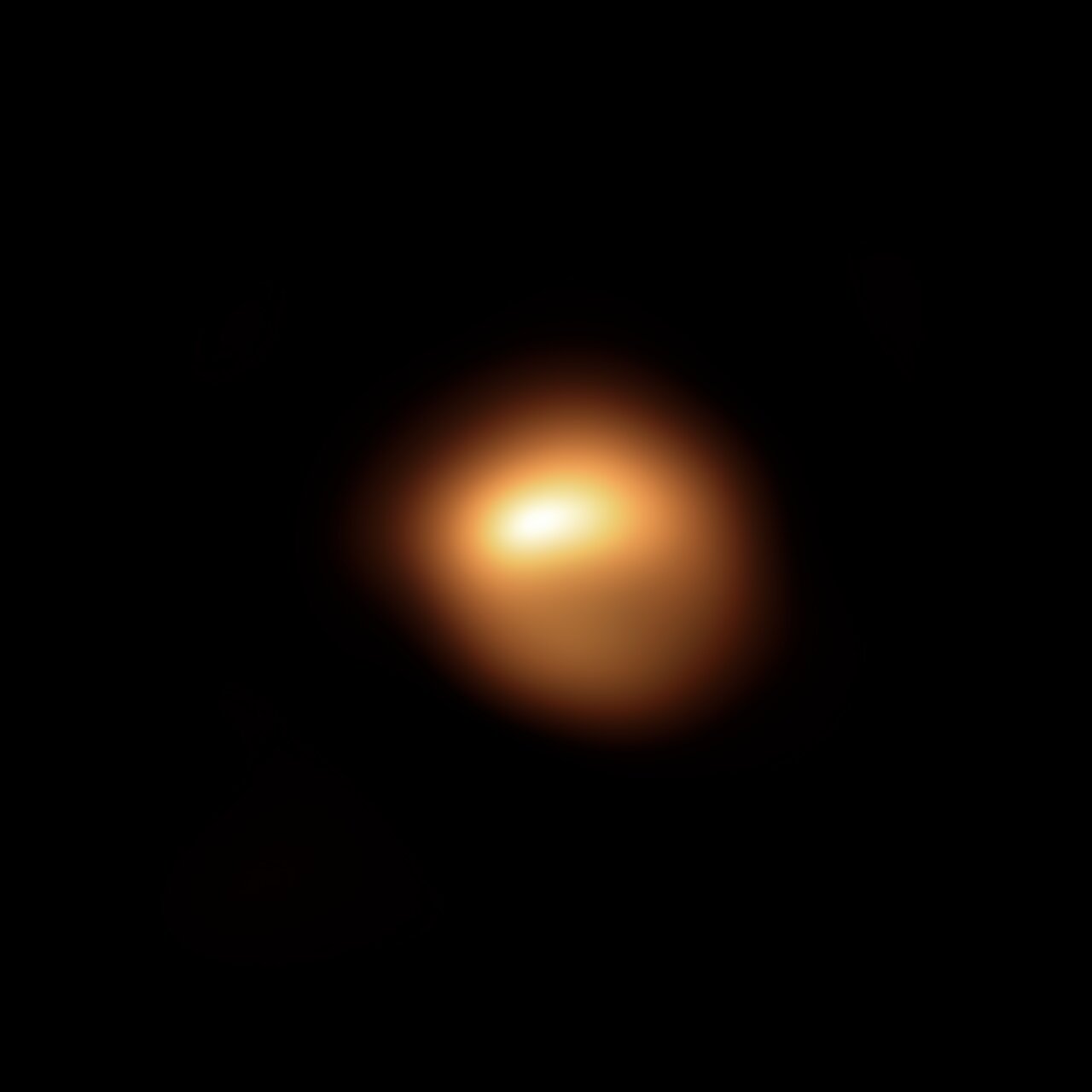
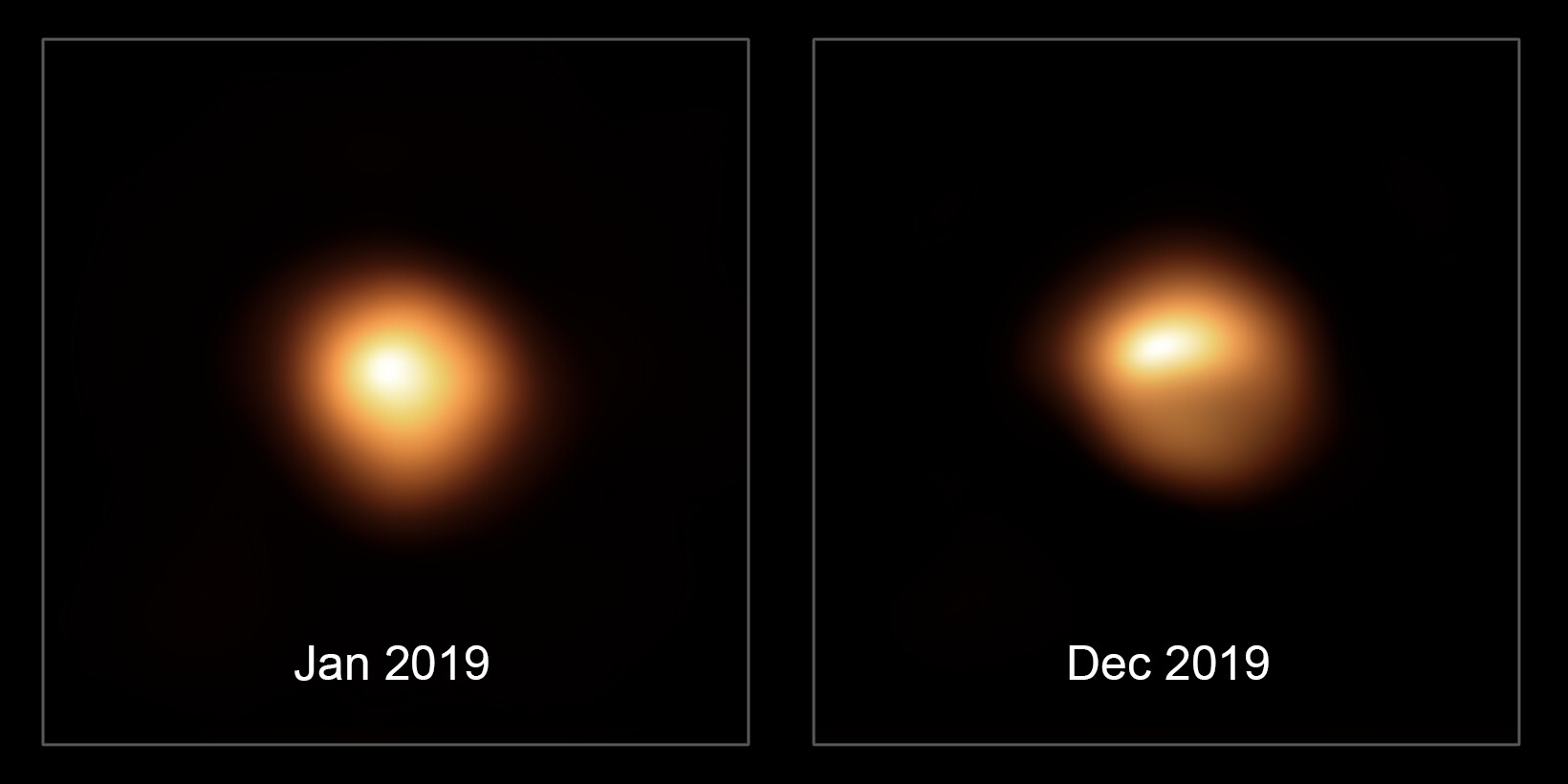
The SPHERE instrument on ESO's VLT caught Betelgeuse in December 2019, during the Great Dimming. The southern hemisphere of the star had become dramatically darker — the result of a massive dust ejection event confirmed by Hubble. Credit: ESO/M. Montargès et al.
VLT/NACO Close-Up
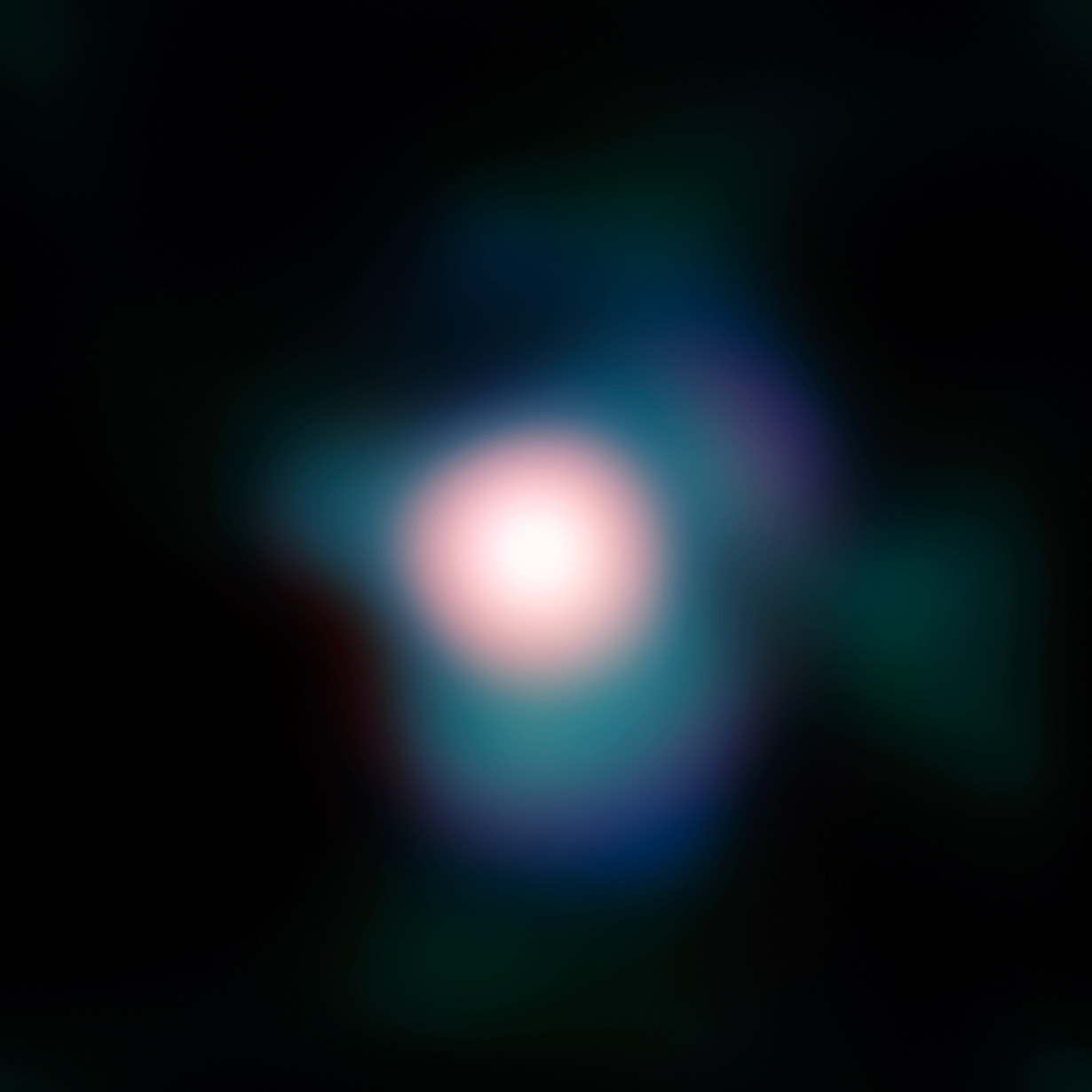
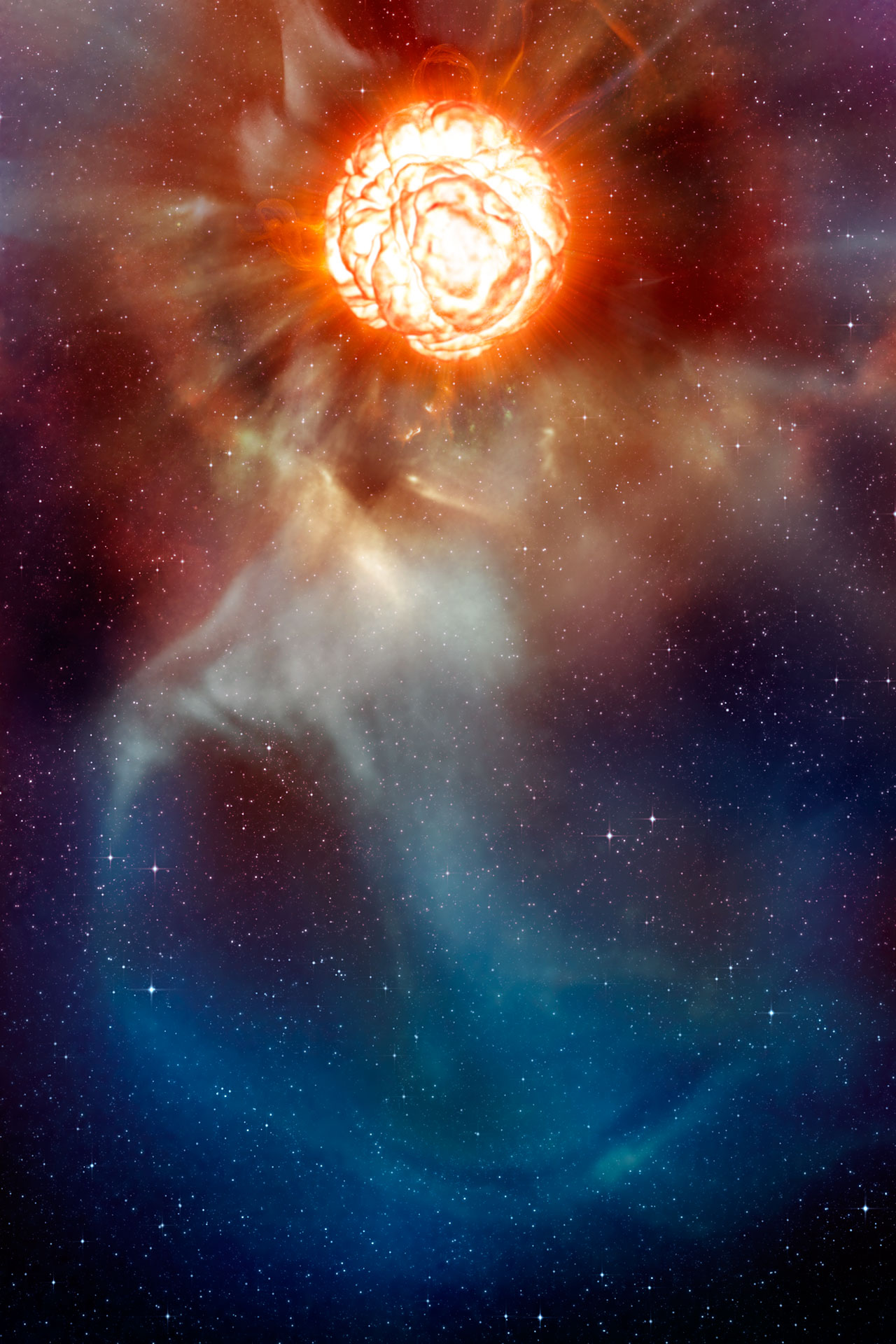
A 2009 adaptive-optics image from the NACO instrument on ESO's VLT resolves Betelgeuse's disk, with a vast plume of gas reaching away from the star — direct evidence of the mass loss that shrouds the supergiant in dust. Credit: ESO and P. Kervella.
Hubble Ultraviolet View
The first resolved image of a star other than the Sun, taken by Hubble in ultraviolet light. The bright spot visible on Betelgeuse's disk is roughly the size of our entire Solar System.
From Yad al-Jauzā to Betelgeuse: a name with a troubled history
The name Betelgeuse comes from the Arabic Yad al-Jauzā, meaning "the hand of al-Jauzā" — the Arabic name for the Orion figure. Through a series of mistranscriptions and misreadings during the translation of Arabic astronomical texts into Latin in medieval Europe, the initial "Y" was corrupted into "B," giving rise to Betelgeuse. The star was never actually named "armpit" in any language, despite that popular folk etymology appearing frequently in popular astronomy writing.
The star was recognized as significant by many ancient cultures. In medieval Islamic astronomy, al-Jauzā was a prominent figure and Yad al-Jauzā was a carefully tracked star. In ancient Egypt, Betelgeuse was associated with the god Osiris. In Chinese astronomy, it formed part of the Three Stars asterism in the White Tiger of the West.
The dimming that made astronomers pay close attention
In late 2019, Betelgeuse began an unprecedented dimming event. By February 2020, it had faded to roughly 40% of its typical brightness — an amount visible to the naked eye and far outside normal variability. Speculation was immediate and widespread: was Betelgeuse about to go supernova?
It was not. Hubble Space Telescope observations during the dimming revealed the cause: a massive gas ejection had released a cloud of material that cooled and condensed into dust as it moved away from the star. The dust cloud blocked southward-facing starlight reaching Earth. Simultaneously, a cool surface patch in the same region reduced the star's intrinsic brightness. The two effects together caused the unprecedented dimming.
By April 2020, Betelgeuse had returned to normal brightness. The event was unusual but not a supernova precursor — it was a particularly dramatic version of the kind of mass-loss events that red supergiants experience throughout their late lives. Betelgeuse will eventually explode, but not on a human timescale: estimates put the supernova roughly 100,000 years in the future.
Betelgeuse saved one more surprise. In July 2025, astronomers using the Gemini North telescope caught what is very likely a small companion star — long nicknamed the "Betelbuddy" and formally named Siwarha, "her bracelet," a nod to the Arabic root of Betelgeuse's own name — orbiting so close that it travels within the supergiant's extended outer atmosphere. The IAU adopted the name in September 2025, and follow-up Hubble observations in early 2026 strengthened the case. Siwarha's roughly six-year orbit may finally explain the puzzling six-year secondary cycle in Betelgeuse's brightness.
The most striking color in the winter sky
Betelgeuse is one of the easiest stars to find and one of the most visually striking. In Orion's familiar hourglass pattern, it marks the upper left shoulder with a distinctly warm orange-red color — a noticeable contrast to blue-white Rigel at the opposite corner (lower right foot). Even a glance from a city sidewalk shows the color difference.
Betelgeuse is also genuinely variable to patient observation. Compare it to nearby Aldebaran in Taurus (also orange-red) or Rigel (blue-white) over weeks and months, and the shifts in relative brightness become apparent. There are no special tools needed — your eyes are sufficient.
Color to look for
Orange-red, distinctly warmer than any other bright winter star. The contrast with Rigel (blue-white) in the same constellation is one of the nicest color pairs in the sky.
Monitor variability
Compare Betelgeuse's brightness to nearby reference stars (Bellatrix, Aldebaran) month to month. The roughly 400-day cycle means shifts are visible to the naked eye over a season.
Binoculars
Binoculars deepen the orange-red color and let you judge brightness relative to surrounding stars more precisely. No other equipment needed.
New to stargazing? See how to observe the night sky, and if you're choosing gear, the no-hype telescope buying guide.
A future supernova safely far away
When Betelgeuse eventually exhausts its remaining fuel, the core will collapse in a fraction of a second, releasing an enormous burst of energy. The resulting Type II supernova could briefly outshine the full Moon and be visible in daylight. At roughly 500–700 light-years away (estimates vary), it poses no danger to Earth — harmful radiation effects from a supernova require proximity of around 25 to 50 light-years or less. The light show would be spectacular but safe.
The collapse would also produce a neutrino burst detectable by underground neutrino observatories on Earth — and that burst would arrive hours before the visible light, because neutrinos pass through the star's outer layers while visible light takes time to escape. This means observatories watching for neutrino bursts could alert the world that Betelgeuse was going supernova before anyone saw it brighten in the sky.
Finding Betelgeuse in the winter sky
Betelgeuse is among the easiest objects in the night sky to identify. Find Orion — the most recognizable winter constellation — by looking for the three-star belt. Betelgeuse is the bright orange-red star in the upper left corner of the hourglass shape, directly above the leftmost belt star. From December through February, it is impossible to miss.
Best setup
Naked eye for color and variability comparison. Binoculars deepen the color. A telescope adds nothing useful — it is a point of light even to Hubble, outside of specialized resolved imaging.
Best season
November through March. December and January are ideal, with Orion high in the south by 9–10 PM. Betelgeuse rises in the east in late September and sets in the west in April.
Primary sources: ESO VLT VISIR Betelgeuse — The Flames of Betelgeuse (eso1121a), ESO SPHERE Betelgeuse during Great Dimming (eso2003a), ESO SPHERE Betelgeuse before/during comparison (eso2003c), ESO VLT/NACO close-up of Betelgeuse (eso0927b), ESO Betelgeuse plume artist's impression (eso0927a), and NASA Betelgeuse reference.
Betelgeuse burns at the threshold of its own ending — a star so vast and so near that we are granted the rare chance to watch a sun grow old, and to wait, across a hundred thousand years, for the light of its farewell.
Stories in the stars
Betelgeuse burns on the shoulder of Orion the hunter. See the full constellation and its myth, and the wider tapestry, on the Greek mythology hub.
Orion Constellation · Greek Myths Hub · Orion Nebula · Pleiades
More astronomy notes
Continue through the astronomy section for beginner-friendly notes, image credits, viewing tips, history, and the stories behind the night sky.
Astronomy · Orion Nebula · Polaris · Ring Nebula · Interests