
Stars: The Life and Death of a Star
Every point of light in the night sky is a sun — a furnace turning matter into light, born from a cloud of gas and destined to die. Some fade quietly; some detonate as the brightest events in the universe; a rare few collapse into objects that break physics. And the single thing that decides which ending a star gets is its mass. This is the whole story, from cradle to grave.
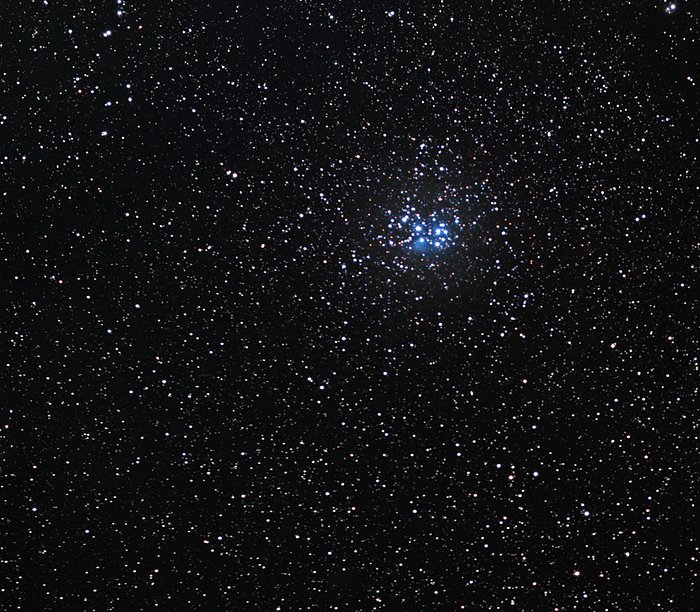
Image: ESO. The Pleiades — hundreds of hot young stars born together from one cloud, still tangled in its leftover dust. Stars are not made one at a time; they are born in litters, and a night sky is a graveyard and a nursery at once.
Mass is destiny
A star is a colossal ball of hot gas held together by its own gravity, shining because nuclear fusion in its core fuses hydrogen into helium and releases light. For most of its life a star is a standoff: gravity pulling inward, the energy of fusion pushing outward, the two in near-perfect balance. That balance is what a "living" star is.
Everything else about a star's life and death follows from one number: how much mass it was born with. A lightweight star sips its fuel and lives for trillions of years. A star like the Sun lives about ten billion, swells into a red giant, and dies gently. A heavyweight burns furiously, lasts only a few million years, and ends in a catastrophic explosion — leaving behind a neutron star or a black hole. Same physics, wildly different fates, all set at birth by mass.
Diagram by Michael Paycer. Two roads out of the main sequence: gentle for lightweights, violent for heavyweights.
Follow a star from birth to death
This section walks the full life cycle in six pages — two on how stars are born and live, four on the very different ways they die. Start anywhere, but the story reads in order.
How Stars Are Born
Cold clouds of gas, gravity, and collapse — how a dark nebula becomes a newborn sun, and why stars arrive in nurseries like Orion and the Cosmic Cliffs.
The Main Sequence
The long, stable adulthood where a star spends 90% of its life fusing hydrogen — plus the H-R diagram, red dwarfs, and the failed stars called brown dwarfs.
Red Giants
What happens when a star's fuel runs low: it swells enormous and cool. The Sun's own distant fate, and the supergiant Betelgeuse teetering on the edge.
Supernovae
The death of a massive star in an explosion that briefly outshines a galaxy — and forges the elements that made you. The Crab Nebula and SN 1987A.
White Dwarfs
The Earth-sized ember most stars, including the Sun, leave behind — impossibly dense, slowly cooling over billions of years.
Neutron Stars & Pulsars
A city-sized stellar corpse so dense a teaspoon weighs a billion tons — spinning, beaming, and sometimes colliding to make gold.
And past the heaviest deaths lies the final door: when even a neutron star can't hold, the core collapses into a black hole. The star cluster ends where the black-hole cluster begins.
Made of star-stuff
The reason this whole story matters to you personally is chemistry. The universe was born with almost nothing but hydrogen and helium. Every heavier atom — the carbon in your cells, the oxygen you breathe, the iron in your blood, the calcium in your bones — was forged inside a star and scattered into space when that star died. You are, quite literally, assembled from the ash of dead stars.
"The nitrogen in our DNA, the calcium in our teeth, the iron in our blood, the carbon in our apple pies were made in the interiors of collapsing stars. We are made of starstuff."
— Carl Sagan, Cosmos (1980)
That is not poetry dressed up as science; it is the plainest possible summary of stellar evolution. The chapters that follow — fusion, red giants, supernovae — are the machinery that actually did it.
What stars are not
"Stars are on fire." — No; fire is chemical burning, and a star shines by nuclear fusion, a completely different and far more powerful process. "Stars twinkle because they flicker." — The twinkle is our atmosphere bending their light; in space, stars shine steadily. "The Sun is an average, unremarkable star." — Half true: it's a middling size, but it's actually brighter and heavier than most stars in the galaxy, which are small red dwarfs. "Stars live forever." — None do; every star is spending a finite fuel supply, and even the longest-lived will eventually go dark. The night sky looks eternal because stellar lifetimes dwarf human ones — but on the universe's clock, stars are born, age, and die like everything else. Some of the "stars" you see tonight died thousands of years ago; their light is still arriving.
Star Formation · Main Sequence · Red Giants · Supernovae · White Dwarfs · Neutron Stars · Black Holes · Astronomy · Glossary
Return to Michael Paycer
Explore Michael Paycer's professional SQL Server, cloud, ETL, API, automation, and consulting pages, or continue browsing the personal interests section.