
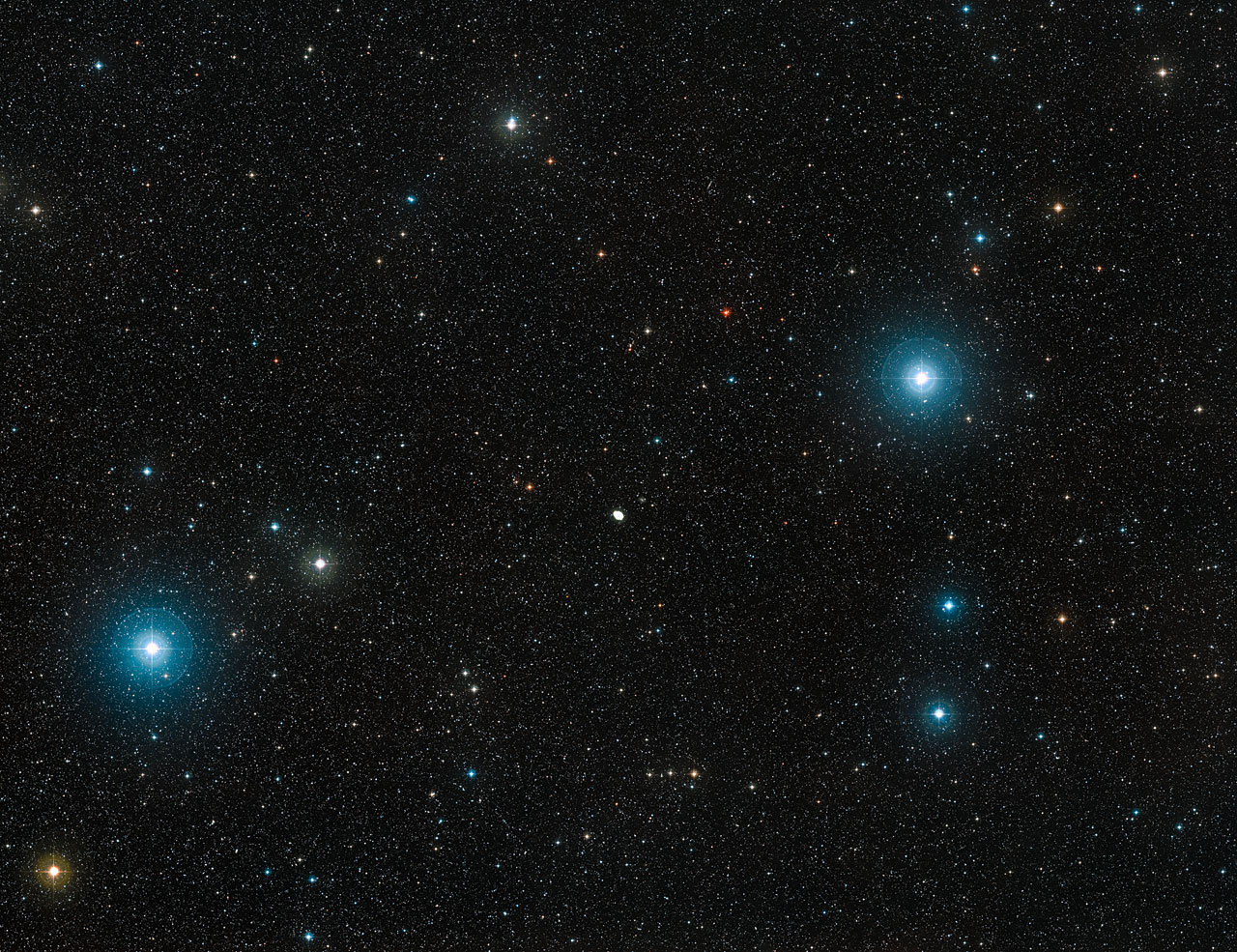
A wide-field view of the Ring Nebula (M57) and its surroundings in Lyra — the constellation's most famous deep-sky object sits midway between two stars of the little Harp. Image credit: NASA, ESA, and the Digitized Sky Survey 2 / ESA/Hubble.
Small, but unforgettable
Lyra represents the lyre — a small harp — of Orpheus, the legendary musician of Greek myth whose playing could charm stones and tame wild beasts. After his death, the gods placed his instrument in the sky. It is one of the smaller constellations, but it sits in a glorious stretch of the summer Milky Way and anchors the top corner of the Summer Triangle.
The constellation's main pattern is easy to learn: brilliant Vega at one corner, with a small, neat parallelogram of fainter stars hanging just below it. That little parallelogram is where the Harp's deep-sky treasures hide.
Lyra is the rare constellation where nearly every named star or object is worth stopping on. For its size, few patches of the summer sky are richer per square degree.
Lyra at a glance
Abbreviation
Lyr · Genitive: Lyrae
Brightest Star
Vega (α Lyr), magnitude 0.03
Size
286 sq. degrees — 52nd of 88 (one of the smaller)
Best Visibility
High overhead on summer evenings; northern skies
Key Stars
- α Lyr — Vega. Magnitude 0.03 — the fifth-brightest star in the night sky and once the zero-point of the entire brightness scale. A hot, blue-white star 25 light-years away, and a corner of the Summer Triangle. (See its full profile.)
- β Lyr — Sheliak. The prototype of the Beta Lyrae variables — a pair of stars so close they are distorted into egg shapes and pour gas onto one another, eclipsing each other every ~13 days in a visible brightness cycle.
- γ Lyr — Sulafat. A blue-white giant marking another corner of the Harp's parallelogram, the brightest "fixed" star in the figure after Vega.
- ε Lyr — the Double Double. A famous multiple star: binoculars split it into two stars, and a telescope splits each of those into two again — four stars in all. A classic test of a telescope's sharpness.
- RR Lyrae. The prototype of an entire class of pulsating variable stars used as standard candles to measure distances across the Milky Way and beyond.
The Harp's crown jewel
Lyra's most celebrated object is the Ring Nebula (Messier 57) — a planetary nebula sitting almost exactly midway between the stars Sheliak and Sulafat in the bottom of the parallelogram. It is the glowing shell of gas cast off by a dying Sun-like star, seen as a near-perfect smoke ring roughly 2,500 light-years away.
The Ring is one of the easiest planetary nebulae to find and a showpiece in even a modest telescope. It has its own dedicated page on this site, with Webb and Hubble imagery and the story of its tangled discovery in 1779.
Lyra deep-sky objects
| Object | Type | Distance | Notes |
|---|---|---|---|
| Ring Nebula (M57) | Planetary nebula | ~2,500 ly | Lyra's signature object; a dying star's shell |
| M56 | Globular cluster | ~33,000 ly | A compact ball of old stars between Lyra and Cygnus |
| Epsilon Lyrae | Multiple star | ~160 ly | The "Double Double" — four stars in two close pairs |
| Sheliak (Beta Lyrae) | Eclipsing binary | ~960 ly | Prototype of the Beta Lyrae variable class |
| RR Lyrae | Pulsating variable | ~860 ly | Prototype standard-candle variable star |
Where Kepler hunted for worlds
Lyra has a special place in the search for planets beyond the Solar System. NASA's Kepler Space Telescope stared at a single patch of sky straddling Lyra and Cygnus for years, monitoring some 150,000 stars for the tiny dips in brightness caused by transiting planets. That one fixed field of view — anchored near the Harp — produced thousands of confirmed exoplanets and transformed our understanding of how common planets are.
Finding and observing Lyra
Lyra is trivially easy to locate: just find Vega, which is often the first brilliant star to appear high overhead on summer evenings. The small parallelogram dangling beneath it is the body of the Harp.
Naked eye: Vega and the parallelogram; the Summer Triangle.
50mm binoculars: Epsilon Lyrae splits into two stars; M56 appears as a faint glow.
6-inch telescope: The Ring Nebula shows clearly as a tiny smoke ring; the Double Double resolves into four stars.
Best season: June through October evenings in the Northern Hemisphere.
New to stargazing? See how to observe the night sky, and if you're choosing gear, the no-hype telescope buying guide.
Constellation data sheet
| Abbreviation | Lyr |
| Genitive | Lyrae |
| Right Ascension | 18h 45m (center, approx.) |
| Declination | +36° (center, approx.) |
| Area | 286 sq. degrees (52nd largest) |
| Brightest star | Vega (alpha Lyr), mag 0.03 |
| Notable objects | Ring Nebula (M57), M56, Epsilon Lyrae, RR Lyrae |
| Meteor shower | Lyrids (mid-to-late April) |
| Bordering constellations | Cygnus, Draco, Hercules, Vulpecula |
| Best visibility | High overhead on summer evenings, northern latitudes |
The harp that charmed the underworld
Lyra is the lyre of Orpheus, the greatest musician of Greek myth. His playing stilled rivers, leaned trees toward him, and quieted wild animals on the hillside. When his wife Eurydice died of a snakebite, Orpheus walked down into the underworld and played until Hades himself wept and agreed to release her, on one condition: Orpheus must lead her back to the light and never once look behind him. A few steps from the surface, doubt won. He turned to be sure she still followed, and she slipped back into the dark for good.
Orpheus never recovered. He met a violent end, and his lyre fell into a river, still sounding notes as it drifted. The Muses gathered the instrument and asked Zeus to set it in the sky, where Vega now burns at its head. The harp that could move the dead became a fixture of the summer night.
Lyra is the small harp of the summer sky — a handful of stars carrying Orpheus's music, a dying star's perfect ring, and the field where we first learned how many other worlds are out there. Proof that the richest things in the heavens don't need to be the largest.
Stories in the stars
Orpheus's lyre is one thread in a wider tapestry of constellation myths. Explore them all on the Greek mythology hub.
Greek Myths Hub · Cygnus · Hercules · Draco · Summer Triangle
All Astronomy Notes · Vega · Ring Nebula · Summer Triangle · Draco · Cassiopeia · Deneb · Altair