
Polaris
Polaris is not the brightest star in the sky, but it may be the most practically important. It marks Earth's North Pole with uncanny precision — a triple-star system that has served as the navigator's anchor star for centuries, and will eventually be replaced as Earth's axis slowly wobbles.
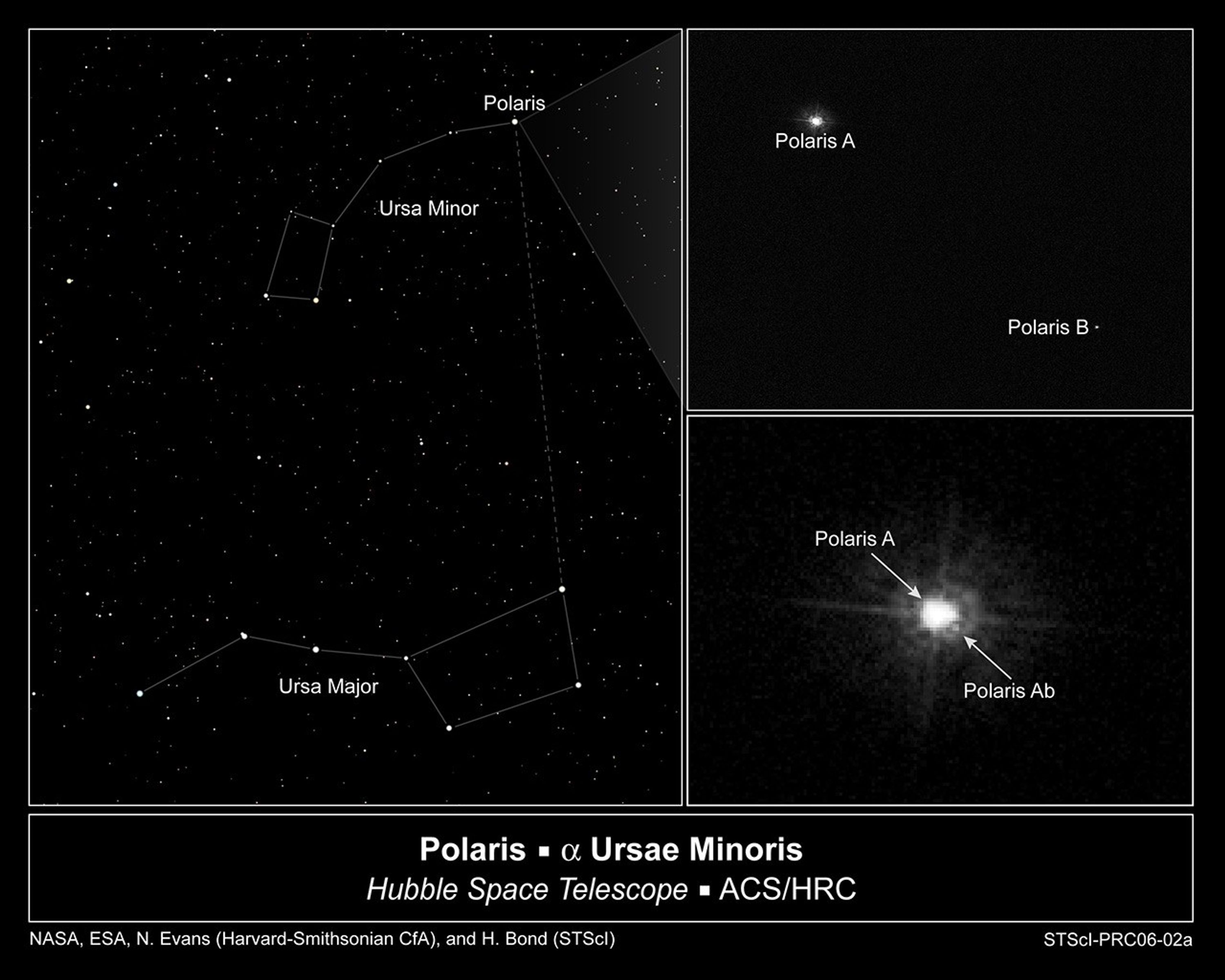
Image credit: NASA, ESA, N. Evans (Harvard-Smithsonian Center for Astrophysics), and H. Bond (STScI). This 2006 Hubble image resolved Polaris Ab — the close inner companion — for the first time, confirming the system's triple nature. The fainter companion sits close to the bright primary in this image.
Designation
Alpha Ursae Minoris
Constellation
Ursa Minor (Little Dipper)
Object Type
Triple-star system (Cepheid variable)
Altitude from Minnesota
~45° above the northern horizon all year
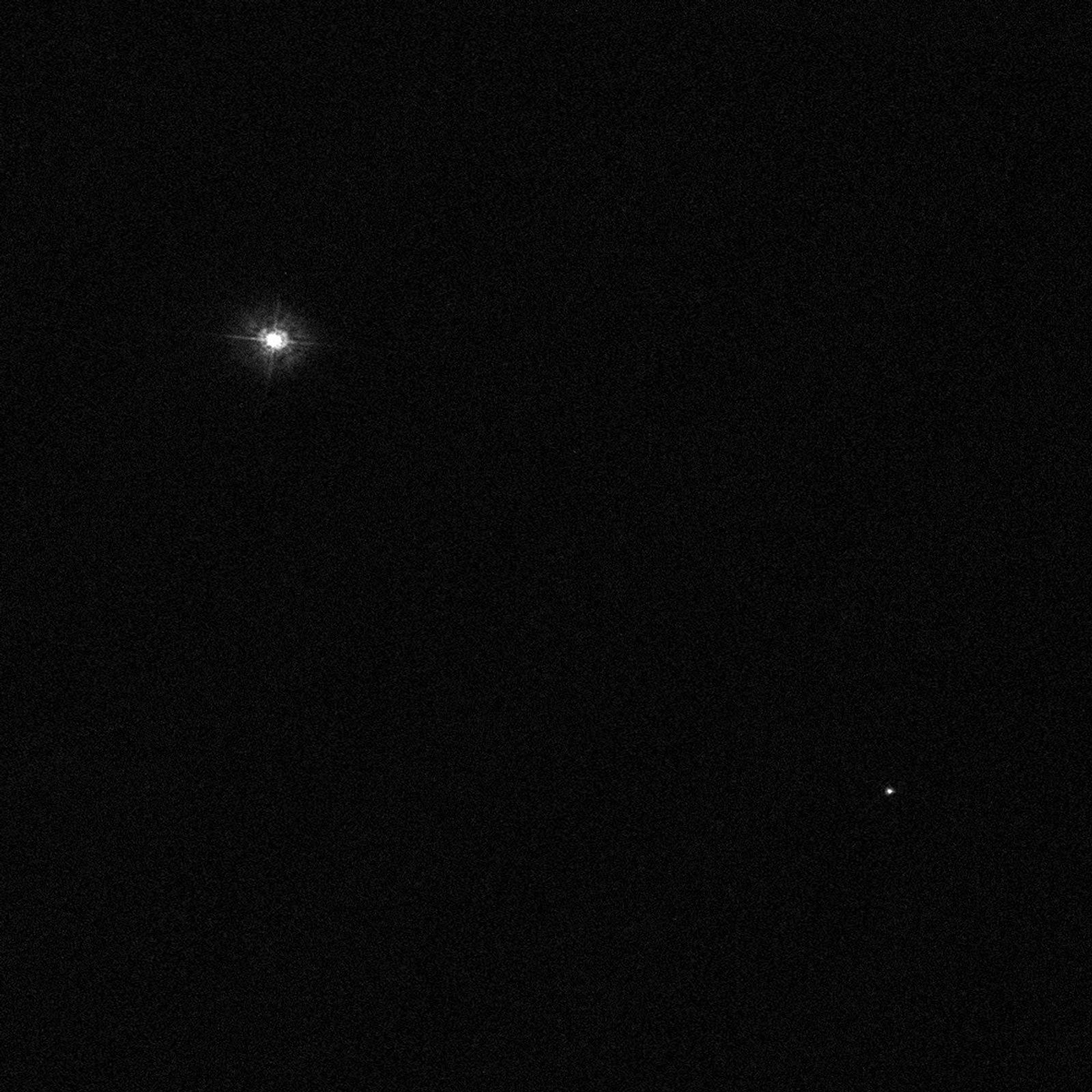
A triple-star system sitting almost exactly over the North Pole
Polaris is not a single star but a triple-star system. The primary component, Polaris Aa, is a yellow supergiant — a star about 50 times the diameter of the Sun and roughly 2,500 times more luminous. Around it orbits Polaris Ab, a smaller companion so close that for decades it was known only through spectroscopy — until Hubble resolved it visually for the first time in 2006. Farther out orbits Polaris B, the outer companion discovered by William Herschel in 1780 and visible in a modest backyard telescope.
What makes Polaris remarkable is not its brightness or its multiplicity, but its location: it sits within approximately 0.7° of the celestial North Pole — the point in the sky directly above Earth's North Pole. As Earth rotates, every other star traces a circle around the sky; Polaris barely moves. That near-perfect stillness is what made it the navigator's star.
Three views of Polaris
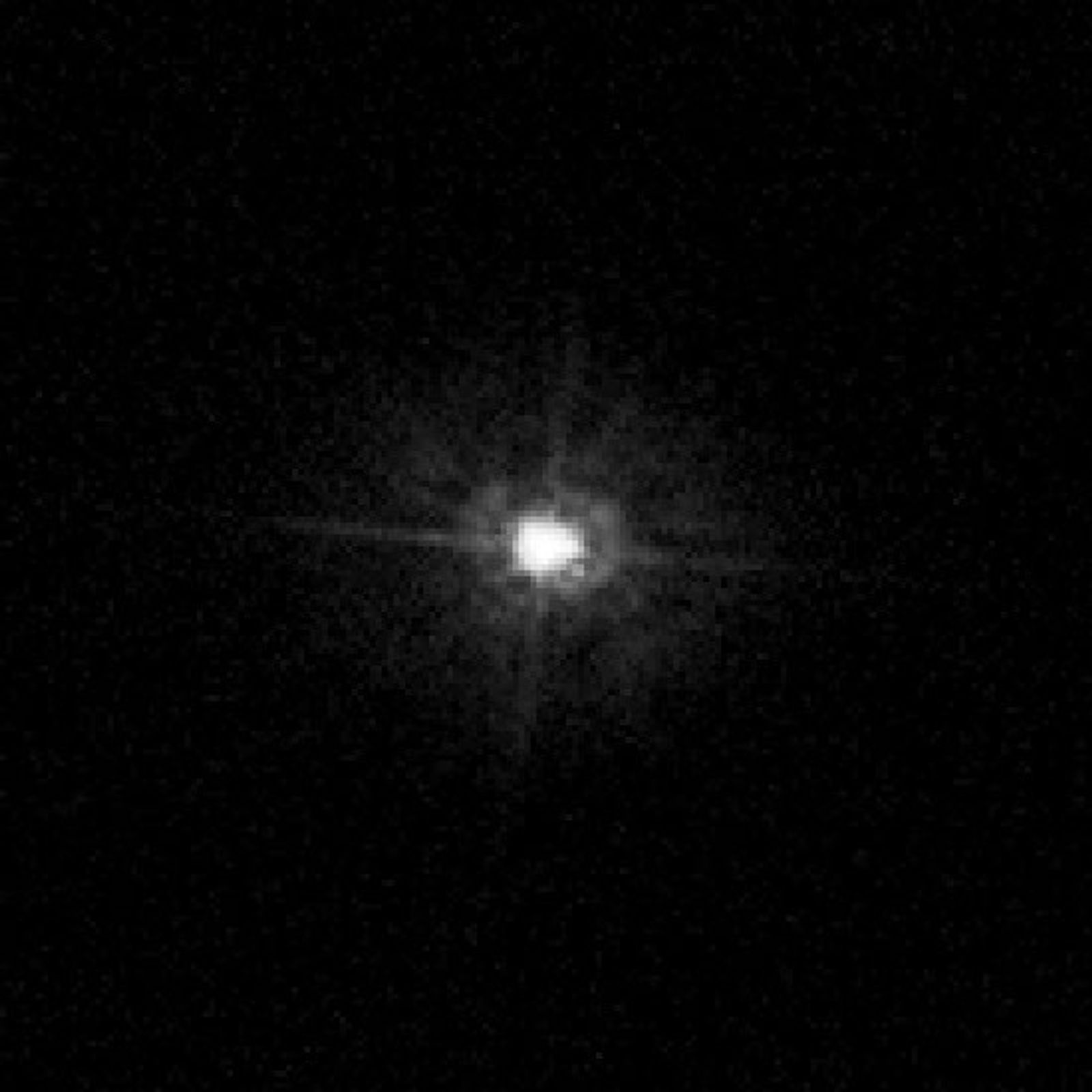
Hubble Resolves the Inner Companion
The 2006 Hubble image that first resolved Polaris Ab from its primary — a landmark observation confirming the triple-star nature of the system.
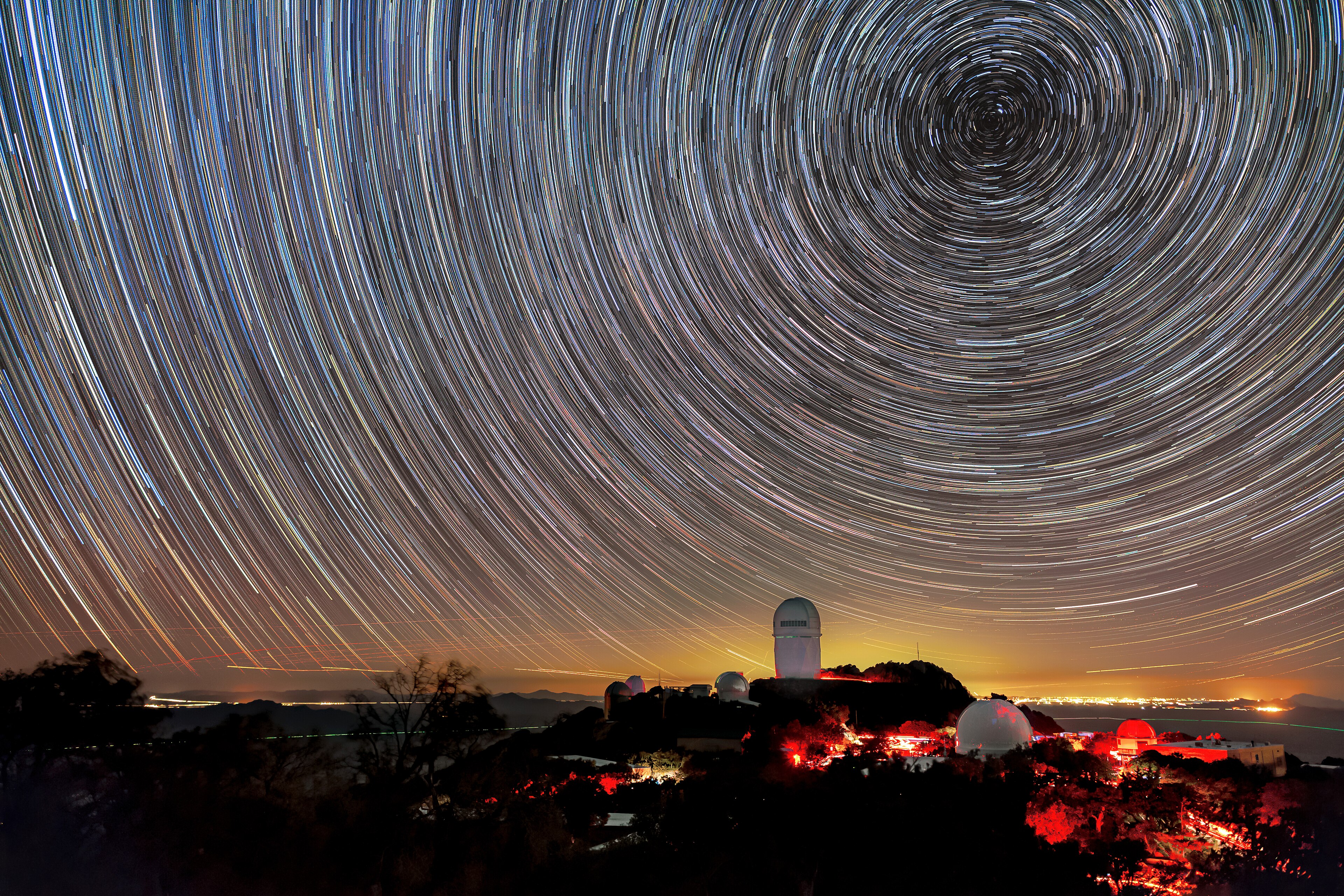
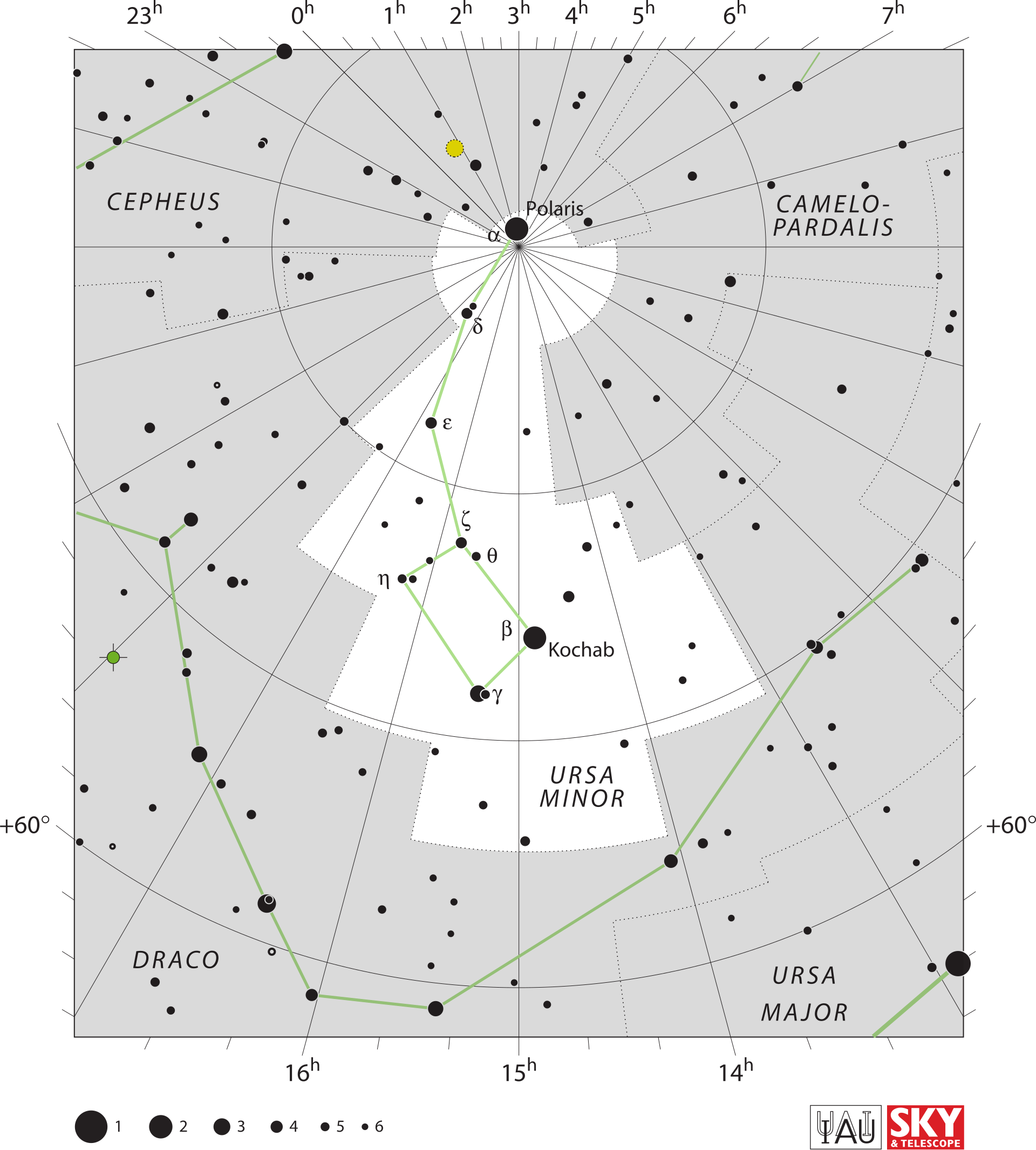
The Fixed Point
Long-exposure star trail photographs show every star except Polaris tracing arcs across the sky. Polaris sits at the center of that rotation, nearly motionless, for hours at a time.
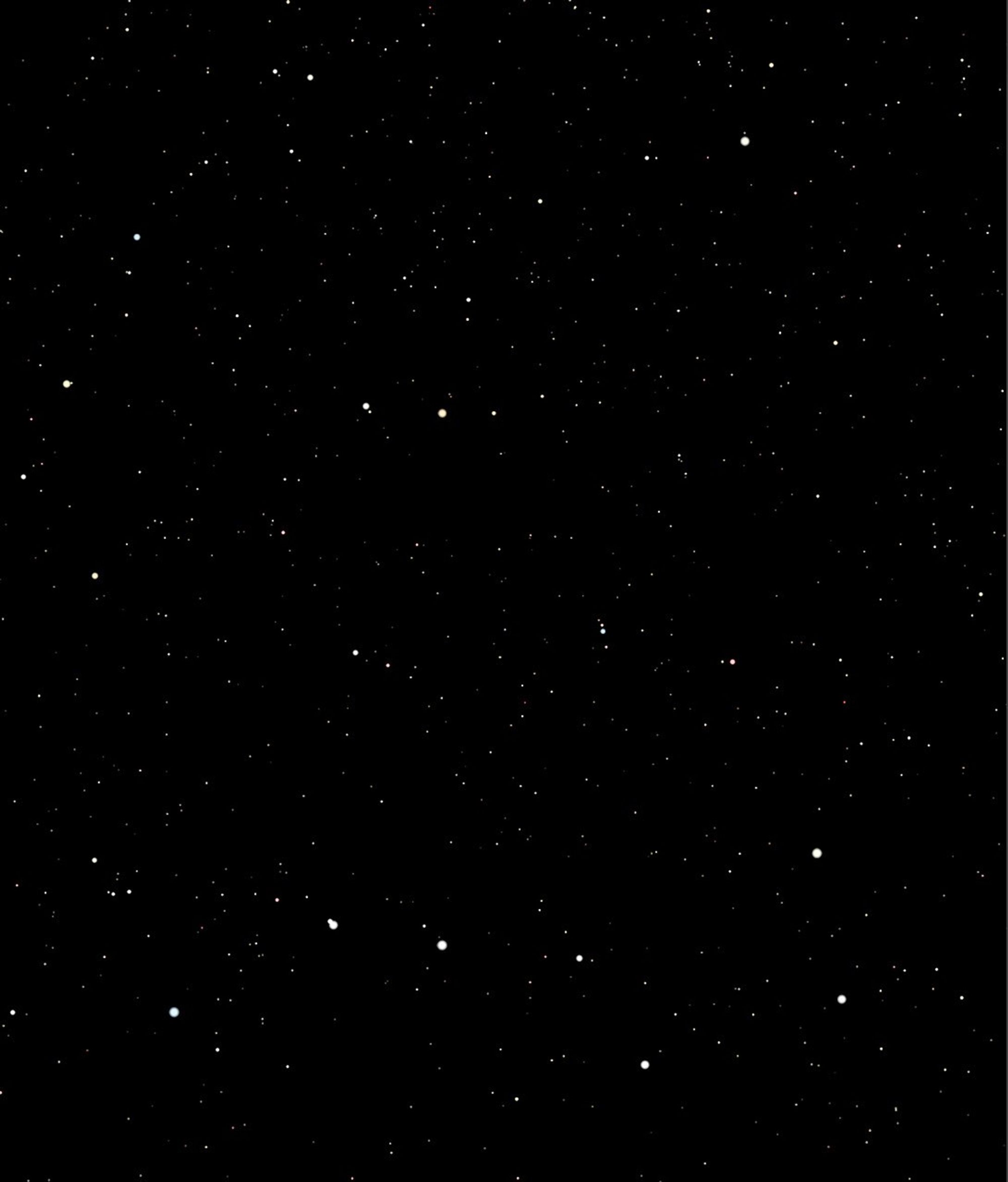
Tip of the Handle
Polaris marks the very end of the handle of the Little Dipper (Ursa Minor). The two pointer stars of the Big Dipper point directly at it — a finder technique used for millennia.
The angle above the horizon equals your latitude
Polaris's most important practical property is that its altitude above the horizon equals the observer's latitude. If you measure Polaris at 45° above the horizon, you are at 45° North — approximately Minneapolis. At the equator, Polaris sits on the horizon (0°); at the North Pole, it is directly overhead (90°).
This relationship was used for navigation by sailors and explorers for centuries. With a simple instrument to measure angle (a quadrant, sextant, or even a stretched hand against the sky) and a clear night showing Polaris, a navigator could determine their north-south position anywhere in the Northern Hemisphere without additional instruments or calculations. It was one of the most useful single observations available to pre-GPS travelers.
The same property means that from any fixed Northern Hemisphere location, Polaris traces a tiny circle around the exact pole each day — so small that with the naked eye it appears completely stationary. Only precise measurement reveals the slight wobble.
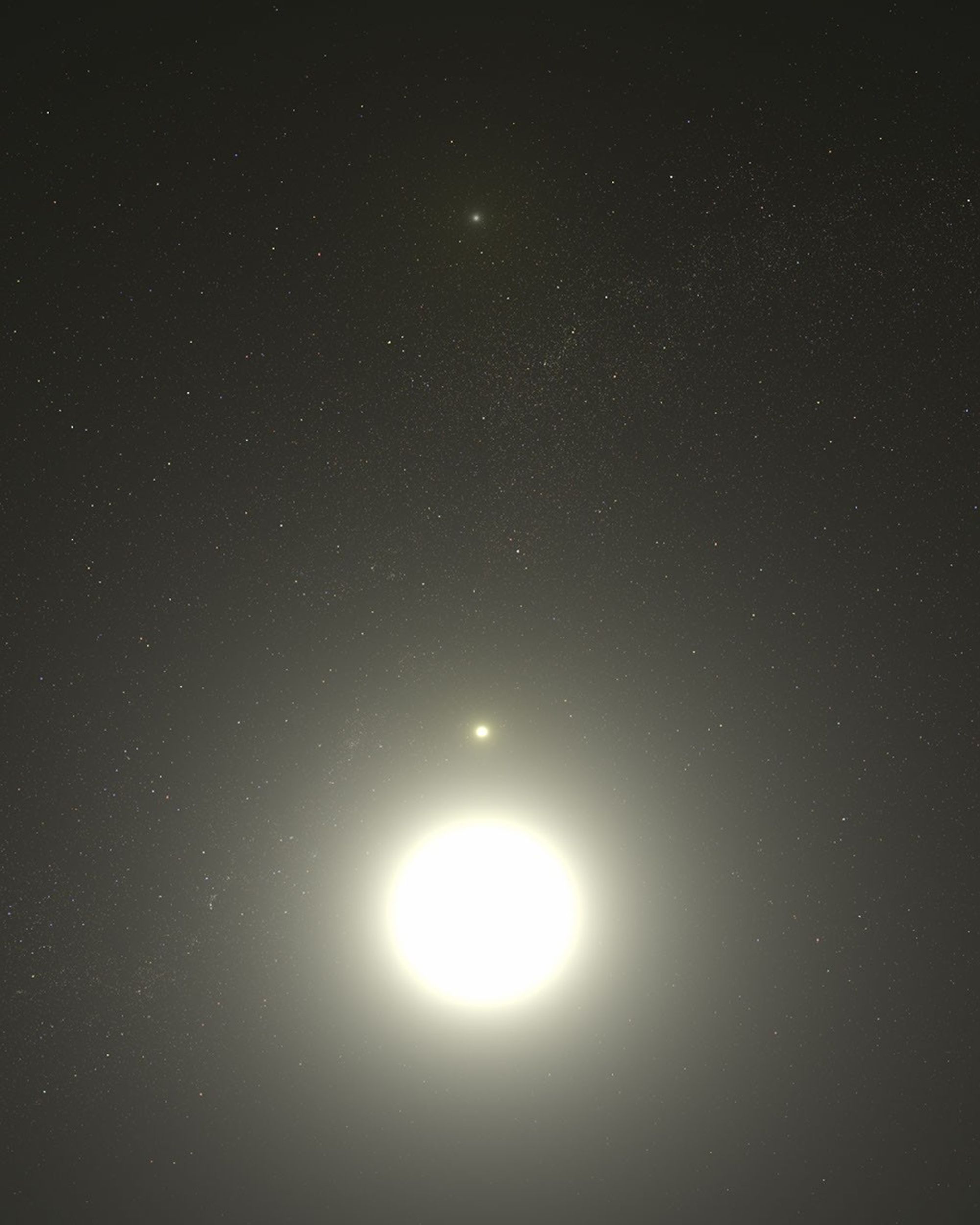
In 12,000 years, Vega will be the North Star
Earth's rotational axis is not perfectly fixed. Like a spinning top that wobbles slowly, Earth's axis traces a slow circle against the background stars over approximately 25,772 years — a cycle called axial precession. At different points in that cycle, different stars are positioned near the celestial North Pole.
Today it is Polaris. In ancient Egypt around 2700 BC, the star Thuban in Draco was the pole star — which is why some Egyptian pyramids may have been oriented with Thuban in mind. In approximately 12,000 years, the bright summer star Vega will become the pole star. Vega is considerably brighter than Polaris; future navigators will have a more conspicuous anchor star — but they will need to look for it in a different part of the sky.
Polaris itself will be at its closest approach to the exact pole around the year 2100, when it will be less than 0.5° away. After that, it will gradually move away, and within a few thousand years will no longer serve as a useful pole star.
A star that used to be more variable than it is now
Polaris Aa is a Cepheid variable star — a class of pulsating star that astronomers use as "standard candles" to measure cosmic distances. Cepheids pulsate with a period precisely related to their intrinsic luminosity: brighter Cepheids pulsate more slowly. By measuring the pulsation period, astronomers can calculate the star's true brightness and therefore its distance. Edwin Hubble used Cepheids in the Andromeda Galaxy to first establish that M31 was far outside the Milky Way.
Polaris pulsates on a roughly 4-day cycle, but the amplitude of that pulsation — how much its brightness changes — has been decreasing over the past century. In the early 1900s, Polaris varied by about 0.1 magnitudes; by the early 2000s that had dropped to under 0.03 magnitudes, barely detectable without precision instruments. Some astronomers have proposed that Polaris is currently transitioning through the instability strip — the zone of the H-R diagram where Cepheid pulsation occurs — and may eventually stop pulsating altogether. Others suggest the variation is cyclical. The mechanism is still debated.
Finding Polaris — the most reliable star trick in the sky
Polaris is not the brightest star in the sky — it ranks about 50th in apparent brightness. On a dark night it is a moderately bright star, not the overwhelming beacon that its reputation suggests. The reason it matters is position, not brightness.
The most reliable finder method: locate the Big Dipper (seven stars forming a bowl-and-handle shape), find the two stars that form the outside edge of the bowl (the "pointer stars," Dubhe and Merak), extend a line from those two stars northward roughly five times the distance between them, and Polaris is there — the moderately bright star with no other bright stars nearby.
Finding it
Use the Big Dipper's two pointer stars — Merak and Dubhe — extending the line they form roughly five times that distance north. Polaris sits alone with no bright neighbor nearby.
Measure latitude
Hold a fist at arm's length, stacked from the horizon up — each fist is roughly 10°. Count the stacks to Polaris and you have your approximate latitude. From St. Cloud MN, it should be around 45 stacks/fists up.
Telescope view
A telescope resolves Polaris B — the outer companion — from the bright primary. The companion sits about 18 arcseconds away; a 4-inch or larger telescope on a steady night should separate them clearly.
New to stargazing? See how to observe the night sky, and if you're choosing gear, the no-hype telescope buying guide.
Polaris is a pulsating supergiant — see the full life and death of stars.
Polaris is visible every clear night of the year
Unlike seasonal objects, Polaris is circumpolar from any Northern Hemisphere location above roughly 0° latitude — it never sets and is visible on every clear night of the year. From Minnesota at about 45° North, it sits at 45° above the northern horizon, high enough to see through even modest amounts of atmospheric haze.
Best setup
Naked eye for finder practice and latitude estimation. Binoculars show it as a single point. A 4-inch or larger telescope will reveal the companion Polaris B separated from the primary at higher magnification (100× or more).
Star trail photography
A camera on a tripod pointing north, left open for 30–60 minutes, shows Polaris as the near-stationary dot at the center of the circular star trails — one of the most striking and easiest long-exposure astronomy photographs to attempt.
Primary sources: ESA/Hubble Polaris system image, NASA Polaris reference, Britannica Polaris reference, and HubbleSite Polaris binary resolution announcement, 2006.
Polaris holds the north for now — steady enough to steer ships and settle compasses — yet even this fixed point is only borrowed, a pole star quietly passing the role to the next as the Earth turns its long, patient circle.
Polaris and the Little Bear
Polaris marks the tail of Ursa Minor, the Little Bear. In Greek myth the Little Bear is Arcas, son of Callisto, set in the sky beside his mother, the Great Bear, after Zeus saved them both from a hunting accident. Hera's revenge condemned both bears to circle the pole forever without resting in the sea, which is why they never set. Explore the wider tapestry of constellation myths on the Greek mythology hub.
More astronomy notes
Continue through the astronomy section for beginner-friendly notes, image credits, viewing tips, history, and the stories behind the night sky.
Astronomy · Hercules Cluster · Pleiades / Seven Sisters · Andromeda Galaxy · Interests