
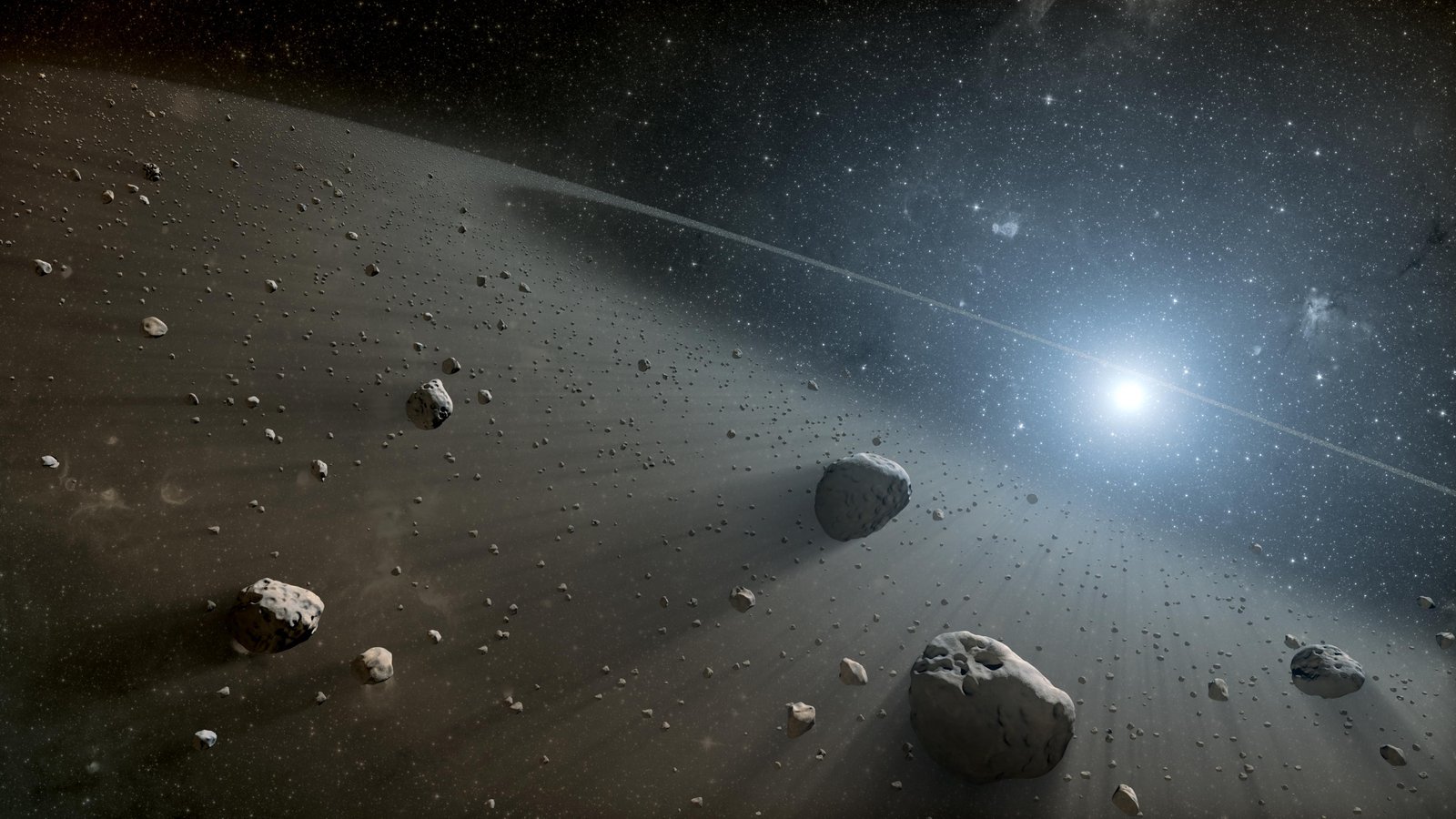
An artist's concept of the warm ring of rocky debris circling Vega, inferred from NASA's Spitzer Space Telescope and ESA's Herschel observatory. Vega's dusty disk hints at planet-building in progress. Image credit: NASA/JPL-Caltech.
The star that set the scale
Vega — Alpha Lyrae — is the fifth-brightest star in the night sky and the brightest in the small constellation Lyra. At about 25 light-years away, it is one of our nearer stellar neighbors: a hot, blue-white, hydrogen-fusing star roughly twice the Sun's mass and about 40 times its luminosity.
For more than a century, Vega held a special job. Astronomers used it as the zero point of the brightness scale — by definition, Vega's brightness across standard filters was magnitude 0.0, and every other star was measured against it. Modern systems have refined that, but the "Vega magnitude" system is still part of how stellar brightness is described today.
Vega isn't just bright — it was the ruler. Generations of astronomers measured the entire sky in units of "how it compares to Vega."
Vega at a glance
Designation
Alpha Lyrae (α Lyr)
Constellation
Lyra (the Harp)
Spectral Type
A0 V — hot, blue-white main sequence
Distance
About 25 light-years
Faster, flatter, and surrounded by debris
Vega is not a calm, perfectly round star. It spins extraordinarily fast — completing a rotation in well under a day, near the speed at which it would begin to break apart. That rapid spin flattens it into an oblate shape, bulging at the equator. We happen to view Vega almost pole-on, looking nearly straight down its rotation axis, which is part of why it has been such a tricky "standard" star to fully model.
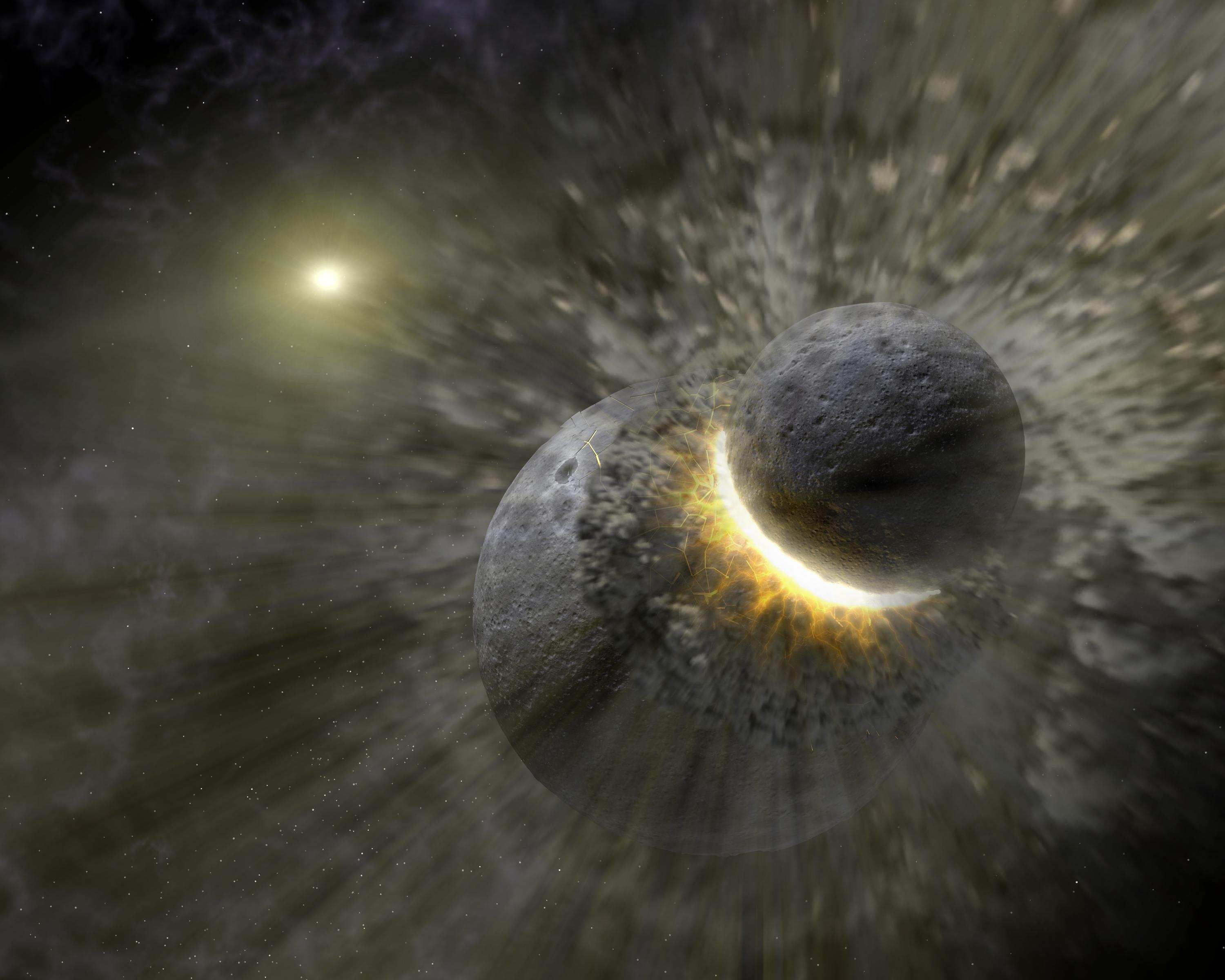
Vega is also encircled by a debris disk — a ring of dust and rocky fragments first detected by infrared observations and studied in detail by Spitzer, Herschel, and more recently Hubble and Webb. Disks like this are the leftover rubble of planet formation: the grinding collisions of asteroid- and comet-sized bodies. Vega was one of the first stars where such a disk was ever found, making it a touchstone for the study of planetary systems beyond our own.
North, slowly drifting
Earth's axis wobbles like a spinning top in a slow circle that takes about 26,000 years to complete — a motion called precession. Because of it, the title of "pole star" passes from one star to another over the millennia.
Around 12,000 BCE, Vega was the closest bright star to the north celestial pole, and it will reclaim that role again around the year 13,700 CE. Polaris is our pole star now, but Vega is north's once-and-future anchor. Vega also holds a place in the history of the camera: in 1850 it became the first star (other than the Sun) ever photographed, and one of the first to have its spectrum recorded.
Color to look for
A crisp, icy blue-white — noticeably cooler in tone than orange stars like Arcturus or Betelgeuse. On a summer night it is often the first star to appear high overhead.
Find it
Vega is the top vertex of the Summer Triangle and the brightest star in Lyra. Look nearly straight up on summer evenings in the Northern Hemisphere.
The first star ever photographed
On the night of 16–17 July 1850, William Bond and the photographer John Adams Whipple aimed the Harvard College Observatory's fifteen-inch Great Refractor at Vega and held a daguerreotype plate open for about a hundred seconds. The faint mark they developed became the first photograph of any star other than the Sun. Stellar astrophotography began with this single point of light.
Vega kept turning up at the frontier. It was among the first stars to have its spectrum recorded, and the fast spin and dusty debris disk that later instruments found made it a favourite laboratory for studying how planetary systems take shape. Carl Sagan chose Vega as the source of the alien message in his novel Contact, twenty-five light-years being close enough to feel reachable and far enough to feel like another world. For more than a century this one star has stood in for the next step outward.
Sources & Image Credits
NASA/JPL-Caltech images used under NASA's image-use policy:
Vega is the bright blue-white anchor of Lyra — a star of music, summer skies, and ancient navigation, close enough to feel familiar, yet old enough to remind us how slowly the heavens move.
All Astronomy Notes · Lyra Constellation · Summer Triangle · Ring Nebula · Deneb · Altair