
Supernovae
A supernova is the most violent death a star can suffer — an explosion so bright it can briefly outshine an entire galaxy of a hundred billion stars, visible clear across the universe. It is also one of the most creative events there is: the forge where most of the elements heavier than iron are made, and the blast that scatters them into space to become new worlds and, eventually, us.
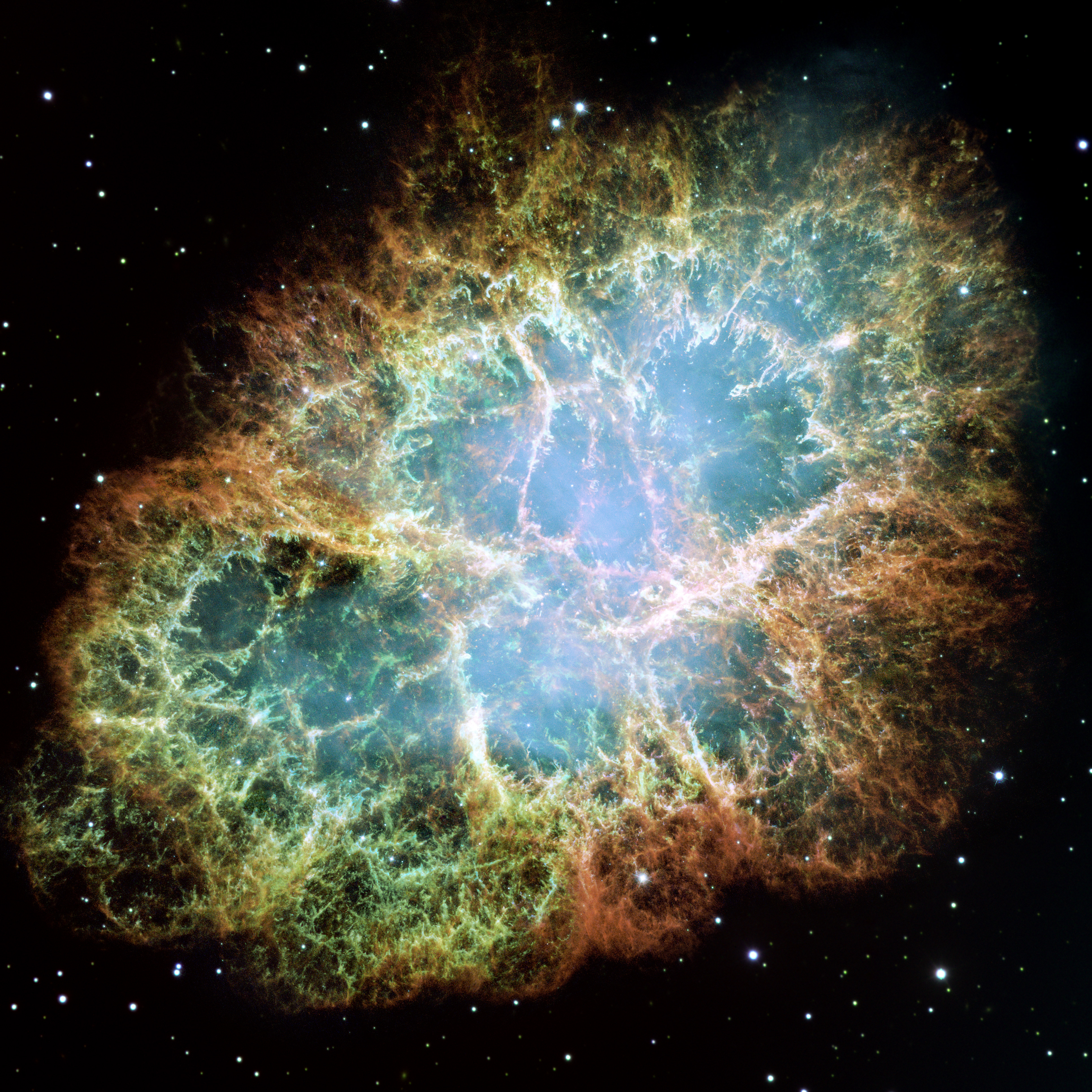
Image: NASA, ESA and Allison Loll/Jeff Hester (Arizona State University). The Crab Nebula — the shredded remains of a star that exploded in the year 1054, an event so bright that Chinese and other astronomers recorded a "guest star" visible in daylight for weeks. At its heart spins the neutron star that was the dead star's core.
Core collapse, and the stolen-fuel bomb
Stars explode by two very different routes. The first, a core-collapse supernova (Type II), is the death of a single massive star. Such a star fuses ever-heavier elements in its core — hydrogen to helium to carbon and on up — until it reaches iron. Iron fusion yields no energy; it costs energy. So the moment the core turns to iron, the fire stops, and gravity wins instantly. In under a second the core collapses, then rebounds in a shockwave that blasts the star's outer layers into space. What's left behind is a neutron star or, for the heaviest stars, a black hole.
The second route, a Type Ia supernova, involves a white dwarf — the dead ember of a Sun-like star — that is stealing gas from a companion star. When the white dwarf's mass creeps past a hard limit (about 1.4 times the Sun's mass, the "Chandrasekhar limit"), it detonates in a runaway thermonuclear explosion, blowing itself completely apart and leaving nothing behind. Because these all explode at nearly the same mass, they all reach nearly the same brightness — which makes them "standard candles" astronomers use to measure cosmic distances. It was Type Ia supernovae that revealed, in 1998, that the expansion of the universe is speeding up.
Diagram by Michael Paycer (M☉ = solar masses). One death leaves a corpse; the other leaves nothing at all.
Where your atoms were made
Supernovae are not just destruction — they are the universe's foundries. The lighter elements up to iron are forged in the cores of living stars, but the heavier ones — much of the gold in a wedding ring, the silver, the uranium — require the extreme conditions of a stellar death or collision to form. And crucially, the explosion disperses everything the star made, seeding interstellar space with the raw material of future stars, planets, and life. Every supernova is both an ending and a sowing.
"We are stardust brought to life, then empowered by the universe to figure itself out — and we have only just begun."
— Neil deGrasse Tyson, astrophysicist
The most-studied nearby example in modern times is SN 1987A, a star that exploded in a neighboring galaxy in 1987 — close enough that its ghostly light and even a burst of subatomic particles were caught by detectors on Earth, confirming the core-collapse theory in real time. And the Crab Nebula, from the supernova of 1054, remains the textbook remnant: still expanding nearly a thousand years later, still lit from within by its spinning stellar corpse.
Reading the explosion correctly
"The Sun will go supernova." — It can't; only stars far heavier than the Sun end this way. The Sun will end quietly as a white dwarf. "A supernova destroys everything nearby forever." — It's lethal up close, but its greatest legacy is creative: it enriches space with the elements that build new solar systems. "All supernovae are the same explosion." — No; core-collapse (Type II) and white-dwarf detonation (Type Ia) are entirely different mechanisms with different debris. "We see supernovae as they happen." — We see the light after it crosses vast distances, so a supernova we watch tonight actually exploded thousands or millions of years ago. And the classic caution: the star that "explodes" in a core-collapse event isn't wholly destroyed — its heart lives on as a neutron star or black hole.
Neutron Stars & Pulsars · White Dwarfs · Red Giants · Black Holes · Betelgeuse · Stars Hub · Supernova Remnants · Glossary
Return to Michael Paycer
Explore Michael Paycer's professional SQL Server, cloud, ETL, API, automation, and consulting pages, or continue browsing the personal interests section.