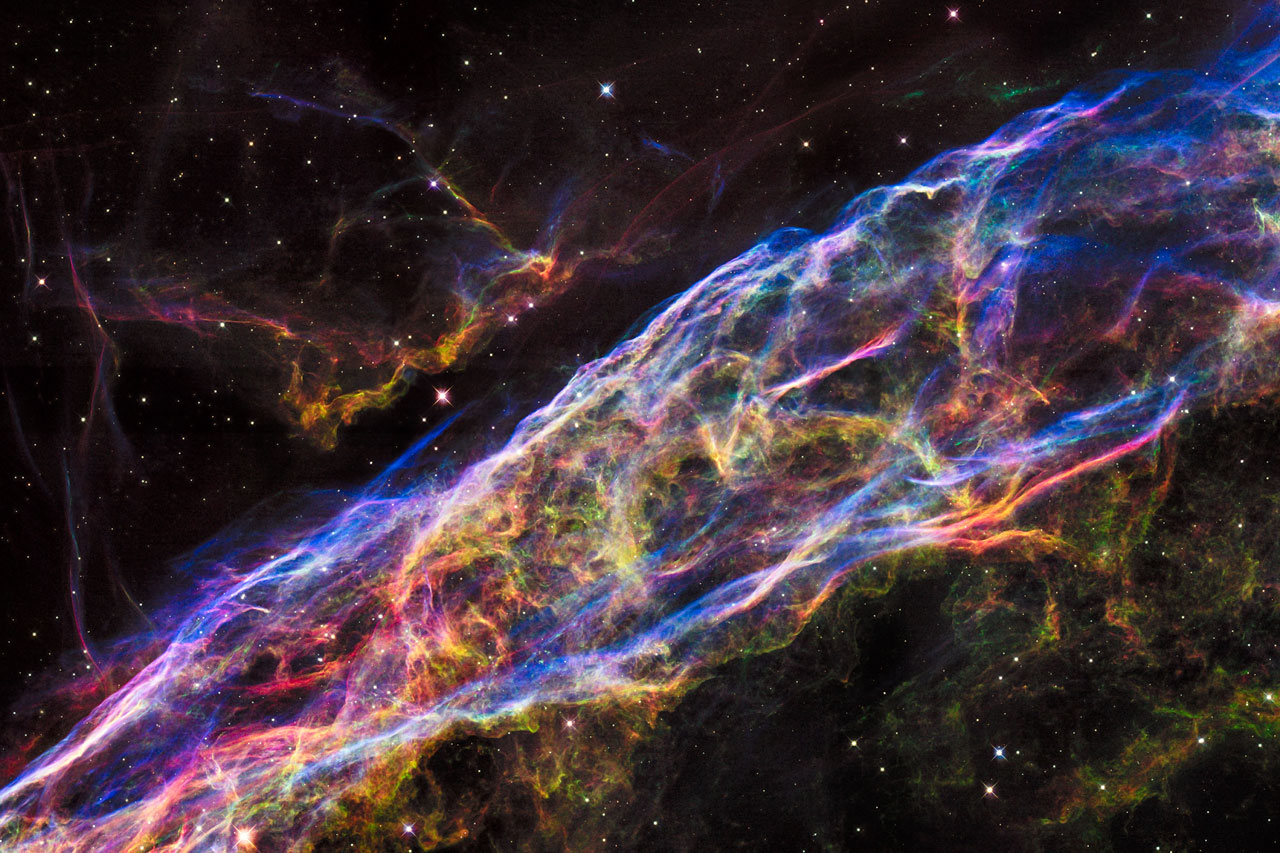
A small section of the Veil Nebula — part of the outer shell known as NGC 6960, the "Witch's Broom" — imaged by Hubble's Wide Field Camera 3 in 2015. Image credit: NASA, ESA, and the Hubble Heritage Team (STScI/AURA).
The wreckage of an exploded star
The Veil Nebula is a supernova remnant — the expanding debris of a star roughly twenty times the mass of the Sun that exploded thousands of years ago. The whole structure is also called the Cygnus Loop, because from a distance the filaments trace out a vast, nearly circular bubble in the constellation Cygnus, the Swan.
It sits about 2,400 light-years away. Age estimates vary — older figures ran as high as tens of thousands of years, while recent work points to roughly 8,000–20,000 years since the explosion. Either way, you are not seeing the blast itself. You are seeing what it left behind, still in motion, long after the light of the explosion faded.
This isn't the explosion — it's the blast wave, still traveling. Think of a snowplow throwing up a glowing wall as it pushes through fresh snow.
The Veil at a glance
Also Known As
Cygnus Loop · NGC 6960 / 6992 / 6995
Constellation
Cygnus (the Swan)
Object Type
Supernova remnant (emission nebula)
Distance
About 2,400 light-years
A glow made by a collision
The Veil doesn't shine because the gas is hot left over from the explosion. It shines because the supernova's shock wave is still expanding outward at hundreds of kilometers per second, slamming into the thin interstellar gas that was already there. That collision heats and compresses the gas until it glows.
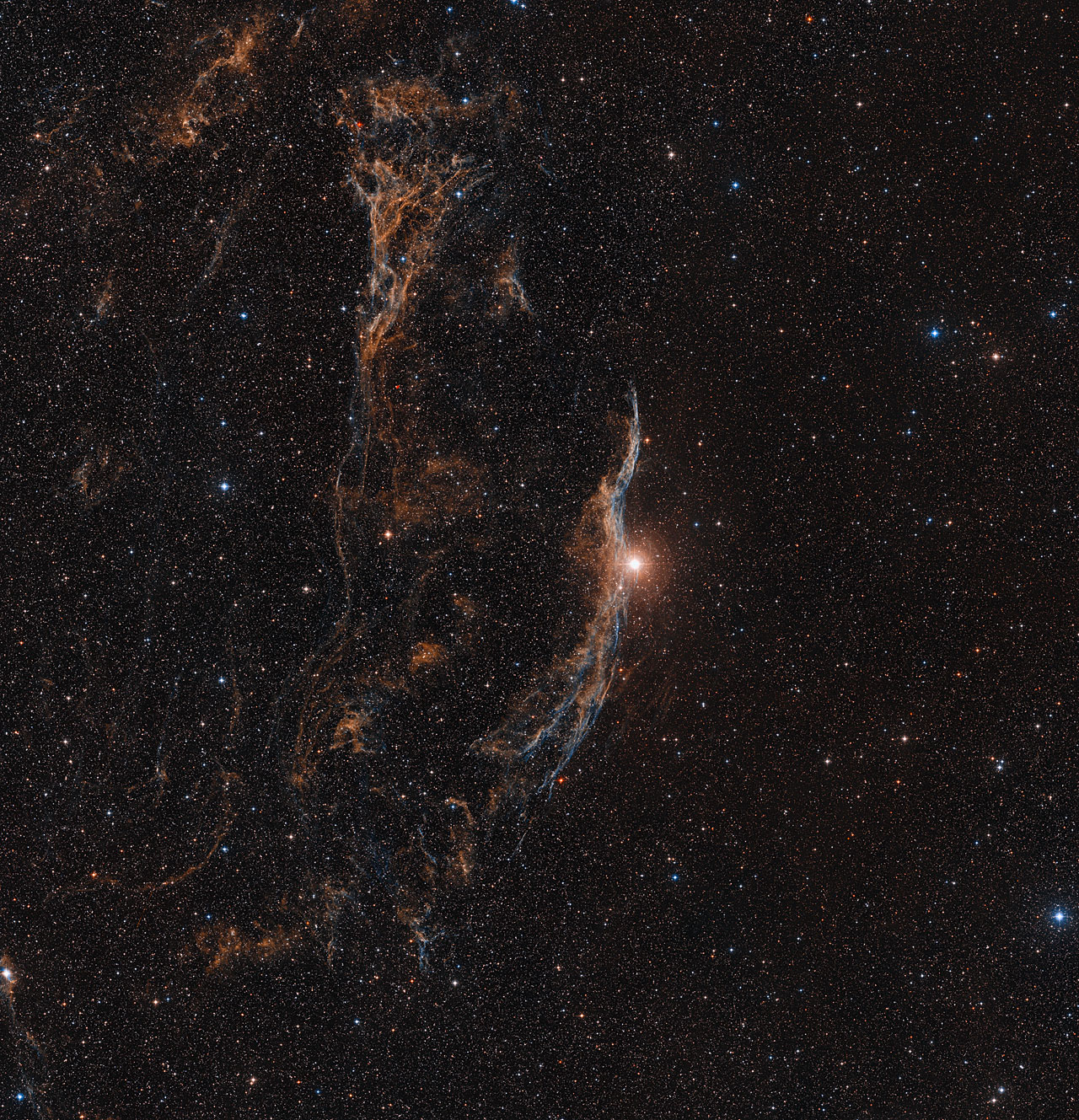
The full loop spans about 3 degrees of sky — roughly six full Moons laid side by side — corresponding to a real diameter of around 110 light-years. All of that delicate, lacework structure is the wreckage of a single star. Its brightest sections have their own names: the Western Veil (NGC 6960, the Witch's Broom, draped across the star 52 Cygni), the Eastern Veil (NGC 6992 and 6995), and the fainter wisp known as Pickering's Triangle.
The colors are chemical fingerprints
The reds and teals in a Veil Nebula image aren't artistic choices — they are the literal signatures of which atoms are glowing. When the shock heats a particular element, it re-emits light at very specific wavelengths, so the color tells you the composition directly.
Red — hydrogen
The most common element in the universe. Glowing hydrogen (and some nitrogen) emits in deep red, tracing the cooler, denser ribbons where the shock has already passed through.
Blue / teal — oxygen
Doubly-ionized oxygen glows blue-green and marks the hottest part of the shock front — the leading edge where the blast wave is freshly colliding with interstellar gas.
Finding the Veil in Cygnus
The Veil rides high overhead on summer and autumn evenings, in the Swan — the same region that hosts the Summer Triangle. The Western Veil is easiest to find because it drapes across the naked-eye star 52 Cygni, a built-in signpost.
Best setup
An OIII (oxygen) filter transforms the view — the Veil leaps out of the background even from suburban skies. Low-power, wide-field eyepieces or rich-field telescopes show the long arcs beautifully.
Best season
July through November in the Northern Hemisphere, with Cygnus high in the evening sky. Dark, moonless skies make an enormous difference.
From Herschel's eyepiece to the next generation of stars
William Herschel swept up the Veil on 5 September 1784. He logged the brighter eastern arc, now catalogued as NGC 6992, and the fainter western arc, NGC 6960, that drapes across the naked-eye star 52 Cygni. He had no idea he was looking at the wreckage of an exploded star. Astronomers only understood supernova remnants for what they are in the twentieth century, once they could measure how fast the gas was still moving.
That gas does not simply fade and vanish. The shock front sweeps up interstellar hydrogen into dense filaments, salts it with the oxygen, carbon, and iron forged inside the dead star, and leaves it ready to collapse one day into new suns and planets. Carl Sagan said as much:
"The nitrogen in our DNA, the calcium in our teeth, the iron in our blood, the carbon in our apple pies were made in the interiors of collapsing stars. We are made of starstuff."
— Carl Sagan, Cosmos (1980)
Sources & Image Credits
Hubble Space Telescope and ground-based survey images used under open science and education licenses:
Every atom in the Veil is being flung back into the dark to seed the next generation of stars and planets. A star's death is not an ending here — it is the raw material of everything that comes after, including us.
All Astronomy Notes · Summer Triangle · Deneb · Ring Nebula · Orion Nebula · Cassiopeia · Betelgeuse