
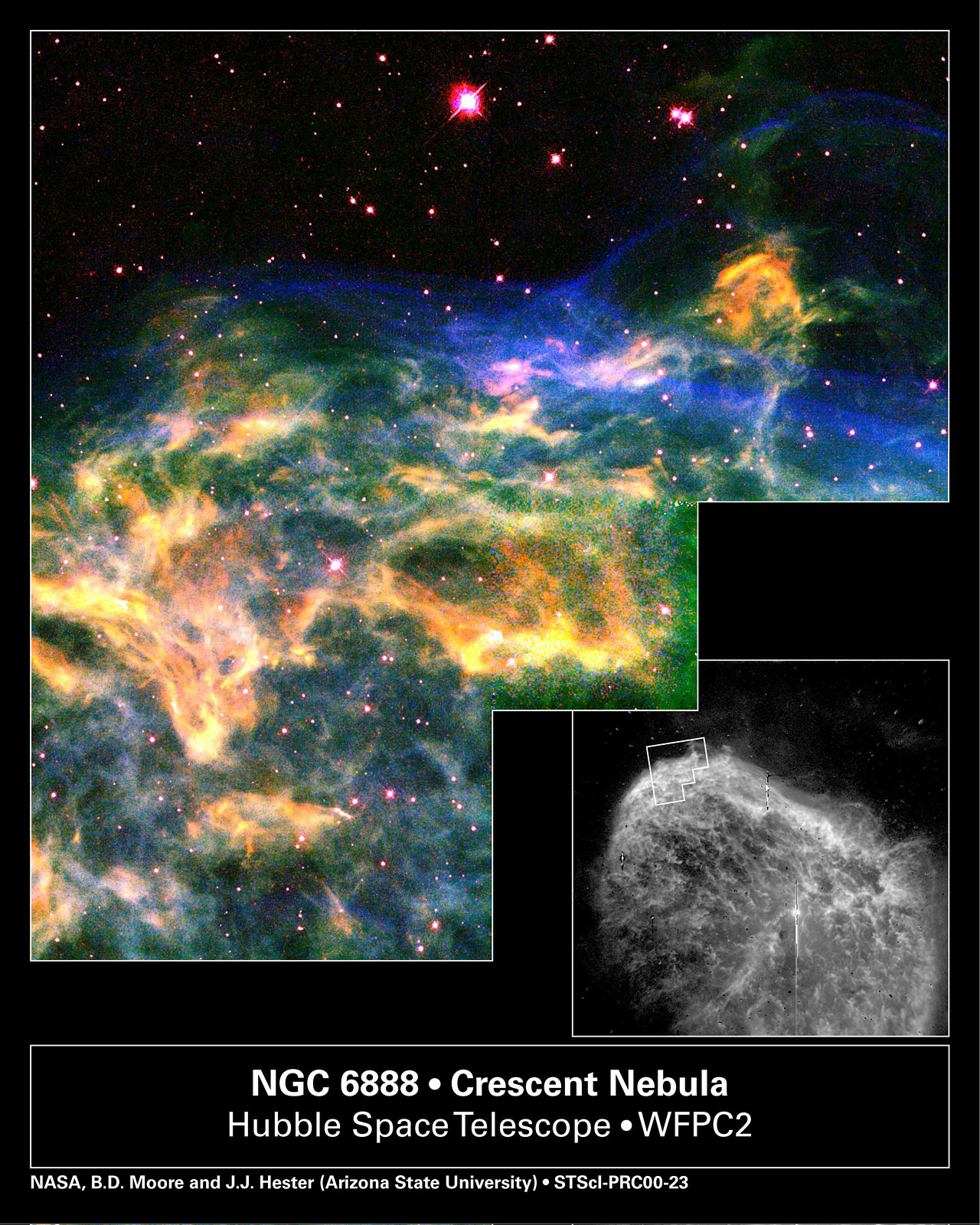
The Crescent Nebula (NGC 6888) in Cygnus, a bubble of gas about 4,700 light-years away, blown off by the fierce wind of a dying Wolf-Rayet star. Image credit: NASA, ESA, and the Hubble Heritage Team (STScI/AURA).
A bird flying south along the Milky Way
Cygnus is drawn as a great swan with its neck stretched out and wings spread, gliding down the bright band of the Milky Way. The Greeks told several stories about the bird. In one, Zeus took the form of a swan to approach Leda. In another, it is Cycnus, the devoted friend of Phaethon, who dove into the river again and again to recover the body of the fallen youth until the gods transformed him into a swan. Some storytellers placed the swan beside Lyra so that Orpheus and his harp could fly together through the summer sky.
The swan's brightest stars also form the Northern Cross, a pattern so clear it stands almost upright above the western horizon on December evenings. Its tail is the supergiant Deneb, which has its own page on this site.
Cygnus rides the densest, most star-packed stretch of the northern Milky Way. Sweep it with binoculars on a dark night and the field overflows. The dark lane splitting it, the Great Rift, is cold dust blocking the starlight behind.
Cygnus at a glance
Abbreviation
Cyg · Genitive: Cygni
Brightest Star
Deneb (α Cyg), magnitude 1.25
Signpost
The Northern Cross
Best Visibility
Summer and autumn evenings; northern sky
The bet that Stephen Hawking lost
In 1964 a rocket flight detected a powerful source of X-rays in the swan, named Cygnus X-1. Over the next decade astronomers worked out what it was: a hot blue supergiant orbiting an invisible companion so dense and massive that gas spiraling toward it heats up and screams in X-rays before it falls in. The unseen object was a black hole, the first ever identified with strong evidence, weighing around 21 times the mass of the Sun about 7,000 light-years away.
It was so striking, and so new, that in 1974 Stephen Hawking made a famous wager with fellow physicist Kip Thorne that Cygnus X-1 was not a black hole, as a kind of insurance policy against his own life's work. By 1990 the evidence was overwhelming, and Hawking conceded the bet. The swan carries the object that turned black holes from theory into fact.
Doubles, nebulae, and a record-setting star
Albireo
The swan's beak, and arguably the most beautiful double star in the sky: a golden star and a blue companion that split cleanly in a small telescope, a colour contrast people never forget.
Veil Nebula
The lacework wreckage of an ancient supernova, glowing in red and teal across a wide patch of the swan. It has its own page on this site.
61 Cygni
In 1838 Friedrich Bessel measured the tiny parallax shift of this nearby pair and calculated its distance, the first time anyone determined the real distance to a star beyond the Sun.
North America Nebula
A huge cloud of glowing hydrogen shaped like the continent, near Deneb. The Kepler planet-hunting telescope stared at this region of Cygnus for years.
Constellation data sheet
| Abbreviation | Cyg |
| Genitive | Cygni |
| Area | 804 sq. degrees (16th largest) |
| Brightest star | Deneb (alpha Cyg), mag 1.25 |
| Signature asterism | The Northern Cross |
| Landmark object | Cygnus X-1, the first identified black hole |
| Bordering constellations | Cepheus, Draco, Lyra, Vulpecula, Pegasus, Lacerta |
| Best visibility | Summer and autumn evenings, northern latitudes |
| Mythology | The swan: Zeus disguised, or Cycnus transformed |
Cygnus flies forever down the river of the Milky Way, a swan stitched from the richest star fields in the north. In its feathers hide a golden-and-blue jewel, the first star we ever measured, and the first black hole we ever found. Beauty and the abyss, sharing one bird.
More stories in the stars
Cygnus is one of many constellations carrying a Greek myth. Explore the connected sagas and figures on the Greek mythology hub.
Greek Myths Hub · Deneb · Veil Nebula · Lyra · Summer Triangle · Orion
New to stargazing? See how to observe the night sky, and if you're choosing gear, the no-hype telescope buying guide.
All Astronomy Notes · Deneb · Veil Nebula · Summer Triangle · Greek Mythology in the Night Sky