
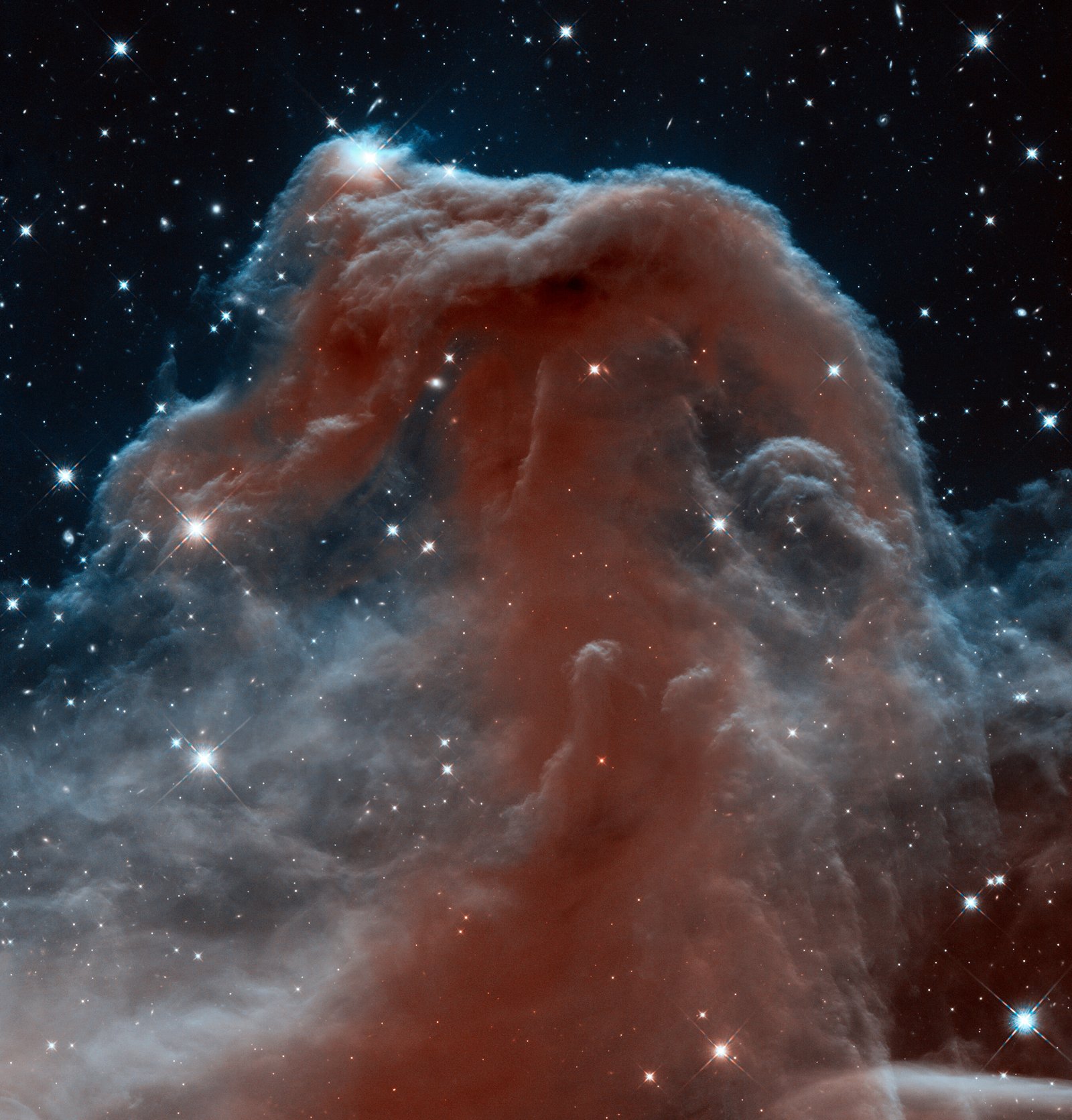
The Horsehead Nebula (Barnard 33) in Orion, imaged by Hubble in infrared for its 23rd anniversary in 2013. The dark pillar of dust sits about 1,375 light-years away, just below Orion's Belt. Image credit: NASA, ESA, and the Hubble Heritage Team (STScI/AURA).
The giant killed by a scorpion
In Greek myth Orion was a giant huntsman, strong and boastful. The stories vary, but the most famous ending is consistent: Orion bragged that he could kill any creature on Earth, and the gods sent a humble scorpion to humble him. The scorpion's sting killed the giant, and both were placed in the sky. They were set at opposite ends so that Scorpius rises in the east only after Orion has fled below the western horizon. The hunter still runs from the scorpion every night.
Orion was also tangled with the Pleiades, the seven sisters he was said to pursue across the sky, and he hunts with his two dogs, Canis Major and Canis Minor, led by Sirius, the brightest star in the night. Few figures connect to so many other constellations.
Orion's Belt is the surest signpost in the sky. Follow it down-left to Sirius, the brightest star; follow it up-right to Aldebaran and the Pleiades. The Belt is the key that unlocks the whole winter sky.
Orion at a glance
Abbreviation
Ori · Genitive: Orionis
Brightest Star
Rigel (β Ori), magnitude 0.18
Famous Stars
Betelgeuse, Rigel, and the Belt
Best Visibility
Winter evenings; visible worldwide
A blue foot, a red shoulder, and three jewels for a belt
- β Ori — Rigel. The brightest star in Orion, a blue supergiant about 860 light-years away marking the hunter's left foot. It pours out tens of thousands of times the Sun's light.
- α Ori — Betelgeuse. The orange-red supergiant on the right shoulder, a dying star destined to explode as a supernova. Its colour contrast with Rigel is the finest in the sky. (See its full profile.)
- The Belt — Alnitak, Alnilam, Mintaka. Three hot blue stars in a near-perfect row, the most recognizable asterism anywhere. Each is hundreds of light-years away and far more luminous than the Sun.
- γ Ori — Bellatrix. The "female warrior," a blue-white star marking the left shoulder.
- κ Ori — Saiph. A blue supergiant at the right knee, roughly the mirror of Rigel across the hunter's body.
A constellation built on a giant cloud
Orion sits in front of a vast complex of gas and dust, the Orion Molecular Cloud, which is busy forming new stars. That is why the hunter is packed with nebulae.
Orion Nebula (M42)
The glowing heart of the Sword, a stellar nursery visible to the naked eye and the brightest nebula in the sky. It has its own page on this site.
Horsehead Nebula (Barnard 33)
The dark dust pillar in the feature image, silhouetted against glowing hydrogen just below the Belt star Alnitak. A famous and difficult target.
Flame Nebula (NGC 2024)
An emission nebula crossed by dark dust lanes, glowing next to Alnitak. It and the Horsehead share the same patch of sky.
Barnard's Loop
An enormous, faint arc of gas curving around much of the constellation, the blown-out shell of ancient supernovae within the Orion complex.
Everyone sees something here
No constellation is read by more cultures than Orion, because its bright stars and tidy belt are impossible to miss. The ancient Egyptians saw Osiris, god of the afterlife, and some researchers argue the three pyramids of Giza echo the three Belt stars. To many cultures the Belt is "the three kings" or "the three sisters." Indigenous Australian traditions see a hunter or a canoe of fishermen. In Chinese astronomy the region forms the lunar mansion Shen. The Greek hunter is just one telling among hundreds, all gathered around the same unmistakable pattern.
Constellation data sheet
| Abbreviation | Ori |
| Genitive | Orionis |
| Area | 594 sq. degrees (26th largest) |
| Brightest star | Rigel (beta Ori), mag 0.18 |
| Signature asterism | Orion's Belt (Alnitak, Alnilam, Mintaka) |
| Meteor shower | Orionids (October), from Halley's Comet |
| Bordering constellations | Taurus, Gemini, Monoceros, Lepus, Eridanus |
| Best visibility | Winter evenings, worldwide |
| Mythology | The giant hunter, killed by Scorpius |
Orion is the figure the whole world agreed to see: a hunter mid-stride across winter, one shoulder slowly dying, one foot blazing blue, a nursery of new suns hanging from his belt. The oldest story and the newest stars, in the same three steps.
More stories in the stars
Orion is one of many constellations carrying a Greek myth. Explore the connected sagas and figures on the Greek mythology hub.
Greek Myths Hub · Betelgeuse · Orion Nebula · Pleiades · Perseus · Draco
New to stargazing? See how to observe the night sky, and if you're choosing gear, the no-hype telescope buying guide.
All Astronomy Notes · Orion Nebula · Betelgeuse · Pleiades · Greek Mythology in the Night Sky