
The Main Sequence
Once a star switches on, it settles into a long, steady adulthood — quietly fusing hydrogen into helium in its core, in near-perfect balance, for the vast majority of its life. Astronomers call this stage the main sequence, and roughly nine out of ten stars you see tonight, including the Sun, are living in it right now.
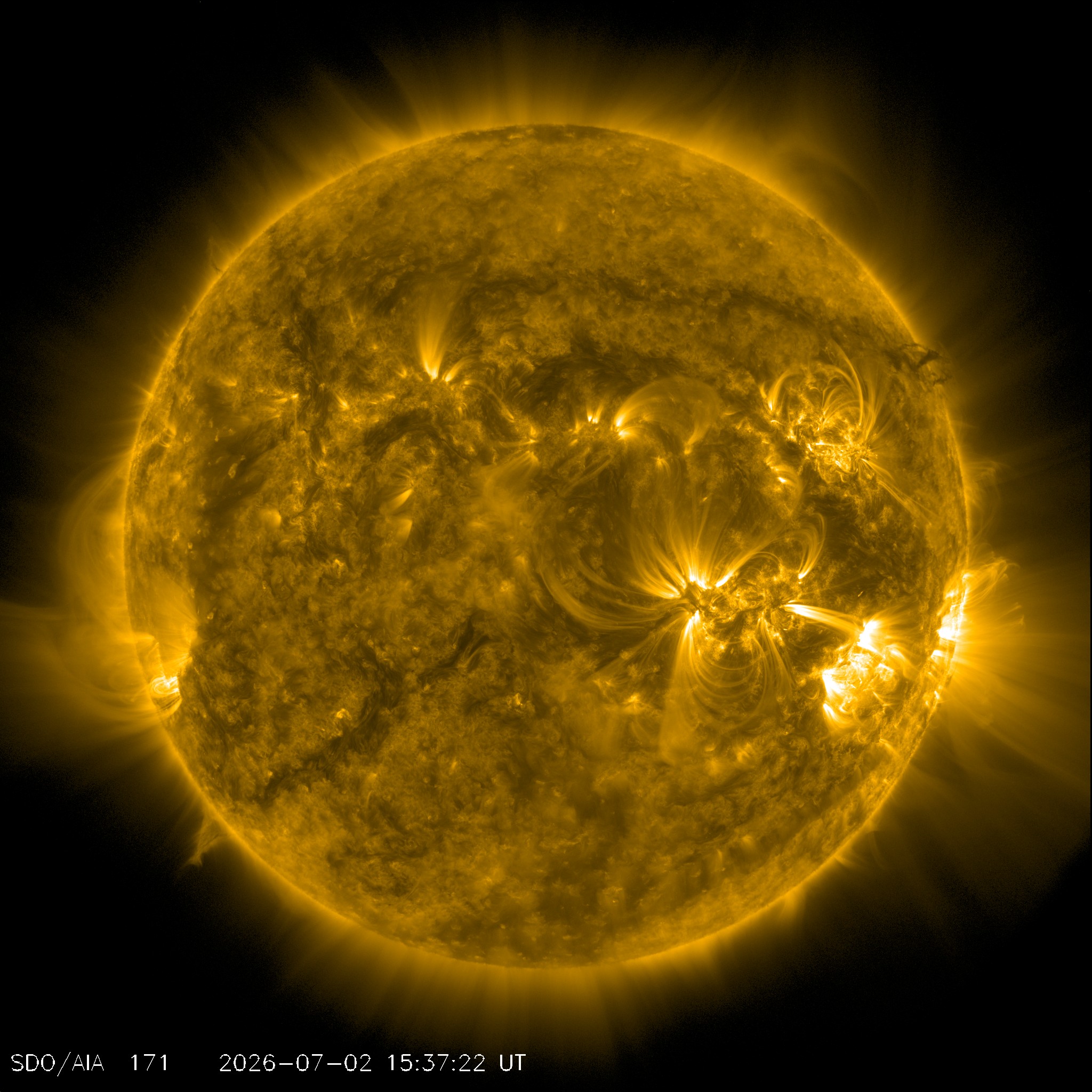
Image: NASA/SDO. Our own Sun — a textbook main-sequence star, middle-aged and stable, about halfway through a roughly ten-billion-year life of fusing hydrogen. Every star begins here; the differences are all about mass.
A star in equilibrium
A main-sequence star is a standoff held in exquisite balance. Gravity relentlessly pulls all that mass inward; the energy pouring out of hydrogen fusion in the core pushes outward. When the two match exactly — a state called hydrostatic equilibrium — the star neither collapses nor blows apart. It just shines, steadily, converting hydrogen to helium and pouring the leftover energy into space as light. This is what a "normal" star does, and it does it for a very long time: about 90% of a star's entire life is spent on the main sequence.
The one thing that sets a star's whole career is its mass. Heavy stars have enormous gravity, so they must burn ferociously to hold themselves up — which makes them blazing, blue-white, and short-lived, exhausting their fuel in just a few million years. Lightweight stars burn gently, glow cool and red, and can stay on the main sequence for trillions of years — far longer than the current age of the universe. Same process, opposite extremes, all decided at birth.
The Hertzsprung–Russell diagram
Early in the 20th century, astronomers Ejnar Hertzsprung and Henry Norris Russell plotted stars by their temperature and their brightness — and a pattern leapt out. Most stars fall along a single sweeping diagonal band, from hot-and-bright at one end to cool-and-dim at the other. That band is the main sequence, and the H-R diagram remains the single most important map in stellar astronomy: tell me where a star sits on it, and I can tell you its stage of life.
Diagram by Michael Paycer (schematic H-R diagram). Stars off the main band — red giants at upper-right, white dwarfs at lower-left — are stars that have left the main sequence, dead or dying.
"I ask you to look both ways. For the road to a knowledge of the stars leads through the atom; and important knowledge of the atom has been reached through the stars."
— Arthur Eddington, Stars and Atoms (1927)
Red dwarfs and the failed stars
Here's a fact that reshapes your sense of the galaxy: the Sun is not a typical star. By far the most common stars are red dwarfs — small, cool, dim stars less than half the Sun's mass, making up perhaps three-quarters of all stars in the Milky Way. They're so faint that not one is visible to the naked eye, yet they vastly outnumber the bright stars we actually see. Because they burn their fuel so slowly, red dwarfs will still be shining long after the Sun and every bright star has died — they are the marathon runners of stellar life.
Below the red dwarfs lies the boundary of starhood itself. Objects between about 13 and 80 times the mass of Jupiter are brown dwarfs — "failed stars" too light to sustain ordinary hydrogen fusion. They occupy the strange middle ground between the largest planets and the smallest stars, glowing dimly from their own warmth and slowly fading. The line between a brown dwarf and a red dwarf is the exact line between an object that is a star and one that merely almost became one.
Reading the main sequence right
"The main sequence is a place in space." — It isn't; it's a stage of life and a region on a graph, not a location. "Bigger stars live longer." — The reverse: massive stars burn out in millions of years, while red dwarfs last trillions. "The Sun is an average star." — It's middling in size but actually brighter and heavier than most stars, which are dim red dwarfs. "A brown dwarf is just a big planet." — It forms like a star and sits above planets in mass, but never ignites like one — a category of its own. And "stars stay on the main sequence forever" — none do; every star eventually exhausts its core hydrogen and moves on to become a red giant and, ultimately, a stellar corpse.
Star Formation · Red Giants · White Dwarfs · The Sun · Red Dwarf Planets · Stars Hub · Glossary
Return to Michael Paycer
Explore Michael Paycer's professional SQL Server, cloud, ETL, API, automation, and consulting pages, or continue browsing the personal interests section.