
Titan
Titan is Saturn's giant moon and the strangest familiar place in the Solar System — a frigid world wrapped in a thick orange atmosphere, where it rains methane, rivers carve valleys, and seas the size of the Great Lakes lap dark shores. Beyond Earth, nowhere else has weather quite like it.
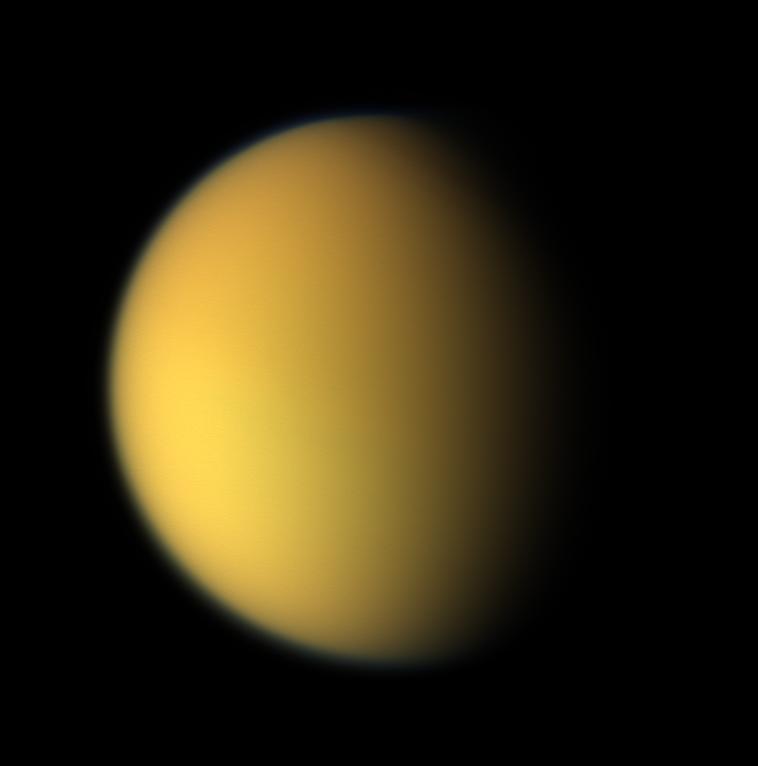
Image credit: NASA/JPL-Caltech/Space Science Institute. Titan in natural color from Cassini — a featureless orange ball, because its thick smoggy atmosphere hides the surface from ordinary cameras. Radar and infrared were needed to map the world beneath.
Orbits
Saturn
Size
2nd largest moon — bigger than Mercury
Atmosphere
Thick nitrogen — denser than Earth's
Surface liquid
Methane & ethane, at about −179 °C
An Earth-like world running on methane instead of water
Titan is the second-largest moon in the Solar System and the only one with a substantial atmosphere — a hazy shroud of nitrogen even thicker than Earth's air, tinted orange by a smog of complex organic molecules. That haze hides the surface so completely that for centuries Titan was just a fuzzy dot; only when Cassini's radar and infrared instruments (and the Huygens lander) pierced the murk did its world come into focus.
And what a world. At around −179 °C, water is frozen rock-hard, but methane plays the role water plays on Earth: it forms clouds, falls as rain, carves river valleys, and pools into lakes and seas near the poles — some larger than North America's Great Lakes. Titan has a full weather cycle, dunes of dark organic sand, and, beneath its icy crust, a hidden ocean of liquid water. In January 2005 the European Huygens probe, carried across the Solar System by Cassini, parachuted down and landed on Titan's surface — the most distant landing humanity has ever made. NASA's Dragonfly rotorcraft is set to fly from site to site across Titan in the 2030s.
A moon you can find beside Saturn
Titan is the one moon of Saturn within easy reach of a backyard telescope. At around magnitude 8 it is far too faint for the naked eye, but a small telescope shows it clearly as a steady point of light near Saturn — noticeably brighter than the planet's other moons. Like Jupiter's Galilean moons, Titan changes position from night to night as it orbits, completing a lap of Saturn about every 16 days.
There is no surface detail to see from Earth — Titan is a tiny dot, and even Hubble sees only a smudge. But there's a real thrill in the identification: that faint speck beside the ringed planet is a world larger than Mercury, with rain, rivers, and seas. Use an astronomy app to tell Titan apart from Saturn's fainter moons, and watch it circle the planet over a couple of weeks.
New to stargazing? See how to observe the night sky, and if you're choosing gear, the no-hype telescope buying guide.
Named for the elder gods — and not a water world
Titan takes its name from the Titans of Greek myth — the elder race of giant deities, led by Cronus (whom the Romans called Saturn), who ruled before the Olympian gods overthrew them. It is a fitting name for the largest moon of the planet named after their king. Saturn's smaller moons continue the theme, many named for individual Titans and giants.
The persistent misconception is that Titan's seas are water. They are not — at Titan's deep cold, water is as hard as granite. Its rivers and seas are liquid methane and ethane, natural gas kept liquid by the frigid temperatures. Another misunderstanding is that Titan's thick, organic-rich air means it is habitable or "Earth-like" in a friendly sense; it is Earth-like in its processes — weather, rivers, seas — but utterly alien and lethally cold in its chemistry. That very strangeness is why scientists study it: Titan may resemble a deep-frozen version of the early Earth, before life began.
Primary sources: NASA — Titan and NASA/JPL Photojournal PIA06230 (Cassini's View of Titan, natural color). Image credit: NASA/JPL-Caltech/Space Science Institute.
Beneath an orange sky it rains methane onto frozen ground, feeding rivers that run to seas we could sail — a world that mimics our own in every gesture except the one that matters, running on gas where Earth runs on water.
More worlds around worlds
Moons (hub) · Our Moon · Galilean Moons · Titan · Enceladus · Triton
More astronomy notes
Continue through the astronomy section for beginner-friendly notes, image credits, viewing tips, history, and the stories behind the night sky.
Enceladus · Saturn's Rings · Moons · Astronomy · Interests