
Enceladus
Enceladus is a small, brilliant-white moon of Saturn that hides a global ocean beneath its ice — and can't keep the secret. Through cracks at its south pole it fires towering fountains of water into space, handing scientists a free sample of an alien sea, and making it one of the best places to look for life.
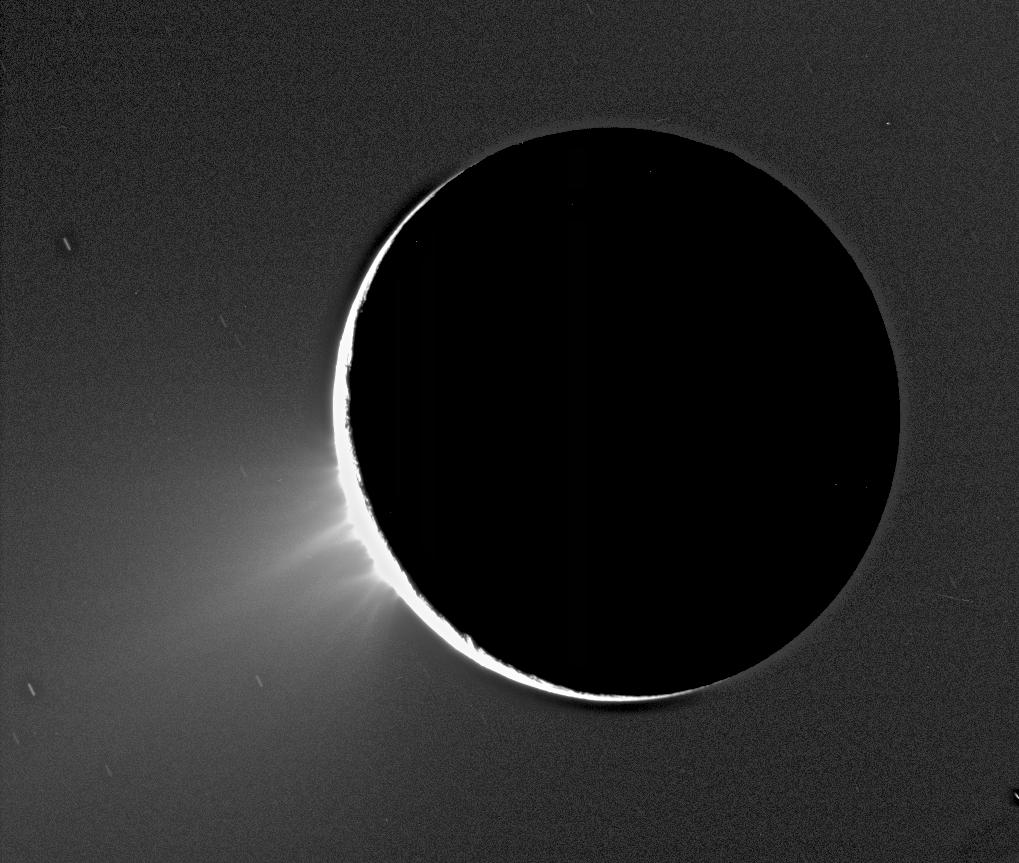
Image credit: NASA/JPL-Caltech/Space Science Institute. Enceladus backlit by the Sun, its jets of water ice glowing as they spray from the south-polar "tiger stripes" — imaged by the Cassini spacecraft.
Orbits
Saturn
Diameter
~500 km (small — very bright, fresh ice)
Hidden feature
A global subsurface ocean of liquid water
Erupts
Water-ice geysers from south-polar "tiger stripes"
A tiny moon that gives away its ocean
Enceladus is only about 500 kilometers across — you could tuck it inside the state of Arizona — yet it is one of the most exciting worlds in the Solar System. Its surface is a dazzling shell of fresh, clean ice, so reflective it bounces back nearly all the sunlight that hits it. But the real story is underneath: a global ocean of liquid water, kept from freezing by heat generated as Saturn's gravity flexes the moon.
Enceladus can't contain that ocean. Near its south pole run four warm fractures nicknamed the "tiger stripes," and from them erupt continuous jets — geysers of water ice and vapor towering hundreds of kilometers into space. Some of that spray falls back as snow; much of it escapes to form one of Saturn's rings (the diffuse E ring). When Cassini flew straight through the plumes, it tasted the ocean without ever landing: it found salts, organic molecules, and signs of hydrothermal activity on the ocean floor. Liquid water, energy, and organic chemistry — the three things life is thought to need — all in one small moon. That is why Enceladus sits near the top of every list of places to search for life beyond Earth.
A serious challenge beside a bright planet
Let's be honest: Enceladus is a tough backyard target. At around magnitude 11.7 it is faint, and it hides in the glare close to brilliant Saturn, often lost against the planet and rings. A telescope of roughly 8 inches or more, a steady night, and a good chart give you a fighting chance to glimpse it as a dim speck near the ring plane — a genuine observing accomplishment.
There is nothing to see but a faint point; the geysers and tiger stripes are spacecraft views, not backyard ones. But as with the other icy moons, the reward is in knowing: that barely-there dot beside Saturn is a 500-kilometer snowball spraying an entire ocean into space. For most observers, Enceladus is best appreciated through Cassini's images and understood rather than hunted — though the challenge is there for those who want it.
New to stargazing? See how to observe the night sky, and if you're choosing gear, the no-hype telescope buying guide.
A buried giant, and a moon that punches above its size
Enceladus is named for one of the Giants of Greek myth — the Gigantes, who warred against the Olympian gods. In the legend, the giant Enceladus was struck down and buried beneath Mount Etna in Sicily, and his restless stirring was said to cause the volcano's eruptions and earthquakes. It is an oddly perfect name for a small moon whose defining feature is eruptions bursting from below.
The natural misconception is that a moon this small must be dead — a frozen, inert snowball. Enceladus is the opposite: it is one of the most geologically active worlds we know, precisely because Saturn's tides keep its interior warm. Another misunderstanding is that its plumes are like volcanic ash; in fact they are closer to a colossal, continuous spray of ocean water flash-freezing in the vacuum of space — which is exactly what makes them so scientifically precious, letting us sample an alien ocean directly.
Primary sources: NASA — Enceladus and NASA/JPL Photojournal PIA07758 (Enceladus plumes). Image credit: NASA/JPL-Caltech/Space Science Institute.
A moon small enough to lose beside its planet, spraying an entire ocean into the dark — and in that spray, salts, organics, and the warm chemistry of a seafloor: everything life is thought to need, offered up for free.
More worlds around worlds
Moons (hub) · Our Moon · Galilean Moons · Titan · Enceladus · Triton