The Moon
The Moon is the one other world every human being has watched their whole life — the maker of tides, the keeper of the month, the only place beyond Earth people have walked. It is also our companion in a locked embrace, forever showing us the same familiar face.
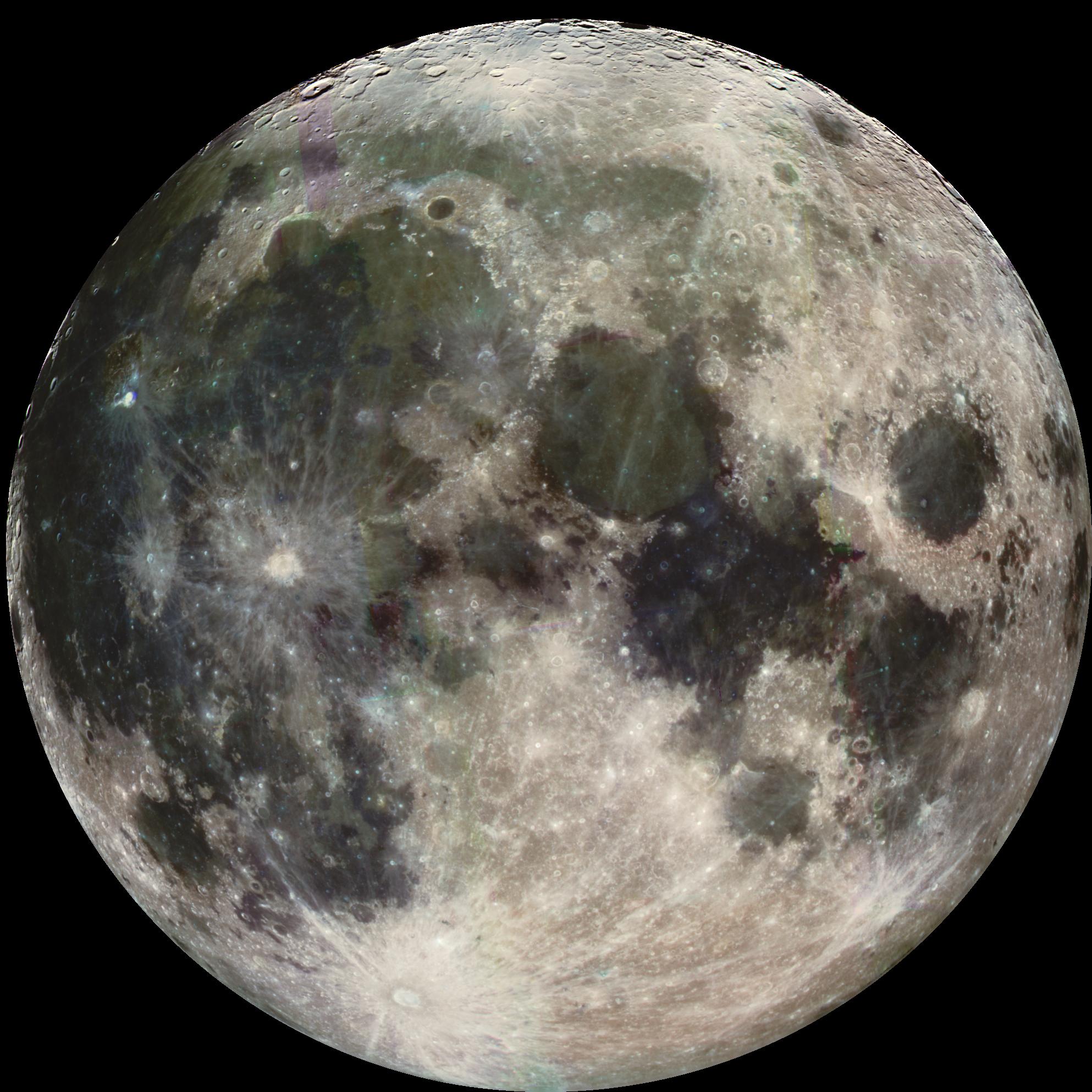
Image credit: NASA/JPL/USGS. Earth's Moon photographed by the Galileo spacecraft in 1992. The dark patches are ancient lava plains (maria); the bright rayed crater near the bottom is Tycho.
Distance
~384,400 km (about 30 Earths away)
Diameter
3,474 km (about 1/4 of Earth's)
Orbit & spin
Both ~27.3 days — tidally locked
Formed
~4.5 billion years ago, from a giant impact
A locked companion born from a collision
The Moon is Earth's only natural satellite and, relative to its planet, one of the largest moons in the Solar System. Its surface is a record of violence: dark plains of ancient lava (the maria, Latin for "seas") set against brighter, heavily cratered highlands. With no atmosphere to erode them, its craters and even the astronauts' footprints will last for millions of years.
The most likely story of its birth is the giant-impact hypothesis: about 4.5 billion years ago a Mars-sized world (nicknamed Theia) slammed into the young Earth, and the debris blasted into orbit gathered into the Moon. That origin explains why the Moon's makeup so closely matches Earth's outer layers. Since then, the Moon has become tidally locked — it spins exactly once per orbit, so the same hemisphere always faces us. And its gravity raises the ocean tides, giving most coastlines two highs and two lows a day.
The phases
As the Moon circles Earth each month, we see different fractions of its sunlit half — the familiar cycle of phases:
Phase diagram by Michael Paycer. The cycle from one new moon to the next takes about 29.5 days.
The richest target in the sky — and the easiest
The Moon is the most rewarding object for a beginner and a lifelong favorite for veterans. It needs no equipment to enjoy, and even cheap binoculars transform it. The counterintuitive tip: don't observe the full Moon for detail. When it's full, sunlight hits it head-on and the surface looks flat and washed out. The magic is along the terminator — the line between lunar day and night — where low sunlight throws long shadows and craters and mountains leap into three dimensions. A first-quarter or gibbous Moon is far more striking through a telescope than a full one.
Sweep binoculars along the terminator to find craters, the great dark maria, and mountain ranges. A small telescope reveals hundreds of craters, the ray systems splashing out from Tycho and Copernicus, and rilles winding across the plains. Come back a few nights running and watch the shadows shift as the phase changes — the same crater looks completely different night to night.
Best time
Not full — a crescent, quarter, or gibbous Moon, when shadows along the terminator show relief.
Naked eye
The maria (the "man in the Moon"), phases night to night, and the occasional lunar eclipse — safe to watch.
Binoculars & scope
Craters, mountain ranges, the bright rays of Tycho and Copernicus, and shadows that change hour by hour.
New to stargazing? See how to observe the night sky, and if you're choosing gear, the no-hype telescope buying guide.
The "dark side," the giant Moon, and the goddess of the hunt
The most famous misconception is the "dark side of the Moon." There is a far side we never see from Earth — because the Moon is tidally locked — but it is not dark. It receives just as much sunlight as the near side; when we have a new moon, the far side is fully lit. A second myth is that the Moon looks huge near the horizon because it's closer or magnified — it isn't; the "Moon illusion" is a trick of the brain, and the Moon is the same size overhead. And the supermoon, while real (a full moon near its closest approach), is only slightly larger and brighter than average — dramatic in headlines, subtle in the sky.
To our ancestors the Moon was a deity and a timekeeper — the root of the very word "month." The Romans personified it as Luna; the Greeks as Selene, who drove the Moon across the night sky, and later linked the Moon to Artemis, goddess of the hunt and the wild. Cultures worldwide read the phases as a calendar and a source of myth, from harvest moons to hunter's moons.
Primary sources: NASA — Earth's Moon and NASA/JPL Photojournal PIA00405 (Earth's Moon, Galileo). Image credit: NASA/JPL/USGS.
It is the one other world we all know by heart — close enough to read the tides by, locked forever face-to-face with us, and the only ground beyond our own that human boots have ever touched.
More worlds around worlds
Moons (hub) · Our Moon · Galilean Moons · Titan · Enceladus · Triton
More astronomy notes
Continue through the astronomy section for beginner-friendly notes, image credits, viewing tips, history, and the stories behind the night sky.
Moons · Galilean Moons · Solar Eclipses · Astronomy · Interests