
Pale Blue Dot
On February 14, 1990, a spacecraft 6 billion kilometers from Earth turned its cameras back toward home. What it captured — a pale blue dot in a scattered ray of sunlight — became one of the most important photographs ever taken, and inspired one of the most moving reflections on human existence ever written.
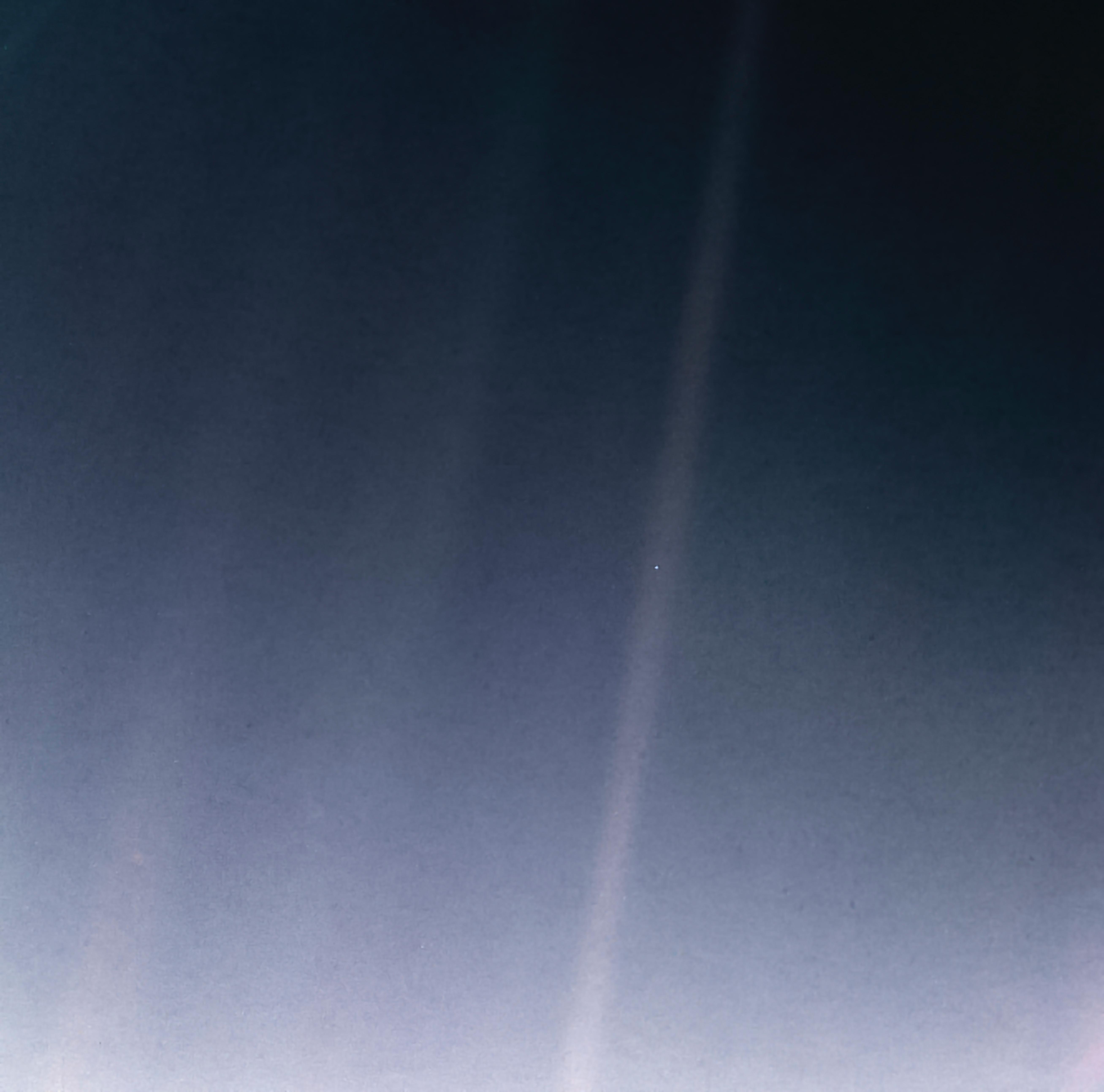
Pale Blue Dot — remastered edition released by NASA for the 30th anniversary in 2020. Earth appears as a tiny fraction of a pixel in a scattered ray of sunlight near the center of the image. Image credit: NASA/JPL-Caltech.
Date Taken
February 14, 1990 — Valentine's Day
Distance
6 billion km (3.7 billion miles) from Earth
Spacecraft
Voyager 1, launched September 5, 1977
Earth's Size
Approximately 0.12 pixels — barely an eighth of a pixel
How Carl Sagan made it happen
In 1977, NASA launched Voyager 1 on a grand tour of the outer solar system. The spacecraft flew past Jupiter in 1979, Saturn in 1980, and by 1989 had completed its primary science objectives and was heading out of the solar system entirely. Its cameras were scheduled to be shut down to conserve power.
Carl Sagan had served on the Voyager imaging team from the beginning. As early as 1981, while Voyager was still relatively close to the outer planets, he began lobbying NASA to do something no spacecraft had done before: turn the cameras around and photograph the solar system from the outside — to look back at the world that had launched it.
The obstacles
NASA had concerns. The cameras were scientific instruments, not commemorative devices. Pointing them anywhere near the Sun risked permanent optical damage. The spacecraft's nuclear batteries were fading. And the picture, whatever it showed, would offer no new science — only perspective. For eight years, the request went unmet.
The approval
In late 1989, with Voyager 1 beyond the orbit of Neptune and the camera platform about to be permanently powered down, NASA agreed. The cameras would be turned on one last time, not to study Jupiter or Saturn, but to look back at where we had come from. The date set for the photographs: February 14, 1990.
What Voyager 1 captured that day
On that Valentine's Day, Voyager 1's camera platform was oriented and 60 individual frames were captured across a wide swath of the solar system. The resulting mosaic — called the Family Portrait — covered six of the nine planets then recognized: Venus, Earth, Jupiter, Saturn, Uranus, and Neptune. Mercury was too close to the Sun to photograph safely. Mars and Pluto were too faint to resolve.
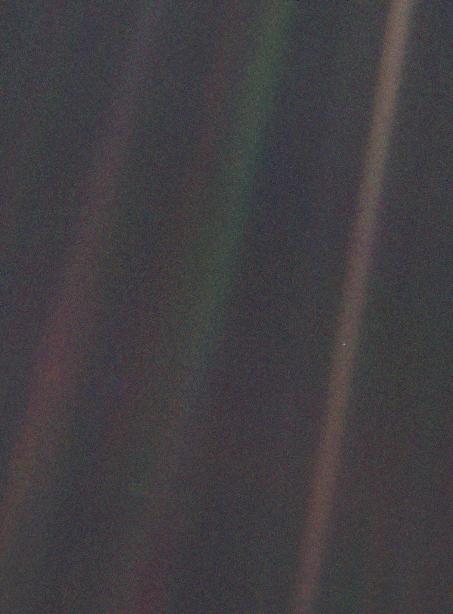
Earth appears in one of the 60 frames of the sequence. In that frame, our planet occupies approximately 0.12 pixels. It is visible as a pale blue point of light sitting within one of several scattered rays of sunlight — optical artifacts produced by sunlight diffracting through Voyager's cameras after passing near Earth during the exposure. The blue color is genuine: sunlight scattering off Earth's oceans and nitrogen-rich atmosphere gives our planet its characteristic hue.
After the images were taken, the cameras were shut down permanently. Voyager 1 continued outward, crossing the boundary into interstellar space in August 2012 — becoming the first human-made object to leave the solar system. As of 2026, it is nearly 26 billion kilometers from Earth and still transmitting.
"A mote of dust suspended in a sunbeam"
The image sat in NASA's archives for several years. When Carl Sagan finally saw the processed photograph, he was moved to write a reflection that has since become one of the most quoted passages in the history of science communication.
On October 13, 1994, he delivered the words as part of a public lecture at Cornell University. They were published that same year in his book Pale Blue Dot: A Vision of the Human Future in Space.
"Look again at that dot. That's here. That's home. That's us. On it everyone you love, everyone you know, everyone you ever heard of, every human being who ever was, lived out their lives."
Sagan went on to describe Earth as "a lonely speck in the great enveloping cosmic dark" — a pale blue dot on which all of human history, all joy and suffering, every empire and every love story, had played out. He noted that the photograph underscores how foolish it is, in his words, to think that "our posturings" and "imagined self-importance" are supported by the cosmos in any way.
The passage did not end in despair. Sagan's conclusion was the opposite: because this is all we have, we have a responsibility to preserve it. He called for kindness toward one another and for the protection of "the pale blue dot, the only home we've ever known." The lecture, recorded on video, has been viewed tens of millions of times. It remains one of the most-shared pieces of science communication in the internet era.
What you are actually looking at in the image
The Pale Blue Dot image is not a telephoto portrait. It is the result of Voyager 1's wide-angle camera capturing the solar system at a distance of 6 billion kilometers — a scale at which even a planet the size of Earth is geometrically negligible. Understanding the image requires knowing what each element represents.
The blue color
Earth appears blue for the same reason it looks blue from orbit: Rayleigh scattering in the atmosphere preferentially scatters short-wavelength blue light in all directions, while its liquid-water oceans reflect the same blue back toward space. From 6 billion kilometers, those physical properties still hold.
The rays of light
The dramatic streaks of scattered sunlight crossing the image are optical artifacts — lens flare produced when sunlight diffracts through the geometric aperture of Voyager's camera. Earth happens to sit within one of these beams. The sunbeam did not exist in space; it was created by the camera's own optics during the exposure.
The 0.12 pixels
Earth subtends an angle of roughly 0.4 arcseconds as seen from Voyager's position. The camera's resolution is limited, so Earth spreads slightly beyond its true angular size due to diffraction and pixel response — producing the roughly 0.12-pixel dot. The entire planet's disk is smaller than the smallest resolvable feature of the imaging system.
Three-color composite
The final image was assembled from three separate exposures taken through blue, green, and violet spectral filters. The filters were combined to produce a color composite that approximates how Earth would appear to the human eye from that distance — which is to say, blue, and very, very small.
Pale Blue Dot — Remastered (2020)
Updated color balance and noise reduction applied by NASA/JPL-Caltech for the 30th anniversary. Image credit: NASA/JPL-Caltech.
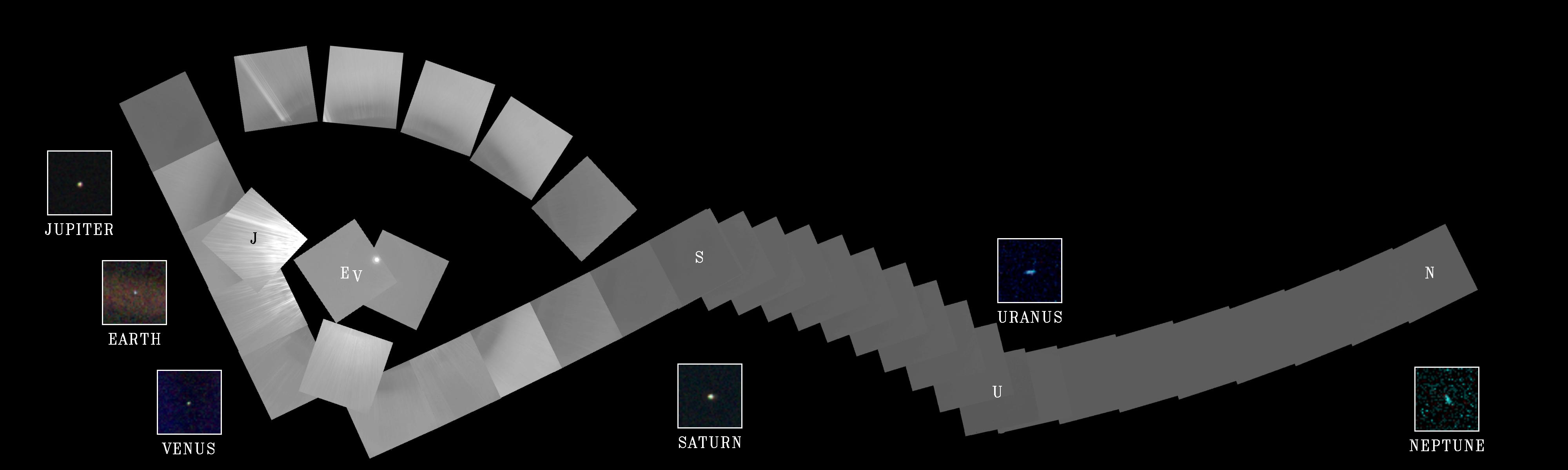
The Family Portrait (1990)
The full 60-frame mosaic in which the Pale Blue Dot appears. Six planets are visible: Venus, Earth, Jupiter, Saturn, Uranus, and Neptune. Image credit: NASA/JPL.
Original 1990 Image
The unprocessed version as first released. Earth appears in the right-center sunbeam, a tiny pale point against the blackness of space. Image credit: NASA/JPL.
Photographs that change perspective
The Pale Blue Dot is often compared to Earthrise, the photograph taken by Apollo 8 astronaut William Anders on December 24, 1968, showing Earth rising over the lunar horizon. Both images accomplished something rare: they changed how humans saw themselves in context.
Earthrise showed Earth as a vivid, detailed sphere — beautiful and isolated against the black of space. The Pale Blue Dot went further. Shot from within our own solar system, it demonstrated that even from close by, on the cosmic scale, Earth barely exists as a resolvable point of light. The planet that seems so vast when you are standing on it disappears into noise at interplanetary distances.
The image influenced environmentalism, inspired philosophical writing, and entered the cultural vocabulary in a way that few photographs have. The phrase "pale blue dot" now appears in policy documents, speeches, and everyday conversation as shorthand for Earth seen from a cosmic perspective — fragile, isolated, and irreplaceable.
In 2006 and again in 2013, NASA's Cassini spacecraft repeated the gesture from Saturn. Looking back at 1.4 billion kilometers, Cassini photographed Earth as a faint dot through Saturn's rings. Sagan had died in December 1996 — a decade before Cassini's first portrait. He never saw those photographs, but the tradition he started continues.
In 2020, for the 30th anniversary, NASA released a remastered version of the original Pale Blue Dot using modern image-processing techniques. The colors are more accurate, the noise reduced, but the point remains the same: that tiny pale dot is everything humanity has ever known.
Primary sources: NASA/JPL-Caltech, Pale Blue Dot Revisited (PIA23645), NASA/JPL, Voyager Family Portrait (PIA00451), NASA/JPL, original Pale Blue Dot (PIA00452), and Carl Sagan, Pale Blue Dot: A Vision of the Human Future in Space (Random House, 1994). All Voyager and NASA images are public domain, courtesy NASA/JPL-Caltech. The quoted passage from Sagan is reproduced for educational purposes; copyright remains with the Estate of Carl Sagan.
On that mote of dust, suspended in a sunbeam, is everyone you have ever known — a pale blue reminder that the whole of human history has unfolded on a single fragile pixel, and that it falls to us to be kind to it and to one another.
More astronomy notes from Michael Paycer
Continue through the astronomy section for beginner-friendly notes, image credits, viewing tips, history, and the stories behind the night sky.
Astronomy · Ring Nebula · Pleiades · Andromeda Galaxy · Betelgeuse · Polaris