
Solid Defenses
Some of the greatest players won by being impossible to beat. The Caro-Kann and French against 1.e4, the Queen's Gambit Declined and Slav against 1.d4 — sound structures, safe kings, and the patient art of absorbing pressure and grinding it down.
Support the centre,
keep the king safe,
avoid weaknesses.
vs 1.e4: Caro-Kann, French
vs 1.d4: QGD, Slav
all rock-solid.
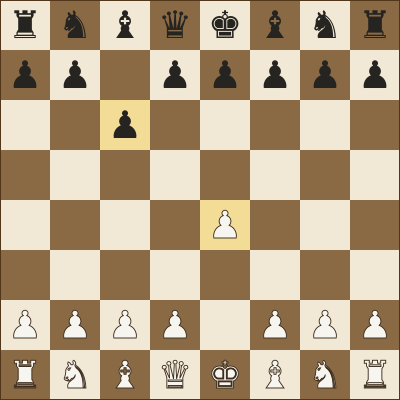
The Caro-Kann, French, QGD, and Slav are usually studied in isolation, but they are variations on a single theme: meet the opponent's first move with a sound, hard-to-crack structure and win on patience rather than tactics. Grouped together, they teach one transferable skill — how to defend a solid position and convert small advantages — that Petrosian, Karpov, and Capablanca turned into world titles. If you want a low-risk, low-maintenance repertoire that almost never gives you a bad position, this is where to start.
Structures that don't break
Not every game has to be a knife fight. Some of the strongest players in history built their careers on defenses whose first virtue is soundness — positions so structurally solid they are almost impossible to attack, where you absorb the opponent's initiative and then outplay them in the long game. Petrosian, Karpov, and Capablanca made this style an art form.
The solid defenses share a common creed: support the centre, keep the king safe, avoid weaknesses, and trust that a sound structure will tell over forty moves. They are the antidote to sharp, memorization-heavy theory — you win not by knowing move twenty, but by understanding the structure you are heading for.
The solid defenses
The Caro-Kann Defense
1.e4 c6 2.d4 d5
The "grandmaster's defense" to 1.e4 — support d5 with the c-pawn and keep the light-squared bishop active. Petrosian, Karpov, and Anand's fortress.
The French Defense
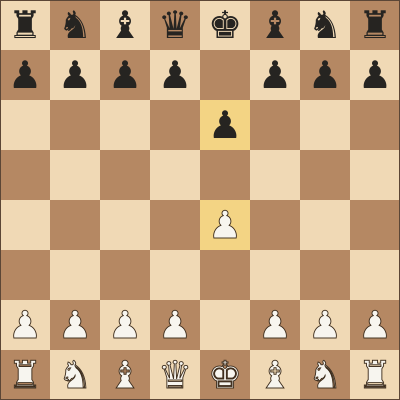
1.e4 e6 2.d4 d5
Compact pawn chains, stubborn resilience, and clear pawn-break plans (...c5, ...f6). Accept a little cramp for a rock-solid structure and long-term counterchances.
Queen's Gambit Declined
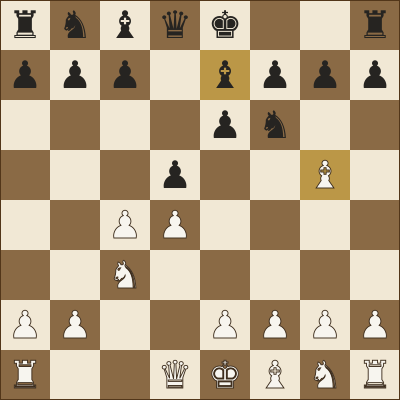
1.d4 d5 2.c4 e6
Chess's great fortress — the most classical answer to 1.d4, almost impossible to break down. The backbone of championship play from Capablanca to Carlsen.
The Slav Defense
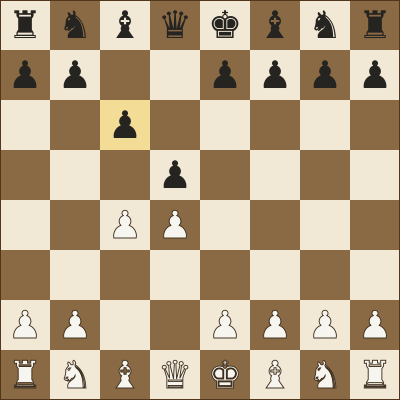
1.d4 d5 2.c4 c6
Support d5 with the c-pawn instead of the e-pawn, keeping the light-squared bishop free. All the solidity of the QGD without the "bad bishop" problem.
The art of solidity
These defenses are not passive — they are patient. The Caro-Kann and the Slav both solve the same problem (freeing the light-squared bishop) that the French and the QGD accept as a trade-off for extra solidity. Master any of them and you master a way of playing: absorb, neutralize, and grind. For the sharper, unbalancing side of Black's repertoire, see the Dutch Defense and the King's Indian; for the full picture of what to play, the Simple Repertoire Ideas page ties it all together.
Frequently Asked Questions
The most solid defenses are the Caro-Kann (1...c6) and French (1...e6) against 1.e4, and the Queen's Gambit Declined (2...e6) and Slav (2...c6) against 1.d4. All prioritize a sound pawn structure and king safety over sharp tactics, and all have anchored the repertoires of positional world champions like Capablanca, Petrosian, and Karpov.
The Caro-Kann (1...c6) is often called the most solid answer to 1.e4 — the 'grandmaster's defense.' It supports d5 with the c-pawn while keeping the light-squared bishop active, giving Black a sound structure with fewer of the passive-bishop problems of the French. The French is equally solid but accepts a slightly cramped light-squared bishop.
No — they are patient, not passive. Solid defenses absorb the opponent's initiative, neutralize it through sound structure and piece trades, and then play for an advantage in the long game or endgame. Karpov and Petrosian showed that this 'absorb and grind' style wins world championships. It's low-risk, but fully capable of playing for a win.
They apply the same idea against different first moves: the Caro-Kann supports ...d5 with ...c6 against 1.e4, and the Slav does the same against 1.d4's Queen's Gambit. Both keep the light-squared bishop free (unlike the French and QGD, which block it with ...e6). Many solid players use the Caro-Kann and Slav together as a matched pair.
Yes — they teach the fundamentals of good chess (structure, development, king safety) with minimal tactical risk, and they rarely leave you in a bad position out of the opening. They demand positional understanding to play for a win, but as a foundation they are among the safest, most instructive choices for improving players.