
Flank & Hypermodern Systems
Refuse to occupy the centre with pawns — pressure it from the wings instead. The English, the Réti, the London, and Bird's: four flexible, low-theory systems built on the hypermodern idea that a big centre is a target, not a trophy.
Fianchetto bishops,
strike with c/f pawns,
keep the move order fluid.
English (1.c4)
Réti (1.Nf3)
London & Bird's
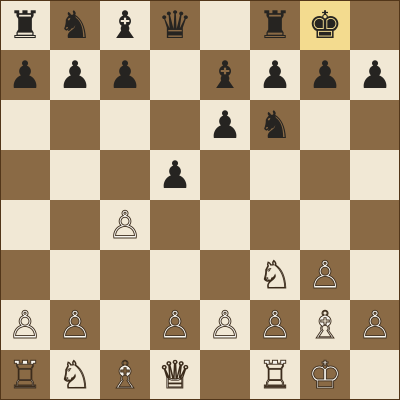
Encyclopedias file the English under "1.c4," the Réti under "1.Nf3," the London under "1.d4," and Bird's under "1.f4" — scattering four openings that are really one idea. Grouped together they reveal their shared DNA: control the centre from the flanks, fianchetto, transpose freely, and win by understanding structures rather than memorizing lines. For a player short on study time, this is the most efficient cluster in chess — learn the mindset once and four openings come with it.
Let them build the centre — then attack it
For most of chess history, the rule was simple: occupy the centre with pawns. Then, in the 1920s, a group of players led by Richard Réti and Aron Nimzowitsch turned the rule on its head. Their hypermodern idea: a big pawn centre is not automatically a strength — it can be a target. Let the opponent build it, pressure it from the wings with pieces and flank pawns, and watch it become a liability.
The flank systems that grew from that idea share a family resemblance: they fianchetto bishops onto long diagonals, strike at the centre with c- and f-pawns rather than occupying it, and — crucially — keep the move order flexible. They are low on forced theory and high on understanding, which makes them some of the most practical openings you can learn.
The flank systems
The English Opening
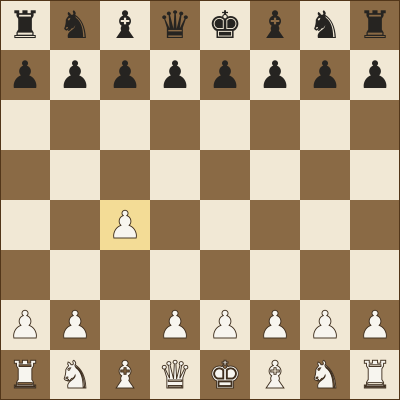
1.c4
Control d5 from the flank with the c-pawn. A reversed Sicilian a tempo up, endlessly transpositional, and a favourite of Botvinnik, Kasparov, and Carlsen.
The Réti Opening
1.Nf3 d5 2.c4
The purest hypermodern move order — pressure d5 with c4 and g3, gambit the c-pawn, or transpose into the English, Catalan, or a King's Indian Attack. Réti beat Capablanca with it.
The London System
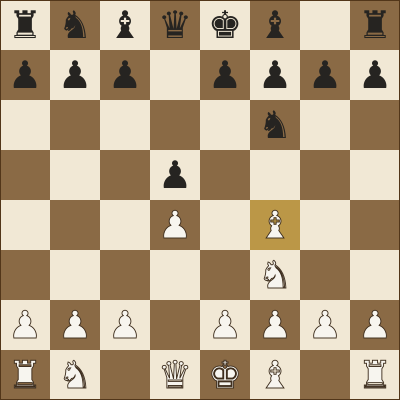
1.d4 d5 2.Nf3 Nf6 3.Bf4
The ultimate low-maintenance system: nearly the same Bf4/e3/Bd3/c3 setup against almost anything. Structure over complexity, from club level to world championship.
Bird's Opening
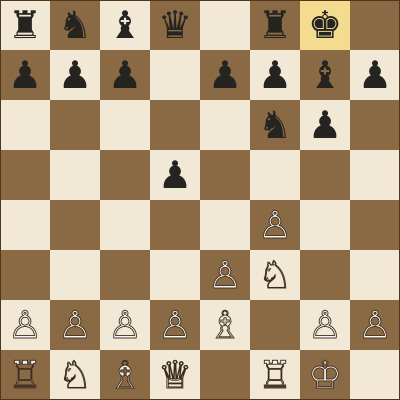
1.f4
The Dutch a tempo up — an offbeat reversed-Dutch surprise weapon that drags opponents out of their preparation, with the sharp From's Gambit to know.
One family, one flexible mindset
What unites these openings is not a move — it is a way of thinking. Because none of them commit the centre early, they melt into one another: a Réti can become an English or a Catalan; a London can adopt Réti-like fianchetto plans; a Bird's reaches reversed-Dutch structures. Learn one and you are halfway to the rest, because the underlying ideas — fianchetto, flank pressure, delayed central breaks — carry across all of them. The counterpart from Black's side is the hypermodern King's Indian Defense, which cedes the centre only to storm it later.
Frequently Asked Questions
Hypermodern openings, pioneered by Richard Réti and Aron Nimzowitsch in the 1920s, treat a big pawn centre as a target rather than a goal. Instead of occupying the centre with pawns, White (or Black) controls it from the wings with fianchettoed bishops and flank pawns, then attacks it. The English, Réti, and King's Indian are classic examples.
A system opening is one where you play nearly the same setup regardless of what the opponent does — the London System (Bf4, e3, Bd3, c3, Nbd2) and the King's Indian Attack are the best examples. Systems are low on forced theory: you learn the ideas and plans once, then apply them against many opponent formations. Ideal for players short on study time.
The London System is the easiest — you repeat almost the same setup against nearly everything, so you focus on plans instead of variations. The English is the most ambitious flank opening, and the Réti the most flexible and transpositional. Bird's is an offbeat surprise weapon. All reward understanding over memorization.
Yes — that flexibility is their greatest strength. A Réti can transpose into the English, the Catalan, or a King's Indian Attack; the English can reach Queen's Gambit or Sicilian-reversed structures; Bird's reaches reversed-Dutch positions. Skilled flank players use move order to steer opponents into structures they know best.
Very much so. Because they minimize forced theory and emphasize structural understanding, flank and system openings let improvers spend their study time on plans, pawn structures, and middlegame ideas — the skills that actually decide games — rather than memorizing twenty-move variations.