The Taimanov & Kan Sicilians
The most flexible Sicilians of all — Black plays ...e6 and keeps the pawn structure fluid, delaying commitments and inviting White to show a hand first. The Taimanov (...Nc6, ...Qc7) and the Kan (...a6).
Kan: B41–B43
Taimanov: B44–B49
English Attack: B48
...e6 and ...Qc7 keep
every pawn break (...b5,
...d5, ...e5) available.
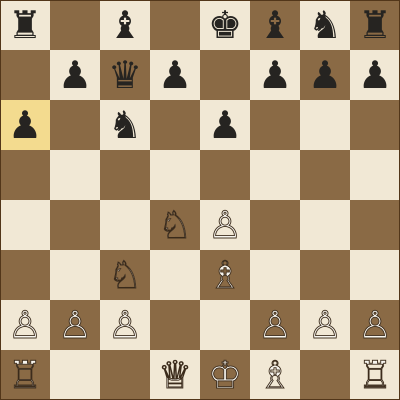
Where the Najdorf and Dragon commit to sharp, concrete structures, the Taimanov and Kan keep everything fluid. Black develops with ...e6, ...Qc7, and ...a6, delaying ...d6, ...Nf6, and the choice of pawn break until White commits. This flexibility is a weapon: Black can steer toward a Scheveningen (...d6), a Hedgehog (...b6, ...d6), or a quick ...b5-...Bb7 expansion depending on White's setup. The cost is a slightly slower fight for the initiative — but for players who prefer manoeuvring and understanding over memorization, these are the ideal Sicilians.
The Taimanov System
Named after Mark Taimanov, this system develops the knight to c6 and the queen to c7, pressuring e4 and keeping the option of ...Nf6, ...b5, and ...Bb7. Black avoids an early ...d6, staying flexible. White's most testing try is the English Attack (Be3, Qd2, 0-0-0, g4), but Black's ...a6 and ...b5 counterplay on the queenside gives fully double-edged chances. The Taimanov has been a top-level mainstay for decades.
The Kan (Paulsen) System
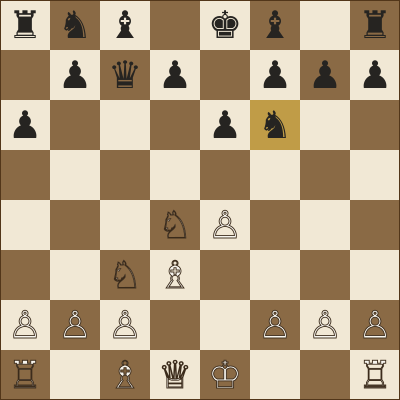
The Kan is even more flexible: the early ...a6 prevents Nb5 and prepares ...b5 without committing the queen's knight to c6 (keeping the c-file and the ...Nc6 or ...Nbd7 choice open). Black can transpose into Hedgehog or Scheveningen structures at will. Kasparov used the Kan to sidestep heavy theory while retaining full winning chances — it is the ultimate move-order chameleon.
The English Attack & White’s Tries
English Attack
Against both systems, White’s sharpest plan is Be3, Qd2, 0-0-0 and g4-g5, storming the kingside. Black counters with ...a6, ...b5, ...Bb7 and queenside play — a race where precise move-order matters more than raw memorization.
Quiet Setups
White can also play the positional Be2/0-0 or the Maróczy-style c4. Here Black’s flexibility shines: ...Nf6, ...Be7, ...0-0 and a well-timed ...d5 or ...b5 break equalize comfortably and keep the game rich.
Frequently Asked Questions
The Taimanov arises after 1.e4 c5 2.Nf3 e6 3.d4 cxd4 4.Nxd4 Nc6 5.Nc3 Qc7. Black develops flexibly with ...Nc6 and ...Qc7, pressuring e4 and keeping the pawn structure fluid. It avoids the sharpest forced theory of the Najdorf while offering full winning chances — a favourite of manoeuvring players.
The Kan (also called the Paulsen) arises after 1.e4 c5 2.Nf3 e6 3.d4 cxd4 4.Nxd4 a6. The early ...a6 stops Nb5 and prepares ...b5, while keeping the knight's development flexible. It is one of the most flexible Sicilians, able to transpose into Hedgehog or Scheveningen structures depending on White's setup.
Both play ...e6 for flexibility. The Taimanov commits the knight early with ...Nc6 and plays ...Qc7; the Kan delays ...Nc6 with an early ...a6, keeping even more options open (the queen's knight can go to c6, d7, or stay home). The Kan is the more chameleon-like of the two.
White's sharpest try is the English Attack (Be3, Qd2, 0-0-0, g4) aiming at Black's king. White can also play positionally with Be2 and 0-0, or grab space with c4 (a Maróczy-style bind). Black's flexible structure allows accurate, structure-based responses to each.
Very much so. The Taimanov and Kan are the go-to Sicilians for players who want a sound, flexible, understanding-based game rather than memorizing 20+ moves of Najdorf or Dragon theory. They reward good middlegame judgment and move-order awareness.