The Sveshnikov & Kalashnikov
A revolution in Sicilian theory: Black plays the "anti-positional" ...e5, voluntarily creating a hole on d5 — and gets so much dynamic piece activity and space in return that it became a World Championship main weapon.
Sveshnikov: B33
Kalashnikov: B32
Pelikan: B33
Concede the d5-square,
gain space, the bishop
pair, and piece play.
Classical principles say never create a hole in front of a backward pawn. The Sveshnikov does exactly that with 5...e5, conceding the d5-square and leaving a backward pawn on d6. For decades it was considered dubious. Then Evgeny Sveshnikov and later a generation of elite players proved that Black's compensation — space on the queenside, the bishop pair, active piece play, and concrete tactical resources — fully justifies the structural concession. Magnus Carlsen's use of the Sveshnikov in the 2018 World Championship sealed its status as one of Black's most respected, fighting answers to 1.e4.
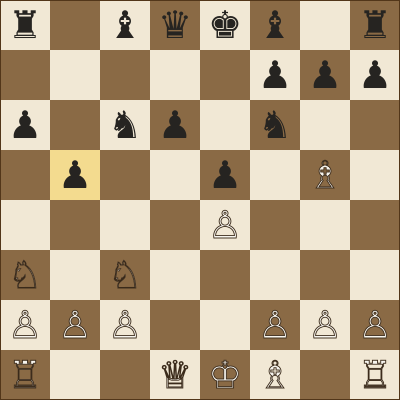
The Sveshnikov Main Line: 6.Ndb5
The critical tabiya. After 5...e5, White's knight leaps to b5 eyeing the d6-hole, but Black kicks it with ...a6 and ...b5, gaining queenside space and the bishop pair. The backward d6-pawn and the d5-hole are real, but so is Black's dynamic activity: ...Be6, ...Nbd7-b6, and pressure down the c-file and against e4. This is one of the most heavily analyzed positions in modern chess — and one of the most rewarding to understand.
Why 5...e5 Works
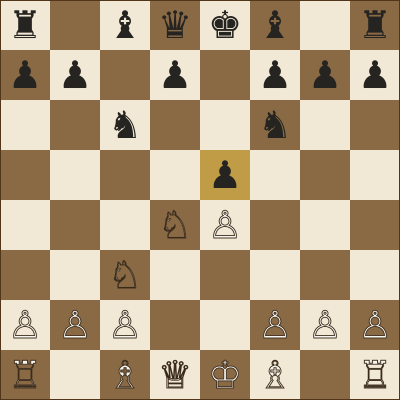
The move that broke the rules. By playing ...e5, Black gains a tempo on the d4-knight and grabs central space — at the cost of the d5-square and a backward d6-pawn. The point: White struggles to exploit the d5-hole because Black's active pieces and the ...f5 break generate constant counterplay. The bishop pair and queenside space give long-term compensation that modern engines and grandmaster practice have fully validated.
The Kalashnikov: An Immediate Cousin
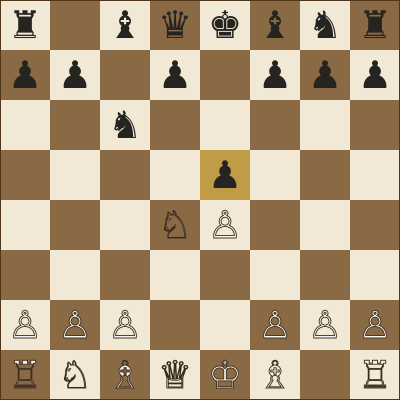
The Kalashnikov reaches a similar ...e5 structure a move earlier, without committing to ...Nf6. After 4...e5 5.Nb5 d6, Black accepts the same d5-hole but keeps a slightly different piece configuration, often steering toward ...a6, ...Be7 and ...Nf6 setups. It is a close relative of the Sveshnikov and appeals to players who want the ...e5 ideas with an independent move order.
Frequently Asked Questions
The Sveshnikov (also called the Pelikan) arises after 1.e4 c5 2.Nf3 Nc6 3.d4 cxd4 4.Nxd4 Nf6 5.Nc3 e5. Black plays the bold ...e5, conceding the d5-square and a backward d6-pawn in exchange for space, the bishop pair, and dynamic piece activity. Once considered dubious, it is now one of Black's most respected answers to 1.e4.
Because Black gets full dynamic compensation. Although ...e5 creates a hole on d5 and a backward d6-pawn, Black gains a tempo on the knight, central and queenside space, the bishop pair after ...b5, and active piece play with ...f5 breaks. Modern practice and engine analysis confirm the compensation is real and lasting.
The main line runs 5...e5 6.Ndb5 d6 7.Bg5 a6 8.Na3 b5, when Black kicks the knight and expands on the queenside. Play continues with ...Be7 (or ...Be6), ...0-0, and a fight over the d5-square and the ...f5 break. It is one of the most analyzed positions in chess.
The Kalashnikov arises after 4.Nxd4 e5 (a move earlier than the Sveshnikov, without ...Nf6). After 5.Nb5 d6, Black reaches a similar ...e5 structure with the d5-hole, but with a different piece setup. It is a close cousin of the Sveshnikov offering an independent move order.
Yes — famously in the 2018 World Championship match against Fabiano Caruana, Carlsen used the Sveshnikov as his main defence to 1.e4. Its blend of solidity and dynamism made it an ideal choice at the highest level, cementing its modern reputation.