
The Accelerated Dragon
Black fianchettoes fast — 1.e4 c5 2.Nf3 Nc6 3.d4 cxd4 4.Nxd4 g6 — without committing to ...d6, sidestepping the feared Yugoslav Attack and gaining the quick ...d5 break. The price: allowing White's Maróczy Bind.
Maróczy Bind: B36–B39
5.Nc3 lines: B34–B35
Hyperaccelerated: B27
Keeps the ...d5 break
in one move, avoiding
the Yugoslav Attack.
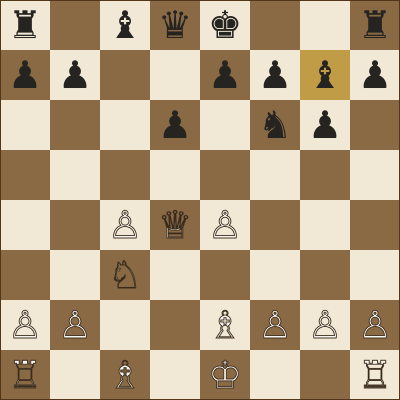
In the ordinary Dragon, Black plays ...d6 before ...g6, which lets White launch the Yugoslav Attack (Be3, Qd2, 0-0-0, h4-h5) — the most dangerous try in all of chess. The Accelerated Dragon reverses the idea: Black plays ...g6 immediately and keeps the ...d6 move in reserve, so the freeing break ...d5 comes in a single tempo. This dodges the Yugoslav Attack entirely. White's most testing reply is the Maróczy Bind (5.c4), grabbing space with pawns on c4 and e4 — a positional clamp that Black meets with patient manoeuvring and the ...b5 or ...f5 pawn breaks.
The Maróczy Bind: 5.c4
White's critical response. The pawns on c4 and e4 form the Maróczy Bind, denying Black the ...d5 and ...b5 breaks and gripping the centre. Black's plan is patient: trade a pair of knights, complete development with ...0-0 and ...Bd7/...a5, and prepare to challenge the bind with ...b5 (after ...a6, ...Rb8) or the freeing ...f5. Ulf Andersson and Bent Larsen showed how Black can slowly equalize — this is a strategic, manoeuvring battle rather than a tactical shootout.
The Non-Maróczy Lines: 5.Nc3
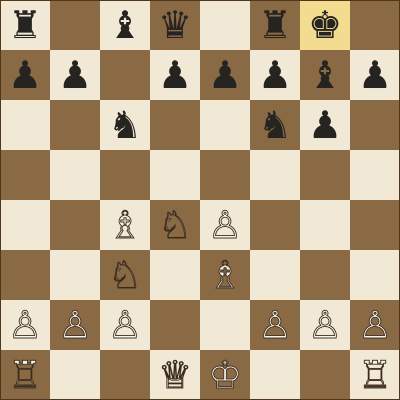
If White declines the bind with 5.Nc3, the game takes on a Dragon-like character — but crucially without the ...d6/Yugoslav structure. Black gets the accelerated ...d5 break: after 7.Bc4 0-0, the thematic ...Qa5 or ...d5 equalizes comfortably. Because Black hasn't played ...d6, White's attacking chances are far reduced compared to the standard Dragon, which is the whole point of the Accelerated move order.
Practitioners & Practical Value
Ulf Andersson & Bent Larsen
The great positional players demonstrated how to hold and outplay from the Maróczy Bind — patient manoeuvring, well-timed pawn breaks, and superb endgame technique made the Accelerated Dragon respectable at the top level.
A Practical Weapon
For club and tournament players, the Accelerated Dragon is a low-maintenance Sicilian: it dodges the most heavily theoretical attacking lines and channels play into understandable, structure-based middlegames — ideal for players who want a Sicilian without memorizing 20 moves of Najdorf theory.
Frequently Asked Questions
The Accelerated Dragon arises after 1.e4 c5 2.Nf3 Nc6 3.d4 cxd4 4.Nxd4 g6. Black fianchettoes the bishop to g7 without first playing ...d6, keeping the freeing ...d5 break available in a single move. Its main purpose is to sidestep the Yugoslav Attack that Black faces in the ordinary Dragon.
The Maróczy Bind is White's main answer to the Accelerated Dragon: 5.c4, establishing pawns on c4 and e4. This 'bind' denies Black the ...d5 and ...b5 breaks and grabs central and queenside space. Black responds with patient manoeuvring and eventually the ...b5 or ...f5 pawn breaks. It is a strategic, positional struggle.
Because it avoids the Yugoslav Attack — the ordinary Dragon's most dangerous line, where White castles queenside and storms the kingside with h4-h5. By delaying ...d6, the Accelerated Dragon reaches the ...d5 break faster and denies White that attacking setup. The trade-off is allowing the Maróczy Bind.
Yes. It is fully sound and has been used by strong grandmasters like Larsen, Andersson, and Carlsen. It is considered a solid, lower-theory Sicilian — Black accepts a slightly passive but very resilient position in the Maróczy Bind in exchange for avoiding the sharpest attacking theory.
The Hyperaccelerated Dragon plays ...g6 even earlier: 1.e4 c5 2.Nf3 g6, before committing the knight to c6. It aims to reach Accelerated Dragon structures while offering extra move-order flexibility, though it allows White some independent tries like an early c4 or 3.c3.