Sicilian: Kan, Taimanov, Four Knights & Sveshnikov
The flexible Sicilian systems — from Karpov's Kan to Sveshnikov's razor-sharp ...f5 systems. Complete coverage of the e6-family and the powerful e5-outpost systems.
Kan: B41–B43
Taimanov: B44–B47
Sveshnikov: B33
Delay commitments,
keep piece options
open until forced.
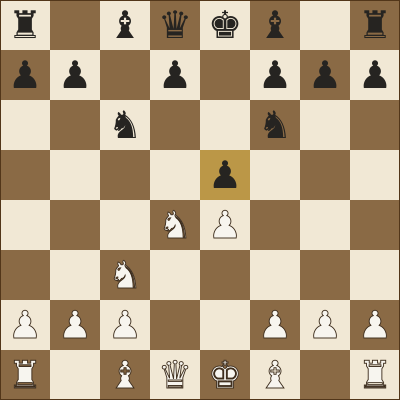
The Kan, Taimanov, and Four Knights share a common thread: Black plays 2...e6 or 2...Nc6 without immediately committing to the sharp Najdorf or Dragon structures. This "keep options open" philosophy means Black can choose between many different pawn structures and piece arrangements based on how White plays. The result is positions where preparation matters less and understanding matters more — exactly the type of Sicilian many players prefer over the hyper-theoretical Open Sicilian main lines.
The Kan Variation: 4...a6
After 1.e4 c5 2.Nf3 e6 3.d4 cxd4 4.Nxd4 a6 — the Kan tabiya (highlighted). Black delays committing the queenside knight, keeping maximum flexibility. White has many plans; Black's position is solid and adaptable.
The 4...a6 move is the defining feature of the Kan. By playing ...a6 immediately, Black: (1) prepares queenside expansion with ...b5; (2) keeps the Nc6/Nd7 option open; (3) avoids White's early Nb5 ideas. The cost is one tempo — but in the Kan, Black's subsequent flexibility more than compensates.
The universal setup with ...Nf6, ...Be7 (or ...Bc5 then ...Be7), and ...d6 gives Black a solid Scheveningen-like structure that can arise from many move orders. White has more space but Black's position has no weaknesses. The plan of ...Nc6, ...0-0, and ...Qc7 then counterattack in the center or queenside is Black's standard approach.
Kan's Flexibility: Transpositional Power
The Kan can transpose to: the Scheveningen (with ...Nf6+...d6+...e6), the Taimanov (with ...Nc6), the Najdorf structure (if Black plays ...d5 aggressively), or unique Kan setups with ...b5-b4 queenside play. This makes preparing specifically against the Kan very difficult — White never quite knows what pawn structure Black intends to reach.
Karpov's Contribution
Anatoly Karpov made the Kan (and related Paulsen/Taimanov structures) his primary Sicilian weapon. His approach was to use the flexibility to avoid the sharpest theoretical battlefields, creating complex positions where his deep positional understanding and endgame mastery would prevail. Karpov's Kan games are model studies in "controlled complexity" — dynamic positions without the wild tactics of the Najdorf or Dragon.
The Taimanov Variation: 4...Nc6
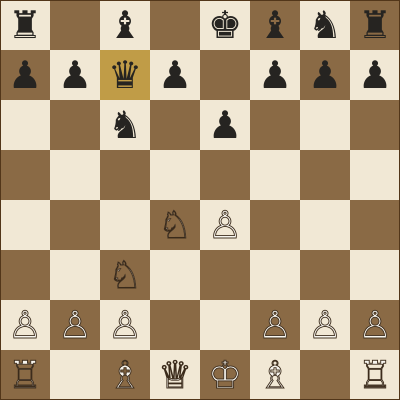
Where the Kan plays 4...a6, the Taimanov immediately develops the queenside knight with 4...Nc6, directly attacking the d4 knight. After 5.Nc3, Black's most popular response is 5...Qc7 — overprotecting the Nc6 and eyeing the e5-square — or 5...a6 transposing to the Kan with the knight already placed.
The English Attack (Qd2 + f3 setup with opposite-side castling) is White's most aggressive approach. White castles queenside and attacks on the kingside with g4-g5. Black responds with queenside counterplay: ...b5-b4, ...Bb7, and ...0-0-0 (sometimes Black also castles queenside, creating a race). The resulting positions are sharp and require concrete calculation rather than general principles.
Taimanov vs. Kan: Key Differences
- Taimanov 4...Nc6 puts immediate pressure on d4
- Kan 4...a6 keeps the knight flexible (Nc6 or Nd7)
- Taimanov has more direct, forcing play early
- Kan has more transpositional subtlety
- Both reach similar long-term pawn structures
Taimanov Specialties
- The Nge7 development — not Nf6 — is a key Taimanov idea
- ...Nge7-g6 puts the knight on an active square while keeping f6 for pieces
- The Nc6+Nge7 formation covers d4 and e5 from different angles
- Michael Adams and Boris Gelfand have been Taimanov specialists at GM level
The Four Knights Sicilian: 5...e6
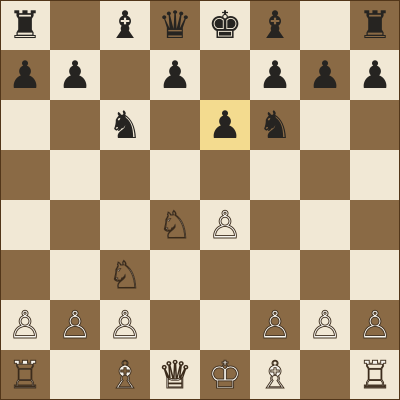
The Four Knights arises after 5...e6, placing all four knights on the board immediately. This move sets up a hybrid position: Black has Nc6 (development), Nf6 (development and pressure on e4), and the solid e6 pawn structure. White has Nc3 (development) and Nxd4 (controlling d4).
From here, White can go to the Taimanov lines (Ndb5), the Scheveningen (Bd3 with the center intact), or other setups. The Four Knights is one of the most versatile Sicilian systems — Black can reach the Sveshnikov (if ...e5 is played later), the Taimanov, or the Scheveningen depending on what White plays.
After 6.Ndb5 d6 7.Bf4 e5 8.Bg5, the position resembles the Sveshnikov — Black gets the backward d6-pawn but the active e5 square in return. This is often called the "Four Knights Sveshnikov" and is distinct from the pure Sveshnikov in that Black's a-pawn hasn't committed to a6 yet.
Kramnik was one of the most effective Four Knights practitioners at the GM level. His approach was to use the opening's flexibility to reach Scheveningen-like positions without entering the absolute main Scheveningen theory, then outplay opponents in complex middlegames and technique-driven endgames. The Four Knights served as a reliable, theory-efficient repertoire choice throughout his career — the type of "know the ideas, not the lines" opening that suited his style.
The Sveshnikov (Pelikan) Variation: ...e5!
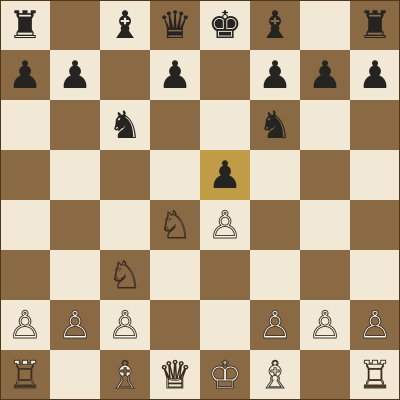
The Sveshnikov is defined by 5...e5, the move that once branded this system as dubious. By pushing the e-pawn forward, Black: (1) kicks the Nd4 immediately; (2) claims the e5-square for a future knight; (3) accepts a permanent backward d6-pawn and a weak d5 square. The strategic logic is that the e5 outpost for Black's knight fully compensates for these structural concessions.
The main line develops to extreme tension. After 7.Bg5, White pins the Nf6 and pressures d5. Black plays 7...a6 8.Na3 b5 — gaining queenside space while driving White's knight to an awkward position. After 9.Nd5 Be7 10.Bxf6 Bxf6, Black has the bishop pair but White has the powerful d5 outpost for a knight. After 11.c3, White stabilizes before pushing c4 or otherwise consolidating the d5 advantage.
The system's signature idea is the aggressive ...f5! counterattack — Evgeny Sveshnikov's own theoretical contribution. By striking in the center with the f-pawn, Black challenges White's d5 knight and opens lines for the pieces. This required precise calculation but demonstrated that Black's position was fully dynamic and not merely defensive. In the 1990s Kramnik, Shirov, and Leko used it to hold their own against world-class opposition, and Magnus Carlsen made it his main defense in the 2018 World Championship.
The d5 Weakness: What It Means in Practice
White's d5 outpost looks imposing on paper — a knight on d5 is beautifully centralized. But in practice, Black can often exchange this knight (...Nxd5 exd5) or live with it for many moves while generating queenside counterplay. The real issue is not d5 per se but whether White can coordinate all pieces to maintain a lasting structural advantage. In practice, Black's counterplay is almost always sufficient.
The Rossolimo Alternative
To avoid the Sveshnikov entirely, White can play the Rossolimo Variation: 1.e4 c5 2.Nf3 Nc6 3.Bb5. This sidesteps the Sveshnikov (and the Dragon) by not playing 3.d4. The Rossolimo leads to very different positions — structural rather than tactical — and is a popular Anti-Sicilian alternative used by Magnus Carlsen and other modern GMs who prefer avoiding Sveshnikov theory.
When Evgeny Sveshnikov and Lev Polugaevsky began playing this system in the 1970s, it was considered objectively bad due to the d5 weakness and the backward d6-pawn. The consensus was "White just occupies d5 and Black has a permanently inferior structure." Then a generation of elite players — Kramnik, Shirov, Leko, van Wely — took it up in the 1990s and the assessment changed completely: their success demonstrated that Black's dynamism and activity were more than adequate compensation. Today the Sveshnikov is considered one of Black's most reliable and combative choices against 1.e4, fully respectable at the highest level.
Move Order Subtleties: Kan vs. Taimanov vs. Sveshnikov
| Variation | Key Move 4 | Key Move 5 | Pawn Structure | Style |
|---|---|---|---|---|
| Kan (Paulsen) | 4...a6 | ...Nf6 or ...Nc6 | e6+d6 (flexible) | Strategic, flexible, transpositional |
| Taimanov | 4...Nc6 | 5...Qc7 or 5...a6 | e6+d6 or e6+d5 | Active, direct, piece-oriented |
| Four Knights | 4...Nf6 (after 2...Nc6) | 5...e6 | e6+d6 (solid) | Universal, hybrid, theory-efficient |
| Sveshnikov | 4...Nf6 (after 2...Nc6) | 5...e5 (!) | e5+d6 (backward) | Dynamic, combative, outpost-focused |
The move order reveals important choices. After 1.e4 c5 2.Nf3, Black can play 2...e6 (Kan/Taimanov territory) or 2...Nc6 (Sveshnikov/Four Knights territory). This initial choice often determines the entire opening strategy — though transpositional tricks abound. Players who know all four systems have maximum flexibility; many GMs maintain repertoires that can reach different structures based on White's choices.
Choosing Your Sicilian System: A Practical Guide
Play the Kan if...
You value flexibility above all. You like positions where the structure isn't committed early. You want to be able to reach many different pawn structures depending on White's play. You appreciate Karpov's style of "strategic complexity without forced tactics." Theory requirement: medium — you need to know the main setups but not deep forced lines.
Play the Taimanov if...
You want active piece play from the start and like the English Attack (Qd2-f3 setups). You prefer playing ...Qc7 and active piece development over queenside expansion. Michael Adams used this throughout his career as a reliable, theory-efficient system. Theory requirement: medium-high in the English Attack lines.
Play the Sveshnikov if...
You want maximum dynamism and are willing to accept structural weaknesses for active piece play. You like the ...e5 outpost structure and don't mind defending the d6 backward pawn. Sveshnikov's credo: play for the win, always. Theory requirement: high — the Sveshnikov main line is deeply theoretical. You must know the ...f5 counterattack ideas.
Champions of the Flexible Sicilian
Anatoly Karpov — The Kan's Champion
Karpov's use of the Kan and related Paulsen structures was a defining feature of his playing style. Where others sought forcing lines, Karpov created complex, flexible positions where his superior understanding of pawn structures and endgame technique would prevail. His Kan games against elite opposition demonstrated that the variation could compete at the absolute highest level.
Evgeny Sveshnikov — The System's Architect
Sveshnikov spent decades proving his own system: the backward d6-pawn and weak d5 could be compensated by active piece play. His innovations — particularly the ...f5 counterattack — transformed the variation from a questionable gamble into a theoretically respectable opening that all 1.e4 players must know how to face. Kramnik, Shirov, and Leko carried it into the 1990s elite, and Magnus Carlsen's use of it in the 2018 World Championship completed its journey to full main-line respectability.
Frequently Asked Questions
The Kan (also called the Paulsen) is 1.e4 c5 2.Nf3 e6 3.d4 cxd4 4.Nxd4 a6 — Black delays committing the queenside knight, keeping both Nc6 and Nd7 as options. The flexibility is the point: Black can reach Scheveningen, Taimanov, or unique Kan structures depending on White's play. Karpov was the greatest Kan practitioner, using it to create "controlled complexity" that suited his positional style perfectly.
The Taimanov is 4...Nc6 immediately after the Open Sicilian moves, directly pressuring the d4 knight. After 5.Nc3 Qc7, Black has an active queen and pieces that coordinate well. The English Attack (Qd2-f3 with opposite-side castling) is White's sharpest response. The Taimanov was Mark Taimanov's primary weapon and remains popular — Michael Adams used it regularly at the top level.
The Sveshnikov is 5...e5 — Black pushes the e-pawn, accepting a backward d6-pawn and weak d5 square in exchange for the powerful e5 outpost for a knight. After 6.Ndb5 d6 7.Bg5 a6 8.Na3 b5, the position is extremely sharp. Sveshnikov himself developed its key ideas, like the ...f5 counterattack, and Carlsen used it in the 2018 World Championship. Today it's considered one of Black's most reliable and combative Sicilian choices.
The Four Knights arises from 1.e4 c5 2.Nf3 Nc6 3.d4 cxd4 4.Nxd4 Nf6 5.Nc3 e6 — all four knights are developed before any pawns advance beyond the initial two squares. From here, the game can transpose to Taimanov, Sveshnikov, or Scheveningen structures. Kramnik used the Four Knights as a theory-efficient choice that could adapt to White's setup without entering the deepest forced lines of any single variation.
After 5...e5, Black creates the e5 square for a knight. If Black can place a knight on e5 — and White can't easily challenge it — the piece becomes a dominant, centralized force. The tradeoff: d5 becomes weak (White's knight often sits there) and the d6-pawn is backward. In practice, Black's queenside counterplay with ...b5-b4, ...a5, and piece activity compensates. The position requires both sides to play concrete, calculating chess rather than relying on structural principles.
The key distinction: Kan (4...a6) keeps the queenside knight uncommitted — Black can play Nc6 or Nd7 later. Taimanov (4...Nc6) immediately develops the knight, exerting direct pressure on d4. The Kan is more flexible and transpositional; the Taimanov is more direct and concrete. Both reach similar middlegame structures eventually, and experienced players know both to have full flexibility in their Sicilian repertoire.
Further Reading & Study
Books
- Sveshnikov, The Sicilian Pelikan: Move by Move
- McDonald, Play the Kan — comprehensive Kan guide from Black's perspective
- Negi, 1.e4 vs. The Sicilian III — White's approach to Kan/Taimanov/Sveshnikov
Online Resources
- Lichess Opening Explorer — B33/B41-B47
- Chessable — Sveshnikov and Kan courses
- YouTube — Kasparov Sveshnikov games (highly instructive)
Model Games
- Karpov – various (Kan/Paulsen flexibility)
- Kasparov – various (Sveshnikov ...f5 attacks)
- Kramnik – various (Four Knights technique)
Opening analysis based on current grandmaster practice. ECO B33, B41–B47 from standard references.