
Sicilian Defense Variations
Najdorf, Dragon, Classical & Scheveningen — the four pillars of the Open Sicilian, explained from first principles.
B70–B79 (Dragon)
B58–B65 (Classical)
B80–B89 (Scheveningen)
3.d4 cxd4 4.Nxd4 Nf6
5.Nc3
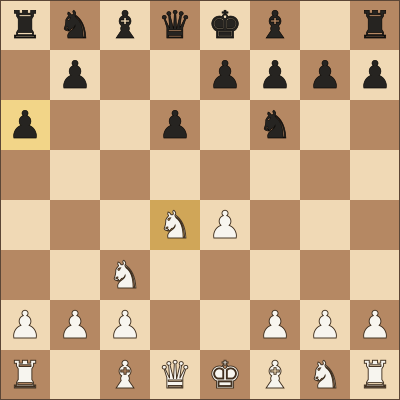
The Open Sicilian Tabiya
After 1.e4 c5 2.Nf3 d6 3.d4 cxd4 4.Nxd4 Nf6 5.Nc3, both sides have made their structural commitments. White controls the center with the pawn pair and has both knights actively posted. Black has traded the c-pawn for White's d-pawn, gaining a queenside pawn majority and dynamic piece play in return. This is the tabiya — the starting position from which all four major variations branch.
The key tension is imbalance: White has more central space and slightly better development; Black has counterattacking chances and will often strike with ...a5, ...b5, or ...d5 at the right moment. Move 5 is where paths diverge. Black's next move determines which variation we've entered.
After 1.e4 c5 2.Nf3 d6 3.d4 cxd4 4.Nxd4 Nf6 5.Nc3 a6 — the Najdorf tabiya. The highlighted a6 pawn is the defining move of the Najdorf Variation.
The Najdorf Variation (5...a6)
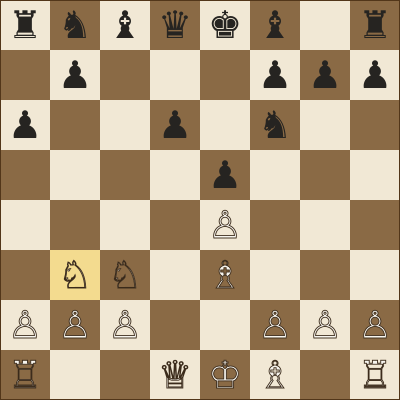
Named after Miguel Najdorf, the Argentine-Polish grandmaster who developed it in the late 1940s, this is the most popular chess opening at the grandmaster level. The quiet 5...a6 seems modest — it prevents Nb5 and prepares Black's queenside expansion with ...b5, ...Bb7, and eventually ...b4 or ...e5. In reality it is a deeply flexible move that keeps every major plan available.
Black's ideas vary by White's sixth move. Against 6.Be3 (English Attack), Black plays 6...e5 7.Nb3 Be6 8.f3 and the game becomes a battle of pawn storms — White goes h4-h5, Black lashes out with ...a5-a4 or ...b5-b4. Against 6.Bg5 (Poisoned Pawn), Black can grab a dangerous pawn with 6...e6 7.f4 Qb6, winning a pawn but allowing White a huge initiative.
Poisoned Pawn (6.Bg5 e6 7.f4 Qb6)
Black grabs the b2-pawn: 8.Qd2 Qxb2 9.Rb1 Qa3. White's compensation is full piece development and attacking chances. Fischer and Kasparov both played this with Black; it remains one of chess's great theoretical debates, deeply analyzed and still not fully resolved.
English Attack (6.Be3 e5 7.Nb3)
White's most popular modern weapon. After 7...Be6 8.f3 h5, both sides launch pawn storms on opposite wings. White plays g4 and h4-h5; Black responds with ...b5-b4. It's a race — material and activity both matter equally.
The Adams Attack (6.h3) avoids heavy theory while keeping pressure. White prevents ...Bg4 and prepares g4-g5 pawn advances. It was popularized by former U.S. champion Michael Adams and remains dangerous despite its quiet appearance.
The Dragon Variation (5...g6)
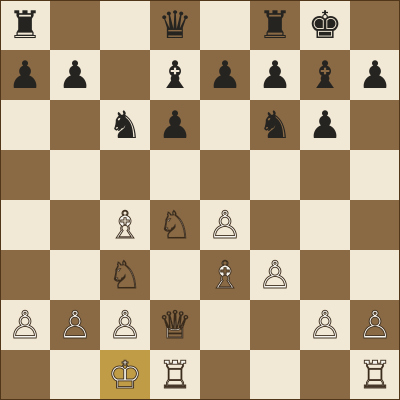
The Dragon is named for the Black pawn formation (d6, e7, f7, g6, h7) which resembles the stars of the Draco constellation. The key idea: Black fianchettoes with 5...g6 6.Be3 Bg7, planting a powerful bishop on g7 that will later batter White's queenside with moves like ...Rxc3 or ...Nxd4. Black then castles kingside, prepares ...d5 breaks, and counterattacks along the c-file.
White castles queenside and immediately starts a pawn storm with h4-h5-h6. Black counters with ...Rc8, ...Nxd4, ...Rxc3 sacrifices. The position often features mutual sacrifices and requires precise calculation from both sides. Tal won brilliantly in the Dragon; so did Fischer.
Chinese Dragon
Black delays ...Bg7 and plays 5...g6 6.Be3 Bg7 7.f3 Nc6 8.Qd2 0-0 9.g4, whereupon Black answers with 9...Be6 rather than Bd7. This subtle variation changes the character of the position — Black aims for ...d5 instead of queenside play.
Levenfish Attack (6.f4)
White plays 6.f4 immediately without the standard setup, gaining space before Black can fianchetto. Not as challenging as the Yugoslav but creates real complications. A good surprise weapon in club chess.
The Classical Variation (5...Nc6)
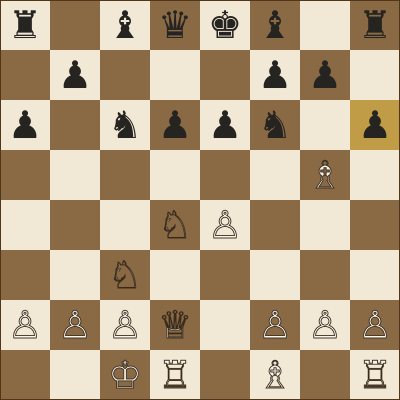
The Classical develops the queenside knight before committing the king's side. Black typically follows with ...e6, ...Be7, and ...0-0, building a solid center before seeking counterplay. The bishop on g5 creates a pin on the Nf6 that can be exploited by Nd5 or f4-f5 pawn thrusts.
Richter-Rauzer Attack (6.Bg5)
White pins the Nf6 immediately after 6.Bg5. The threat is Nxc6 followed by f4-f5. Black must decide: accept the doubled pawns after ...e6 and ...Bxg5, or avoid the pin with ...Bd7. The Richter-Rauzer creates rich strategic complexity with both sides nursing long-term plans.
Sozin/Velimirovic Attack (6.Bc4)
White aims the bishop at f7 and prepares a kingside attack with f4-f5. After 6.Bc4 e6 7.Be3 Be7 8.Qe2, White has a menacing setup. The Velimirovic Attack (7.Be3 Be7 8.Qe2 0-0 9.0-0-0) is the sharpest version, with White pursuing a direct kingside attack.
The Scheveningen Variation (5...e6)
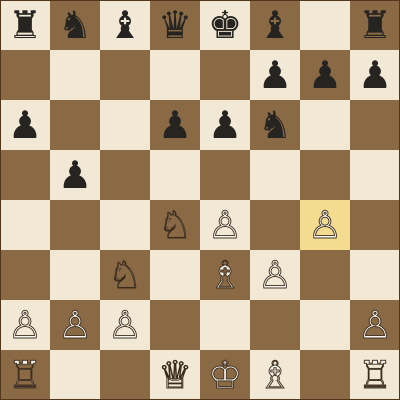
Named after the Dutch beach resort where it was popularized, the Scheveningen features Black's pawn formation on d6 and e6 — a restrained, compact structure. Black avoids committing the center pawn to e5 (as in the Najdorf), instead maintaining maximum flexibility. The queenside expansion with ...a6 and ...b5 comes naturally.
The Keres Attack (6.g4) is White's most aggressive try, immediately threatening g5 to drive the Nf6. Black must react accurately. The English Attack (6.Be3 a6 7.f3 b5 8.Qd2) is the main modern continuation — White builds a similar setup to the Najdorf English Attack, with plans of 0-0-0 and h4-h5.
Paul Keres discovered this aggressive advance in the 1940s. White threatens g5 to kick the Nf6, gaining space before Black consolidates. Black's best response is typically ...h6 followed by ...Nc6 and ...d5 counterplay. Kasparov prepared deeply against the Keres Attack using ...Nc6 lines.
Choosing Your Variation — Style Guide
| Variation | Complexity | Black's Plan | Best for |
|---|---|---|---|
| Najdorf | Very High | Queenside expansion, ...e5 or ...b5-b4 | Tactical, theoretical players |
| Dragon | Very High | ...Rxc3 sacrifices, g7 bishop pressure | Aggressive, attack-minded players |
| Classical | High | Solid center, ...d5 breaks | Positional players who like long games |
| Scheveningen | High | Compact ...a6/...b5, flexible center | Positional players, Anand's choice |
Champions of the Open Sicilian
Bobby Fischer
Fischer declared the Sicilian "best by test" for Black and used the Najdorf as his primary weapon throughout his career. His crushing victories over Taimanov (6–0 match) and Larsen (6–0 match) featured the Najdorf prominently. Fischer's analytical work on the Poisoned Pawn remains definitive.
Garry Kasparov
Kasparov's five World Championship matches against Karpov frequently featured the Najdorf from Kasparov's side. He prepared extensively, revealing new ideas in post-match books. Kasparov considered the Najdorf not just an opening but a philosophical statement about dynamic chess.
Mikhail Tal
The "Magician from Riga" frequently employed the Dragon Variation, embracing its mutual attacking nature. Tal's tactical genius was perfectly suited to the Dragon's razor-edge positions. He also used the Scheveningen, creating complications from solid-looking positions.
Frequently Asked Questions
The Najdorf (5...a6) is the most played Sicilian variation at top level. The quiet pawn move prevents Nb5 and prepares queenside expansion with ...b5. Fischer called it the best opening move for Black; Kasparov used it throughout his world championship matches. Its flexibility allows Black to adapt to White's setup rather than committing to a fixed plan.
Yes — the Dragon is one of chess's sharpest openings. The Yugoslav Attack creates genuine mutual attacks where both sides race to deliver checkmate. It rewards precise calculation and is unforgiving of inaccuracies. Many club players win brilliantly with the Dragon; others lose quickly. Studying the theoretical lines before playing it in serious games is strongly recommended.
In the Classical (5...Nc6), Black develops the queenside knight early and often plays ...e5 to claim space. In the Scheveningen (5...e6), Black maintains a more compact pawn structure with e6 and d6, avoiding an early ...e5 and keeping the position more flexible. The Scheveningen is typically somewhat quieter and more positional.
The Scheveningen or Classical are most instructive for club players. Both teach piece coordination and solid pawn structure without requiring memorization of 20-move forced lines. The Najdorf and Dragon require significant theoretical preparation before they become reliable — one missed move can lead to a lost position quickly.
White's main options are the English Attack (6.Be3), the Adams Attack (6.h3), and the Classical (6.Bg5). The Poisoned Pawn (6.Bg5 e6 7.f4 Qb6 8.Qd2 Qxb2) is among chess's most complex theoretical battles. At club level, 6.Be2 followed by castling gives White a solid position without deep preparation.
Both were devoted Sicilian players with the Najdorf as their primary weapon. Fischer wrote about the Najdorf in My 60 Memorable Games and used it to defeat the world's best players. Kasparov adopted the Najdorf from childhood, calling it his most important opening weapon and using it in every World Championship cycle.
Further Reading & Sources
Books
- Kasparov, My Great Predecessors (Fischer chapter)
- Nunn, Nunn's Chess Openings (Sicilian section)
- McDonald, The Najdorf for the Tournament Player
- Emms, Play the Open Sicilian
Online Resources
- Lichess.org opening explorer — Sicilian Defense
- ChessBase openings database
- Chess.com opening library
- TWIC (This Week in Chess) for current theory
Model Games
- Fischer – Spassky, 1972 WCh (Najdorf)
- Kasparov – Karpov, 1985 WCh Game 16
- Tal – Koblents, 1957 (Dragon)
- Anand – Kasparov, 1995 PCA (Scheveningen)
Opening classifications per ECO (Encyclopaedia of Chess Openings). Game annotations drawn from published grandmaster analysis. Historical information sourced from Chess.com and ChessBase.