
Red Giants
When a star finally begins to run low on fuel, it does something that sounds backwards: instead of shrinking, it swells — ballooning to hundreds of times its old size and cooling to a deep, sullen red. This is the beginning of the end for a star like the Sun, and it is the fate written into our own solar system's future.
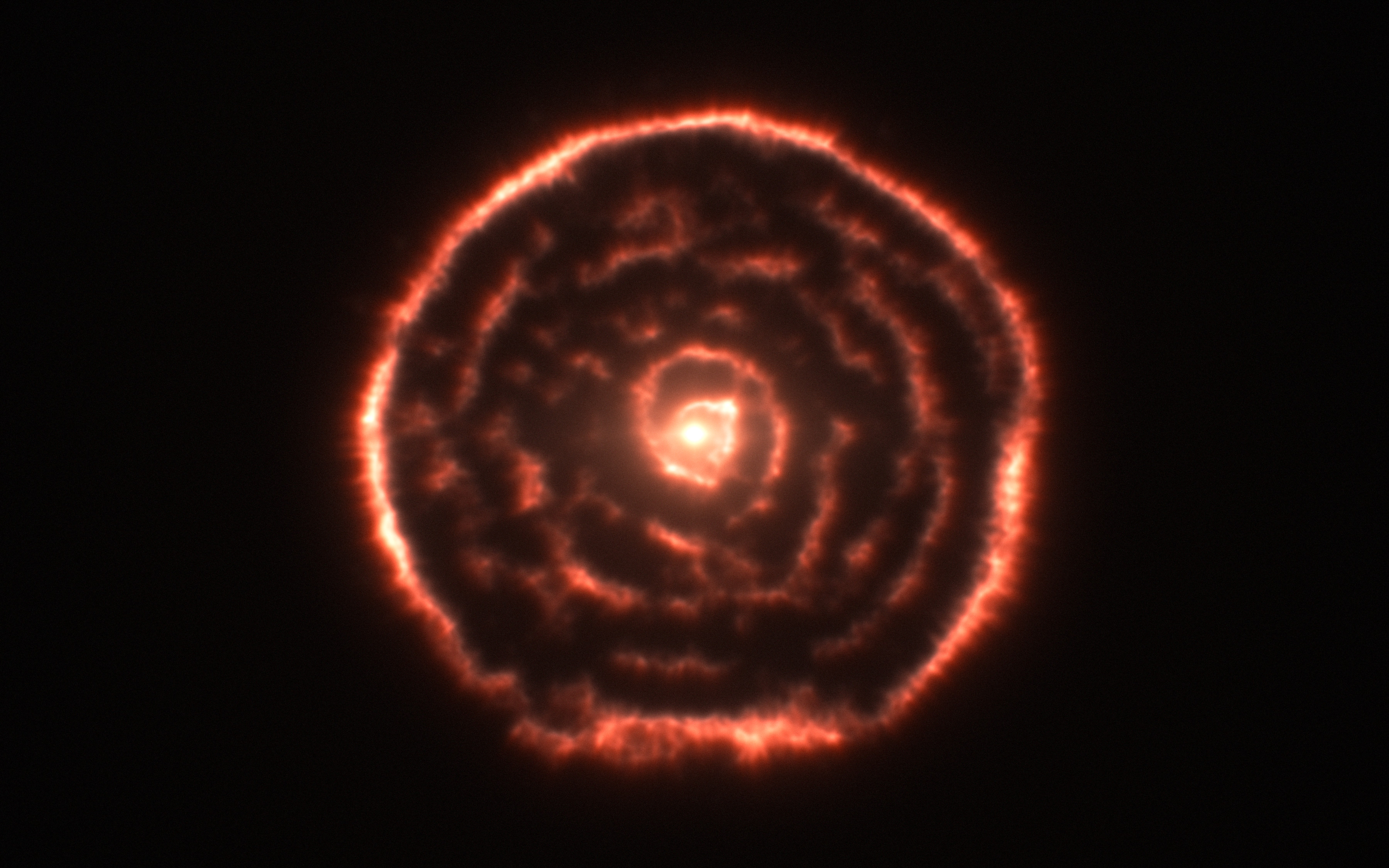
Image: ALMA (ESO/NAOJ/NRAO)/M. Maercker et al. The dying red giant R Sculptoris, ~1,500 light-years away, is shedding its outer layers in expanding shells and a delicate spiral — a star in the slow act of giving its material back to space.
Running low, and puffing up
For most of its life a star fuses hydrogen into helium in its core, and the outward push of that fusion balances gravity's inward pull. But the core's hydrogen is finite. When it runs out, the core has no more fuel to burn there, and gravity squeezes it tighter and hotter. That heat ignites hydrogen fusion in a shell around the now-inert core — and this shell burns so ferociously that it drives the star's entire outer envelope outward.
The result is a paradox of aging: the core contracts while the surface balloons. The star's outer layers spread across a vast volume, so they cool and glow red, even as the core grows hotter than ever. A red giant is not a young, warm star — it is an old star turned inside-out, huge and cool on the outside, dense and blazing within. Eventually the core gets hot enough to start fusing helium into carbon, buying the star a little more time before the final act.
The day the Sun swallows the Earth
This is not an abstract process — it is the Sun's scheduled fate. In roughly five billion years, the Sun will exhaust the hydrogen in its core and swell into a red giant. It will grow so large that it engulfs Mercury and Venus outright, and its surface may reach or nearly reach Earth's orbit. Long before that, the rising heat will have boiled away the oceans and rendered our planet uninhabitable. The Earth, if it survives at all, will be a charred cinder orbiting a bloated red star.
Diagram by Michael Paycer (schematic, not to exact scale). This is scheduled for about five billion years from now — the Sun is only middle-aged today.
Supergiants — and Betelgeuse
Stars much heavier than the Sun become supergiants — red giants on a monstrous scale. The most famous is Betelgeuse, the ruddy shoulder of Orion. If Betelgeuse replaced the Sun, its surface would swallow the orbits of the inner planets and reach out toward Jupiter. It is a star so large and so far along in its life that it is expected to end in a supernova — astronomically soon, though that still means sometime in the next hundred thousand years or so.
Betelgeuse made headlines with its "Great Dimming" of 2019–2020, when it faded so dramatically that some wondered whether the explosion was imminent. The truth turned out to be less apocalyptic: the star had belched out a cloud of dust that briefly veiled it. And in 2025, astronomers confirmed something long suspected — Betelgeuse has a close companion star, nicknamed the "Betelbuddy" and formally named Siwarha, a hot young star orbiting so close it lies within the supergiant's own extended atmosphere. Its gravity may help explain some of Betelgeuse's mood swings. The full story lives on the Betelgeuse page.
"Mortal as I am, I know that I am born for a day. But when I follow the multitude of the stars in their circular course, my feet no longer touch the Earth."
— attributed to Ptolemy, astronomer of the 2nd century
Getting the giant phase right
"Red giants are young, hot stars." — The opposite: they're old stars, and red because their bloated surfaces are relatively cool. "The Sun will explode." — It won't; it's far too light for a supernova. It will swell into a red giant, shed its outer layers as a planetary nebula, and leave a white dwarf. "Betelgeuse might blow up tonight and hurt us." — It may already have, or may not for 100,000 years — and at 500-plus light-years, its supernova would be a spectacular but harmless light show. "A bigger star lives longer." — Backwards again: the heaviest stars burn out fastest, in a few million years, while the smallest sip their fuel for trillions.
Supernovae · White Dwarfs · Main Sequence · Betelgeuse · The Sun · Stars Hub · Glossary
Return to Michael Paycer
Explore Michael Paycer's professional SQL Server, cloud, ETL, API, automation, and consulting pages, or continue browsing the personal interests section.