
The Sun
The Sun is our star — a million-kilometer ball of glowing plasma holding 99.86% of the Solar System's mass, powered not by fire but by nuclear fusion in its core. Everything in this section orbits it. Here is what it is, how to look at it safely, and the myths we've told about it.
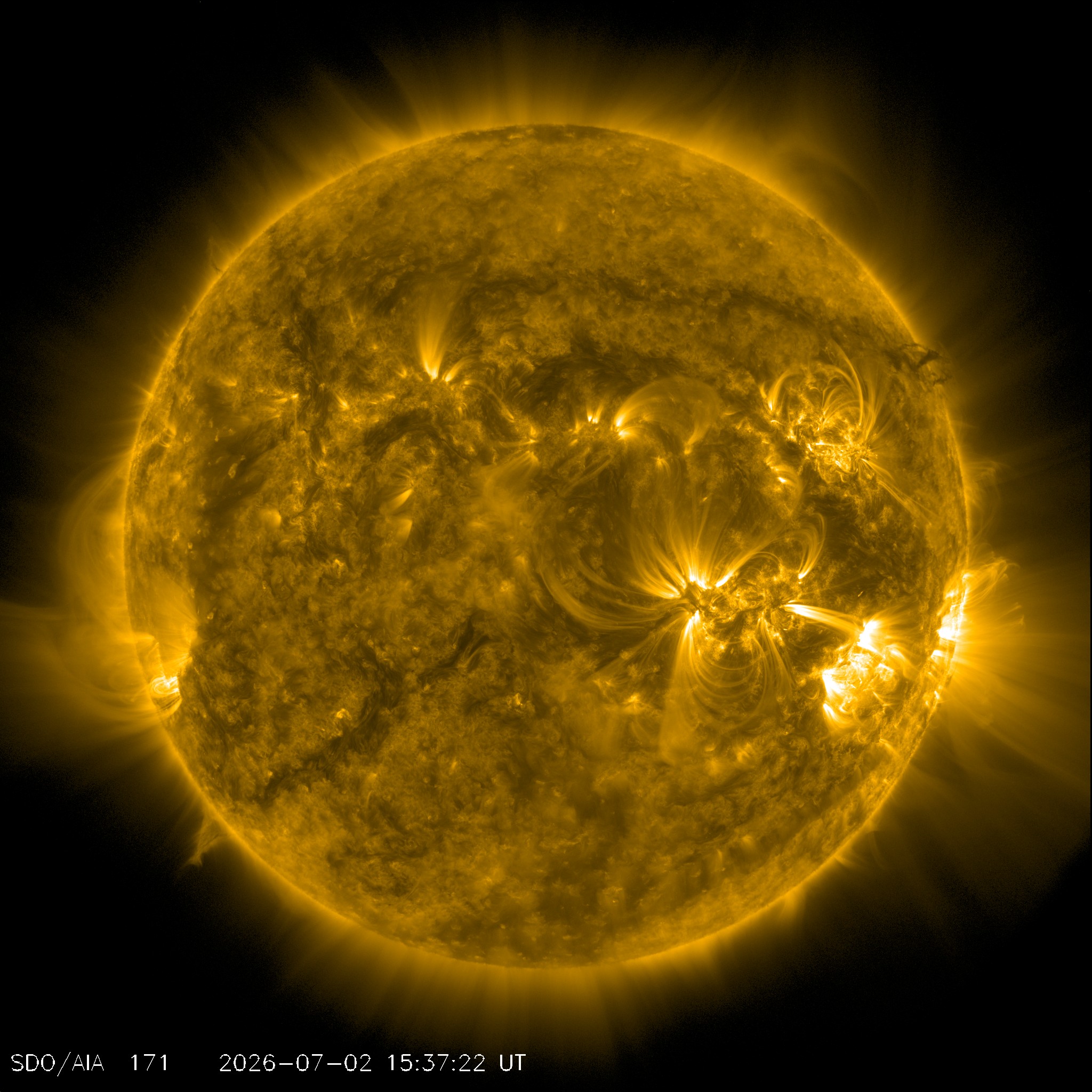
Image credit: NASA/SDO (AIA 171 Å). The Sun in extreme-ultraviolet light from the Solar Dynamics Observatory, which watches our star around the clock. This wavelength reveals glowing arcs of million-degree plasma tracing the Sun's magnetic field.
Type
G-type main-sequence star (yellow dwarf)
Diameter
~1.39 million km (109 Earths across)
Powered by
Nuclear fusion — hydrogen into helium
Age
~4.6 billion years (about halfway through its life)
A thermonuclear furnace with layers
The Sun is a star — an enormous sphere of hot plasma (mostly hydrogen and helium) held together by its own gravity. It contains about 99.86% of all the mass in the Solar System; everything else — all the planets, moons, asteroids, and comets — makes up the rest. It does not burn like a fire. Instead, in its core, gravity squeezes hydrogen so hard and so hot (around 15 million °C) that atomic nuclei fuse into helium, converting a tiny fraction of their mass into a staggering amount of energy. That energy takes tens of thousands of years to struggle out from the core, and then just eight minutes to cross space to Earth.
The Sun is built in layers, and this cutaway shows them from the inside out:
Cutaway schematic by Michael Paycer — not to scale. Energy is made in the core, crawls out through the radiative and convective zones, escapes as light at the photosphere, and the faint corona streams outward as the solar wind.
The one object you must never look at directly
This is the most important safety note in all of astronomy: never look at the Sun with unprotected eyes, and never, ever point binoculars or a telescope at it without a proper solar filter. The Sun is so bright that a moment's unfiltered glimpse through optics can burn your retina and cause permanent blindness — there are no pain receptors in the retina to warn you. That said, the Sun is a wonderful and safe target with the right gear.
Three safe methods: certified solar eclipse glasses (look for the ISO 12312-2 standard) let you view the Sun with the naked eye and spot large sunspots. A white-light solar filter that fits over the front of a telescope or binoculars shows sunspots in crisp detail. And the projection method — casting the Sun's image through a telescope or pinhole onto a white card — is completely safe and great for groups. Dedicated hydrogen-alpha telescopes reveal prominences and flares, but they are a specialist investment.
Eclipse glasses
ISO 12312-2 certified only. Naked-eye views of the Sun's disk and big sunspots. Never use them with a telescope or binoculars.
Front solar filter
A proper white-light filter over the front aperture of a scope reveals sunspots and the Sun's mottled surface.
Projection
Project the Sun's image onto a card — the safest method, and perfect for showing others sunspots and eclipses.
New to stargazing? See how to observe the night sky, and if you're choosing gear, the no-hype telescope buying guide.
Two closer looks at our star
Solar Eclipses
When the Moon covers the Sun — why it happens, the difference between total, annular, and partial, how to watch safely, and the spectacle of totality.
Sunspots & the Solar Cycle
The Sun's magnetic heartbeat — sunspots, the 11-year cycle, flares and coronal mass ejections, and the space weather that lights up the aurora.
Not on fire, not yellow, and once a god
Two misconceptions are almost universal. The first: that the Sun is on fire. It isn't — fire is combustion, a chemical reaction that needs oxygen, and there is no oxygen in space to burn. The Sun shines by nuclear fusion, a completely different process that merges atomic nuclei and releases far more energy than any fire could. The second: that the Sun is yellow. In truth it is white — it pours out all visible colors together. It only looks yellow or orange from the ground because our atmosphere scatters away the shorter blue wavelengths, an effect that also gives us blue skies and red sunsets. Seen from space, the Sun is a brilliant white.
For nearly every ancient culture, the Sun was a god — and understandably so, as the giver of light, warmth, and life. The Romans worshiped it as Sol; the Greeks as Helios, who drove a blazing chariot across the sky each day (and whose son Phaethon famously lost control of it). The Greek god Apollo also became associated with the Sun. That reverence is written into our calendar: Sun-day is the Sun's day.
Primary sources: NASA — The Sun and the NASA Solar Dynamics Observatory (AIA 171 Å imagery). Image credit: NASA/SDO.
It is the one star we can study by daylight — a furnace 150 million kilometers away whose eight-minute-old light warms your face, powers every living thing, and holds the entire family of planets in its grip.
Closer looks at our star
The Sun · Solar Eclipses · Sunspots & the Solar Cycle · The Solar System
More astronomy notes
Continue through the astronomy section for beginner-friendly notes, image credits, viewing tips, history, and the stories behind the night sky.
Solar Eclipses · Sunspots · The Solar System · Astronomy · Interests