
White Dwarfs
Most stars don't go out with a bang. When a star like the Sun finishes dying, it gently sheds its outer layers and leaves behind its bare core — an object the size of Earth but nearly as heavy as the Sun, so dense that a teaspoon of it would weigh tons. This is a white dwarf, the quiet and by far the most common ending a star can have.
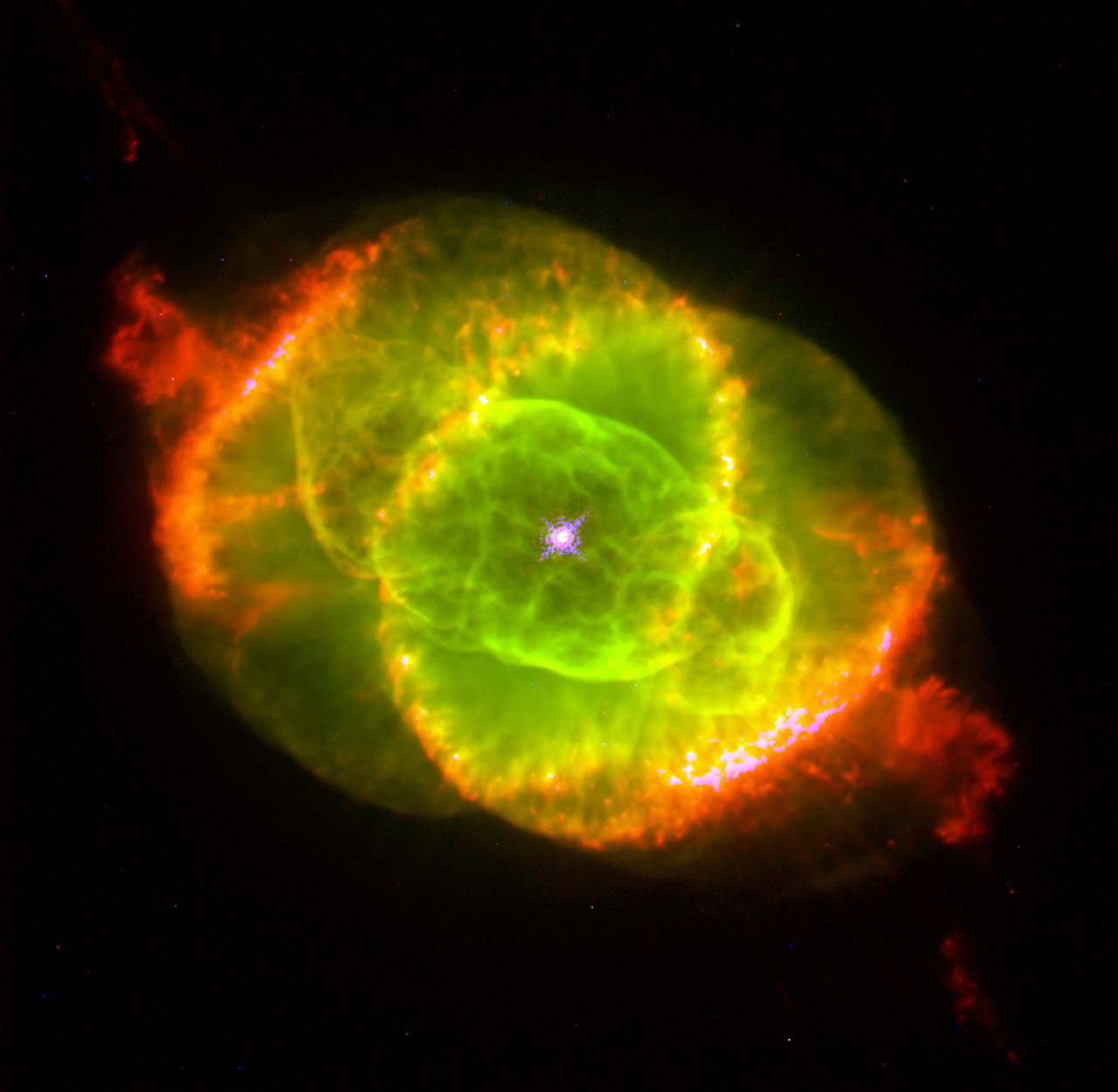
Image: NASA, ESA, HEIC & the Hubble Heritage Team (STScI/AURA). The Cat's Eye Nebula in Draco — a "planetary nebula," the glowing shells a dying Sun-like star casts off. The tiny hot point at the center is the exposed core that will become a white dwarf.
Shedding the shroud
A star up to about eight times the Sun's mass ends its life as a red giant, its core fusing helium into carbon and oxygen while its bloated outer layers drift ever farther out. Eventually those outer layers float away entirely, expanding into a glowing shell called a planetary nebula — a name that's a historical mistake, since it has nothing to do with planets; early observers just thought the round glow looked planet-like through small telescopes.
What remains at the center, laid bare, is the star's dead core: a ball of carbon and oxygen, no longer fusing anything, about the size of the Earth. This is the white dwarf. It shines not because it's still burning, but because it's still ferociously hot — a fading ember, glowing white-hot at first, cooling over billions of years. The planetary nebula lasts only tens of thousands of years before dispersing; the white dwarf endures almost forever.
Held up by a quantum rule
A white dwarf packs the mass of a star into the volume of a planet. Nothing you know of ordinary matter should be able to resist that crushing gravity — and ordinary matter can't. What holds a white dwarf up is a strange quantum rule called electron degeneracy pressure: electrons simply refuse to be squeezed into the same state, and that refusal props the star up against collapse. It's not heat and not fusion; it's a fundamental law of quantum mechanics acting as a scaffold.
But that scaffold has a breaking point. In the 1930s, the young physicist Subrahmanyan Chandrasekhar calculated that if a white dwarf's mass exceeds about 1.4 times the Sun's — the "Chandrasekhar limit" — even electron degeneracy fails, and the star must collapse further. A lone white dwarf never reaches this limit. But one stealing gas from a companion can be pushed over it, triggering the complete thermonuclear detonation of a Type Ia supernova. The nearest white dwarf to us, Sirius B, is a faint companion to the brightest star in our night sky — a dead star hiding in the glare of a living one.
"This is the way the world ends
Not with a bang but a whimper."
— T. S. Eliot, "The Hollow Men" (1925)
Toward the black dwarf that doesn't exist yet
A white dwarf's future is simply to cool. With no fuel to burn, it radiates its leftover heat into space over tens of billions of years, sliding down the color scale from white to yellow to red, and finally — in theory — to a cold, dark, inert black dwarf. Here's the remarkable part: the universe isn't old enough for a single black dwarf to exist yet. The cooling takes longer than the current age of the cosmos, so every white dwarf ever formed is still faintly glowing. Black dwarfs are a prediction about the far future, not an observed object.
This is the Sun's real fate. Not an explosion, but a slow, dignified fade: red giant, planetary nebula, then an Earth-sized ember cooling in the dark for longer than the universe has so far existed. It's the most common ending in the cosmos, and a strangely peaceful one.
Clearing up the ember
"A planetary nebula has planets." — None; the name is a centuries-old misnomer for the round glow of a dying star's shed layers. "A white dwarf is a small star still burning." — It's not burning at all; it's a dead core glowing from residual heat. "Nothing could be denser." — Plenty is: a neutron star crams even more mass into a far smaller ball. "Black dwarfs are out there." — Not one exists yet; the universe is too young for any white dwarf to have finished cooling. And "the Sun will explode into a nebula" — the planetary nebula is a gentle exhale, not a blast; the Sun is far too light for a supernova.
Neutron Stars & Pulsars · Supernovae · Red Giants · The Ring Nebula · The Sun · Stars Hub · Planetary Nebulae · Glossary
Return to Michael Paycer
Explore Michael Paycer's professional SQL Server, cloud, ETL, API, automation, and consulting pages, or continue browsing the personal interests section.