Queen's Gambit Variations
The QGD in depth — Tartakower, Ragozin, Exchange Variation, and Queen's Gambit Accepted — with strategic plans for both colors.
D38 (Ragozin)
D35–D36 (Exchange)
D20–D29 (QGA)
3.Nc3 Nf6 4.Bg5 Be7
5.e3 0-0 6.Nf3
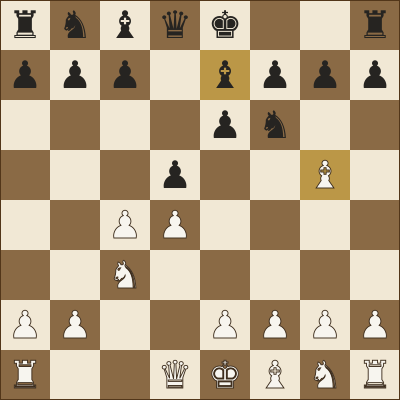
The QGD Tabiya: After 4.Bg5
The mainline QGD arises after 1.d4 d5 2.c4 e6 3.Nc3 Nf6 4.Bg5. White pins the Nf6 with the bishop — a move that defines the Orthodox Defense and the Tartakower. Black's key challenge is the development of the c8-bishop, which is locked behind the e6-pawn and d5-pawn. Every major QGD variation answers the question: how does Black free that bishop?
After 1.d4 d5 2.c4 e6 3.Nc3 Nf6 4.Bg5 — the QGD main tabiya. White's bishop on g5 (highlighted) pins the Nf6, setting up the main strategic battle of the QGD. Black's c8-bishop is locked in and must find a route to activity.
The Tartakower–Makogonov–Bondarevsky (TMB) Defense
The Tartakower Defense solves Black's central problem elegantly: the c8-bishop will go to b7 via the b6-b7 diagonal. After 7...b6, Black intends 8...Bb7 followed by ...Ne4 and ...Nxc3 or ...c5 breaks to dissolve the center. Black accepts a slight positional concession — the b6-pawn slightly weakens the queenside — in exchange for a clear plan and active bishop.
This was Anatoly Karpov's signature defense as Black against Kasparov in their 1984–1986 World Championship matches. Karpov's handling was masterful: he would maneuver into favorable endgames, using his superior technique to exploit even tiny structural advantages.
Lasker Defense (7...Ne4)
Rather than playing ...b6, Emanuel Lasker's move 7...Ne4 immediately challenges White's bishops. After 8.Bxe7 Qxe7 9.cxd5 Nxc3 10.bxc3 exd5, Black has symmetrical pawns and easy development. Lasker used this in World Championship play — it's solid if somewhat dry.
Cambridge Springs (5...c6 6.Nf3 Qa5)
An older defensive system: Black plays 4...Nbd7 5.e3 c6 6.Nf3 Qa5, immediately threatening Bxf3, Ne4 and Bb4 simultaneously. It pressures White to solve multiple problems. The Cambridge Springs requires precise White play to keep the advantage.
The Ragozin Defense (4...Bb4)
The Ragozin combines elements of the QGD (with d5 pawn pressure) and the Nimzo-Indian (with the Bb4 pin on Nc3). Black pins the knight and pressures d4-c4 from multiple angles. After 5.Bg5 h6 6.Bxf6 Qxf6, Black gets the bishop pair and fighting chances. The resulting positions tend to be asymmetrical and dynamic.
Vladimir Kramnik was one of the great modern practitioners of the Ragozin, using it in his preparation for the 2000 World Championship match against Kasparov. The Ragozin is popular at all levels because it avoids symmetrical positions and demands concrete play from both sides.
Black grabs the c4-pawn and uses the time to place the bishop on b4. White's center looks menacing but is difficult to maintain. Black will castle and seek ...c5 breaks. This Vienna Variation (not to be confused with the Vienna Game) is one of chess's sharpest QGD-family gambits and rewards careful preparation from both sides.
The Exchange Variation & the Minority Attack
In the Exchange Variation, White captures early on d5 to reach the "Carlsbad pawn structure": White has pawns on a2-b2 facing Black's c6-d5-e6 (or after ...exd5: c6-d5). This structure grants White a strategic plan called the minority attack — advancing b2-b4-b5-b6 to create a weak pawn on c6 that Black must defend permanently.
The minority attack operates on a simple principle: White's two queenside pawns attack Black's three. When White plays b6xc6, Black is left with a backward c-pawn on an open file — a long-term structural weakness. Black's counterplay typically involves piece activity and ...f5-f4 pawn advances on the kingside.
Carlsbad Structure Plans for White
- Knight to f5 or g5 targeting kingside
- Rook lifts via Rb1-b4-g4
- b4-b5-b6 minority attack
- Open c-file pressure after bxc6
Carlsbad Structure Plans for Black
- ...f5-f4 kingside pawn storm
- Knight outpost on e4 via ...Ne4
- Piece activity on the g-file after ...f4-f3
- Counterplay on the b-file after ...Rb8
The Queen's Gambit Accepted (QGA)
Black accepts the gambit pawn with 2...dxc4. White cannot hold the pawn — a quick ...b5 or ...c5 will consolidate — but gains time and a strong center in the meantime. Black uses that time to develop freely, often achieving an excellent position. The QGA was long considered slightly suspect; modern theory treats it as fully equal and dynamic.
Vishy Anand used the QGA successfully in World Championship matches. The opening produces open games with active piece play — quite different from the closed maneuvering of the QGD. After 5...c5, Black immediately strikes the center, reaching positions similar to the Nimzo-Indian or Benoni in structure.
Main Line: 3.Nf3 (Classical QGA)
After 3.Nf3 Nf6 4.e3 e6 5.Bxc4 c5 6.0-0 a6, Black seeks to equalize with rapid development. The key is ...Nc6 and ...Be7 followed by castling. White's slight development advantage tends to fade once both sides castle. Model games: Alekhine-Euwe 1935 World Championship.
Pawn-Center Line: 3.e4 (Central Variation)
More aggressive — White builds a large pawn center immediately. After 3.e4 e5 4.Nf3 exd4 5.Nxd4, White has open lines and piece activity. Black must play precisely to avoid getting steamrolled. Risky but rewarding for White at amateur level.
Variation Style Guide
| Variation | Character | Black's Goal | Best for |
|---|---|---|---|
| Tartakower (7...b6) | Strategic, positional | Free c8-bishop via b6-b7 | Endgame specialists, Karpov-style players |
| Lasker (7...Ne4) | Solid, drawish | Simplify, equal endings | Players needing a safe draw weapon |
| Ragozin (4...Bb4) | Dynamic, asymmetric | Pin, unbalance, fight for initiative | Active, tactical players |
| Exchange (3.cxd5) | Slow, strategic | Piece activity to counter minority attack | Positional players comfortable in defended positions |
| QGA (2...dxc4) | Open, dynamic | Free development, fast piece play | Players who prefer open positions |
Champions of the Queen's Gambit
Anatoly Karpov
Karpov was perhaps the greatest QGD player in history. His Tartakower and Lasker Defense handling was the model for an entire generation. In his World Championship matches against Kasparov, the QGD was his main defensive weapon — he understood its structural subtleties better than anyone of his era.
Vladimir Kramnik
Kramnik's 2000 World Championship preparation included the Ragozin Defense and other QGD-family lines. He selected these precisely because they avoid sharp Sicilian-style complications while still offering winning chances. His positional mastery of the QGD's structural nuances was a key factor in defeating Kasparov.
Vishy Anand
Anand used the QGA in multiple world championship matches, demonstrating its soundness at the highest level. His sharp, direct play was perfectly suited to the QGA's open positions. Anand's preparation showed that accepting the gambit pawn leads to rich, fully playable positions for Black.
Frequently Asked Questions
The Tartakower Defense (7...b6) directly addresses Black's main structural problem: the c8-bishop is locked in by the e6-pawn. By playing ...b6, Black creates a route for the bishop to go to b7, where it exerts long-diagonal pressure. The cost is a slight queenside pawn structure concession. Karpov's handling of this line is the definitive model for Black.
White plays 3.cxd5 to reach the Carlsbad structure. White's strategic plan is the minority attack: advancing b4-b5-b6 to force bxc6, leaving Black with a backward c-pawn. Black's counterplay typically runs along the kingside with ...f5-f4. Understanding this structure is essential for both sides — it's one of chess's most instructive strategic battlegrounds.
The Ragozin (4...Bb4) arises in a QGD position where Black also has a d5-pawn, giving extra central pressure compared to the Nimzo-Indian. The pin on Nc3 is the same, but Black has the option to maintain ...d5 or trade it. The Ragozin tends to produce asymmetric, dynamic positions that reward creative play from both sides.
Yes — the QGA is fully sound and has been used at the highest level for over a century. Black accepts the pawn knowing White cannot hold it long-term. The opening produces open, dynamic positions where both sides can play for a win. At club level, accepting the gambit is perfectly safe with basic knowledge of the development plan.
The Vienna Variation (4...dxc4 5.e4 Bb4 6.Bg5) is an aggressive QGD sideline where Black accepts the gambit pawn and pins the Nc3. White gets a large center; Black gets active pieces. It leads to sharp, concrete positions requiring precise play from both sides. Named for the Vienna tournament games in the early 20th century.
Yes — the QGD remains one of the most played openings at world championship level. Carlsen, Kramnik, and Anand all used QGD-family lines in title matches into the 2020s. The Netflix series The Queen's Gambit (2020) drove enormous interest in the opening, with chess.com reporting a spike in 1.d4 games following the show's release.
Further Reading & Sources
Books
- Kramnik & Bareev, Chess Explained: The Queen's Gambit Declined
- Avrukh, 1.d4 (Grandmaster Repertoire series)
- McDonald, The Queen's Gambit Accepted
Online Resources
- Lichess.org opening explorer — 1.d4 d5 2.c4
- ChessBase QGD mega-database
- Chess.com lessons — Queen's Gambit
Model Games
- Karpov–Kasparov, 1984–86 WCh matches
- Kramnik–Kasparov, 2000 World Championship
- Anand–Topalov, 2010 World Championship (QGA)
ECO classifications from ECO. Strategic concepts drawn from grandmaster annotations and opening theory publications.