
Queen's Gambit Accepted
Black takes the pawn — 1.d4 d5 2.c4 dxc4 — then hands it back for rapid development and a quick ...c5 strike at White's centre. The Classical main line, the sharp Central Variation, and the modern ...a6 systems.
Central: D20–D21
Classical: D23–D27
...a6 lines: D25–D27
White recovers c4,
but Black gets fast
development and ...c5.
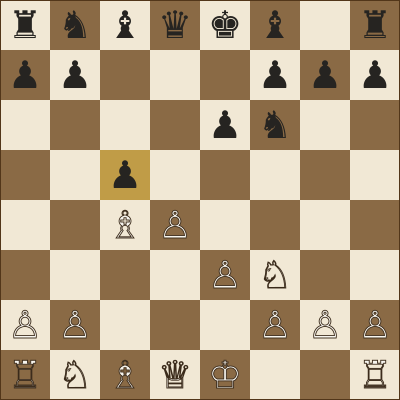
Declining with ...e6 (the QGD) is solid but passive; the c8-bishop can languish behind its own pawns. Accepting with 2...dxc4 concedes the centre only temporarily — White almost always regains the pawn with Bxc4 or Qa4+, and in return Black gets rapid, harmonious development and the freeing break ...c5. The QGA trades a little central space for activity and clarity, which is why it has become a mainstay of elite repertoires seeking a fighting game with Black.
The Central Variation: 3.e4
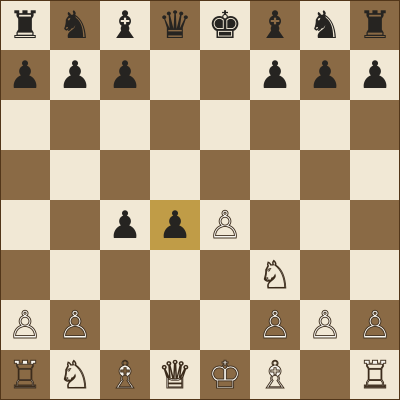
The most ambitious try: White grabs the full centre with 3.e4. Black must react immediately with 3...e5, hitting d4 before White consolidates. After 4.Nf3 exd4 5.Bxc4, White has a lead in development and open lines to compensate for the temporarily loose centre. The Central Variation leads to lively, piece-active positions where accurate development matters more than material.
The Classical Main Line: 3.Nf3 and Bxc4
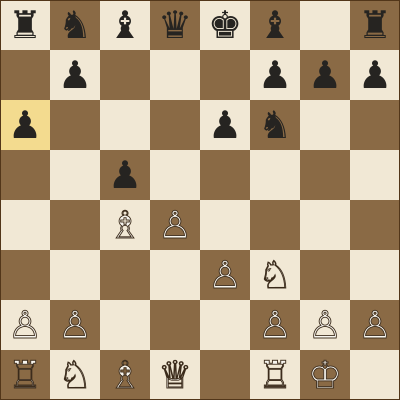
The classical treatment: White develops naturally with 3.Nf3 and 4.e3, recovers the pawn with Bxc4, and castles. Black answers with the thematic ...c5 break and ...a6 to prepare ...b5, gaining queenside space and freeing the c8-bishop to b7. This is the backbone of modern QGA practice — sound, flexible, and rich in both isolated-queen's-pawn and hanging-pawn middlegames.
Champions of the QGA
Viswanathan Anand
Anand used the QGA repeatedly as a reliable equalizer with Black, including in World Championship play. His handling of the ...c5 and ...a6-...b5 structures showed how Black's activity fully compensates for White's central space.
Alexander Alekhine
Alekhine's classic QGA games established the modern understanding of the isolated-queen's-pawn positions that so often arise — treating the IQP as a source of dynamic energy rather than a static weakness.
Frequently Asked Questions
The QGA arises after 1.d4 d5 2.c4 dxc4 — Black captures the gambit pawn. It is not a true pawn sacrifice: White regains the pawn with Bxc4 (or Qa4+) in almost every line. In exchange for conceding some central space, Black gets fast development and the freeing break ...c5. It is one of the most active, clear-cut answers to 1.d4.
No. Trying to hold the c4-pawn with ...b5 too early (the 'greedy' approach) usually backfires — after a2-a4 White regains the pawn with a better position. Black's plan is to return the pawn for development and central counterplay, not to cling to it.
After 1.d4 d5 2.c4 dxc4 3.e4, White seizes the whole centre. Black strikes back immediately with 3...e5, and after 4.Nf3 exd4 5.Bxc4 the game becomes an open, piece-active fight where development outweighs the temporarily loose pawns. It is White's most ambitious try.
The classical main line runs 3.Nf3 Nf6 4.e3 e6 5.Bxc4 c5 6.0-0 a6, when Black prepares ...b5 and ...Bb7. This leads to isolated-queen's-pawn and hanging-pawn structures that are among the most instructive middlegames in chess.
Yes — the QGA teaches clear, principled chess: rapid development, central breaks, and the handling of isolated and hanging pawns. It avoids the heaviest memorization of the Slav/Semi-Slav while still being fully sound at every level.