
QGD Main Lines: Tartakower, Cambridge Springs & Ragozin
The three great classical systems inside the Queen's Gambit Declined — Tartakower's freeing ...b6, the counterattacking Cambridge Springs, and the Nimzo-flavoured Ragozin. Each is a fully sound, battle-tested equalizer for Black.
Ragozin: D38–D39
Cambridge Springs: D52
Tartakower: D58–D59
...b6/...Bb7, ...Qa5/...Bb4,
or ...Ne4 — each system
solves the QGD's cramp.
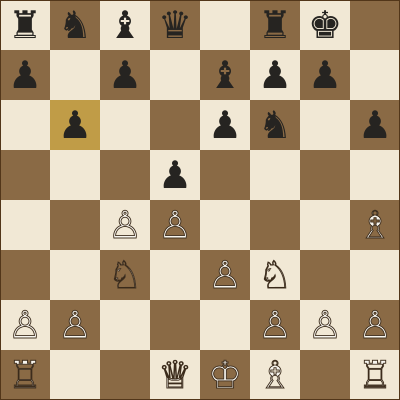
Every QGD player faces the same challenge: the ...e6 pawn keeps the centre solid but hems in the c8-bishop. These three systems are the classical answers. The Tartakower frees the bishop directly with ...b6 and ...Bb7. The Cambridge Springs ignores the problem and counterattacks the pinned Nc3 with ...Qa5. The Ragozin sidesteps it entirely, pinning White's knight with ...Bb4 in a Nimzo-Indian spirit. Learn all three and you can meet any White setup in the Queen's Gambit Declined.
The Tartakower–Makogonov–Bondarevsky (TMB)
The most respected modern QGD system. Black plays ...h6 to question the bishop, then ...b6 and ...Bb7 to develop the problem bishop on the long diagonal, where it is anything but bad. After ...c5 and ...dxc4 at the right moment, Black reaches full equality with an active, harmonious position. Spassky and Karpov used the TMB as a bedrock defence, and it remains a top choice at every level.
The Cambridge Springs Variation
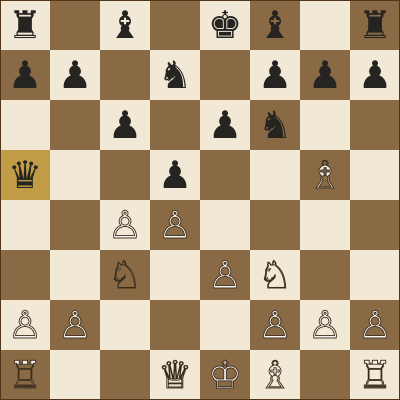
A counterattacking gem. Instead of solving the bishop problem, Black develops with ...Nbd7 and ...c6, then springs ...Qa5 — pinning the Nc3 to the queen and threatening ...Ne4 and ...Bb4. White must handle the pin carefully; a careless move can drop the c4-pawn or walk into tactics on c3. The Cambridge Springs turns the QGD into a sharp fight for the initiative.
The Ragozin Defense
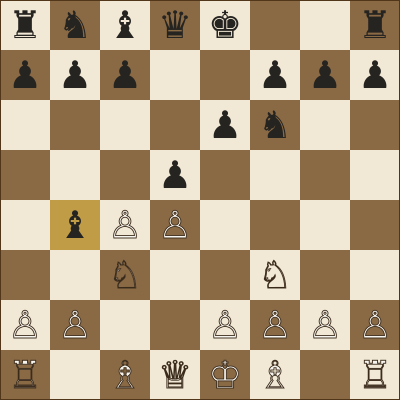
A QGD/Nimzo-Indian hybrid: Black pins the Nc3 with ...Bb4 before White can set up the Bg5 pin. This injects immediate piece activity and can lead to doubled c-pawns for White (after ...Bxc3) in exchange for the bishop pair — a classic Nimzo trade-off. The Ragozin has surged in elite popularity because it gives Black a dynamic, un-passive way to meet 1.d4 while staying within QGD structures.
Champions of the Classical QGD
Boris Spassky
Spassky's universal style found a natural home in the Tartakower, where he demonstrated that the QGD's "bad bishop" becomes a strong piece on b7 with correct handling.
Vladimir Kramnik
Kramnik revitalised the classical QGD systems at the top level, using their rock-solid structures to neutralise 1.d4 and grind out wins from tiny edges.
Frequently Asked Questions
The Tartakower-Makogonov-Bondarevsky arises after 1.d4 d5 2.c4 e6 3.Nc3 Nf6 4.Bg5 Be7 5.e3 0-0 6.Nf3 h6 7.Bh4 b6. Black fianchettoes the problem bishop to b7, where it becomes active on the long diagonal. It is one of the most respected, fully equal QGD systems and a favourite of Spassky and Karpov.
The Cambridge Springs arises after 4.Bg5 Nbd7 5.e3 c6 6.Nf3 Qa5. Black pins the Nc3 with the queen and threatens ...Ne4 and ...Bb4, generating immediate counterplay. It is named after the 1904 Cambridge Springs tournament and remains a dangerous surprise weapon.
The Ragozin arises after 3.Nc3 Nf6 4.Nf3 Bb4 — a QGD/Nimzo-Indian hybrid. Black pins the knight with ...Bb4 for active piece play, often accepting structural concessions for the bishop pair or dynamic chances. It has become very popular at the elite level as a fighting answer to 1.d4.
Yes. All three are principled and sound, and each teaches a key idea: the Tartakower (freeing the bad bishop), the Cambridge Springs (counterattacking a pin), and the Ragozin (Nimzo-style pinning). They reward understanding over rote memorization and scale well from club level to master play.
This page goes deeper on three specific classical systems within the Queen's Gambit Declined. The companion QGD page covers the Orthodox/Capablanca freeing manoeuvre, the Exchange Variation minority attack, and the Lasker Defense. Together they give complete coverage of Black's classical answer to the Queen's Gambit.