
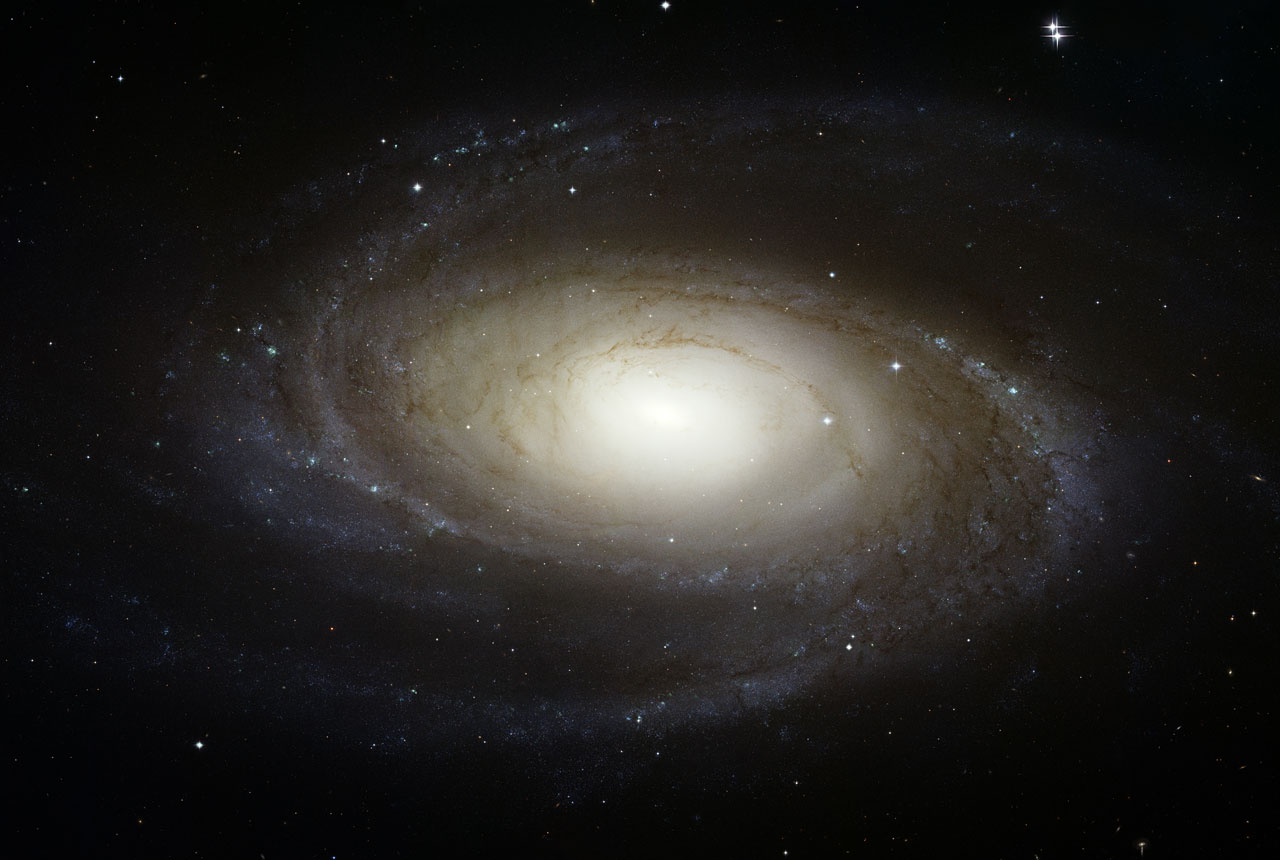
Messier 81, Bode's Galaxy, in Ursa Major, the sharpest image ever taken of it by Hubble. A grand-design spiral about 12 million light-years away. Image credit: NASA, ESA and the Hubble Heritage Team (STScI/AURA).
Callisto, condemned to circle the pole
In Greek myth Ursa Major is Callisto, a nymph and companion of the huntress Artemis. Zeus fell in love with her, and when his wife Hera discovered it, she turned Callisto into a bear in a jealous rage. Years later Callisto's own son Arcas, out hunting, nearly killed the bear without knowing it was his mother. Zeus swept them both into the sky to spare them, Callisto as the Great Bear and Arcas as the nearby Little Bear (or, in some tellings, the herdsman Boötes).
Hera was not finished. She persuaded the sea gods never to let the bears bathe in the ocean, which is the mythic reason these constellations are circumpolar: from northern latitudes they wheel endlessly around the pole and never sink below the horizon to rest in the sea.
The Big Dipper is only part of the bear, but it is the part everyone uses. Find the two stars at the end of the bowl, Dubhe and Merak, draw a line through them, and you arrive at Polaris and true north.
Ursa Major at a glance
Abbreviation
UMa · Genitive: Ursae Majoris
Brightest Star
Alioth (ε UMa), magnitude 1.77
Signpost
The Big Dipper (the Plough)
Best Visibility
Circumpolar above ~40°N; highest in spring
Pointers, a horse and rider, and a spinning group
- Dubhe and Merak — the Pointers. The two stars at the end of the Dipper's bowl. A line through them, extended upward, leads straight to Polaris, the North Star.
- Mizar and Alcor. The middle star of the handle is really a pair: bright Mizar with faint Alcor beside it, "the horse and rider." Spotting both with the naked eye was once a traditional test of good vision. A telescope splits Mizar itself into two, and it is a multiple-star system in all.
- Alioth. The brightest star in the constellation, at the base of the handle.
- The Ursa Major Moving Group. Five of the Dipper's seven stars actually travel through the galaxy together, a loose cluster of stars born from the same cloud, all drifting in the same direction.
Galaxies above the bear's back
Messier 81 (Bode's Galaxy)
The grand spiral in the feature image, bright and beautifully symmetric, a favourite first galaxy for many observers.
Messier 82 (the Cigar Galaxy)
M81's close companion, a galaxy ablaze with star formation, blowing plumes of gas out of its core. The two sit in the same low-power field of view.
The Pinwheel (M101) & Owl Nebula (M97)
A large face-on spiral and a round planetary nebula with two dark "eyes," both within the bear's borders for patient observers.
The Hubble Deep Field
In 1995 Hubble stared at a tiny, seemingly empty patch of Ursa Major for ten days and found thousands of galaxies, a landmark image of the early universe.
One of humanity's oldest shared pictures
Remarkably, cultures separated by oceans and ages both saw a bear in these stars, from ancient Greece to many Native American nations, which some scholars think points to a shared story tens of thousands of years old. Others saw different things in the same seven bright stars: a plough or a wagon across much of Europe, a saucepan in France, the seven sages (Saptarishi) in India. In North America the Dipper was the Drinking Gourd, sung about as a guide that pointed enslaved people north toward freedom. Few patterns have carried so many human meanings.
Constellation data sheet
| Abbreviation | UMa |
| Genitive | Ursae Majoris |
| Area | 1,280 sq. degrees (3rd largest) |
| Brightest star | Alioth (epsilon UMa), mag 1.77 |
| Signature asterism | The Big Dipper / the Plough |
| Navigation | Dubhe and Merak point to Polaris |
| Bordering constellations | Draco, Boötes, Canes Venatici, Leo, Lynx, Camelopardalis |
| Best visibility | Circumpolar from >40N; highest on spring evenings |
| Mythology | Callisto, turned into a bear and set by the pole |
Ursa Major is the bear that never sets, circling the pole through every season as punishment in the old myth and as a gift to anyone learning the sky. It has pointed sailors, travellers, and the enslaved toward north for as long as people have looked up and needed a way home.
More stories in the stars
Ursa Major is one of many constellations carrying a Greek myth. Explore the connected sagas and figures on the Greek mythology hub.
Greek Myths Hub · Polaris & Ursa Minor · Draco · Cassiopeia · Orion · Whirlpool Galaxy
New to stargazing? See how to observe the night sky, and if you're choosing gear, the no-hype telescope buying guide.
All Astronomy Notes · Polaris · Whirlpool Galaxy · Draco · Greek Mythology in the Night Sky