
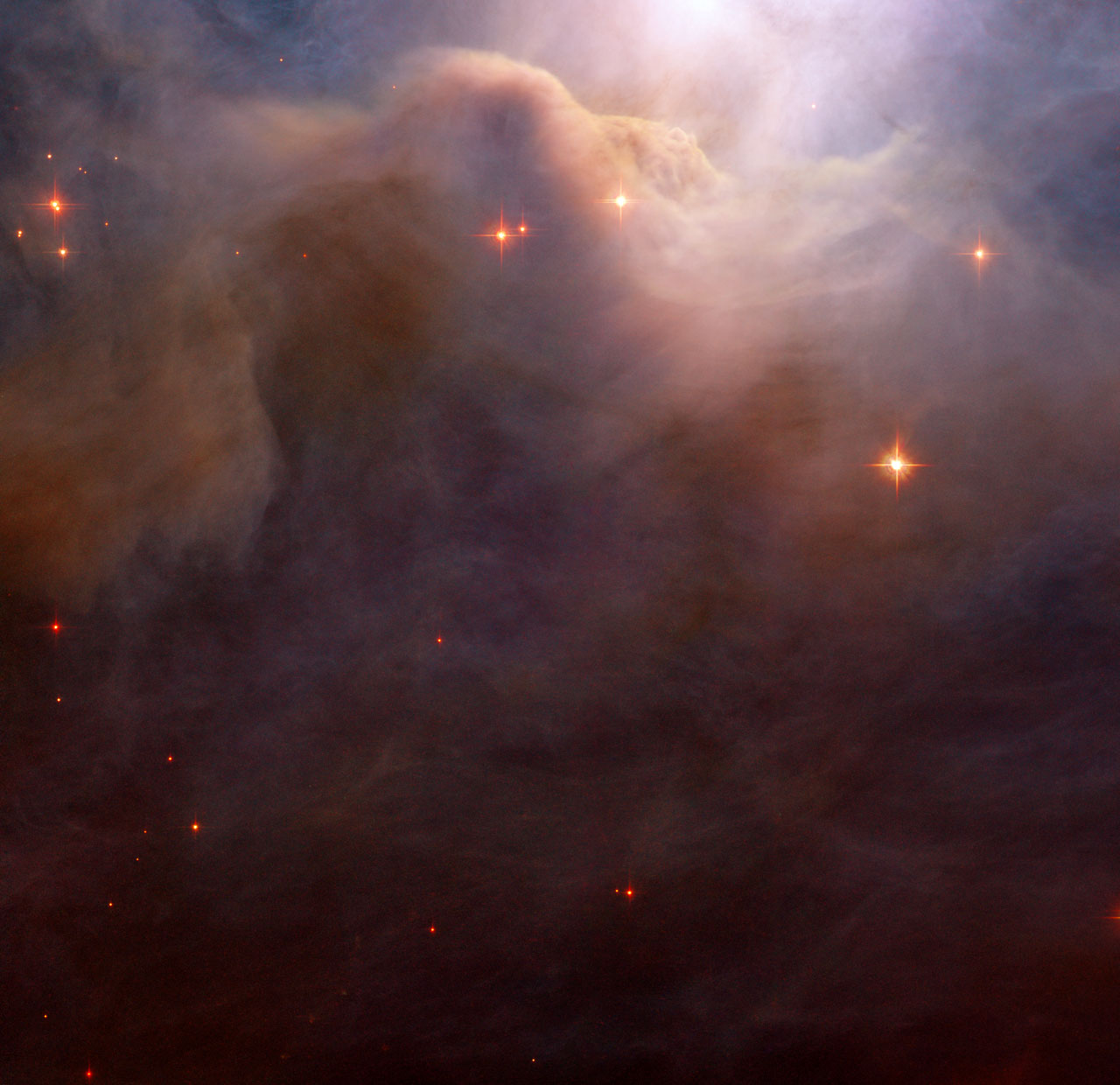
A Hubble close-up of the Iris Nebula (NGC 7023) in Cepheus, where dust glows in light scattered from the nearby star HD 200775, about 1,400 light-years away. Image credit: NASA & ESA.
The quiet father of the story
Cepheus was the king of Aethiopia, husband of the boastful queen Cassiopeia and father of Andromeda. He plays the smallest active role in the Royal Family drama. When the oracle demanded that he chain his own daughter to the rocks to satisfy the sea monster Cetus, he wept and obeyed. His reward, such as it is, was a place in the sky beside his family.
His constellation is faint and easy to overlook, shaped like a child's drawing of a house, a square with a pointed roof, sitting between Cassiopeia and the pole. What Cepheus lacks in bright stars he more than makes up for in remarkable ones.
Find Cassiopeia's W, then look toward Polaris. The little house tilted between them is Cepheus. Once you spot the roof, you will always recognise the king.
Cepheus at a glance
Abbreviation
Cep · Genitive: Cephei
Brightest Star
Alderamin (α Cep), magnitude 2.45
Famous Star
Delta Cephei, the Cepheid prototype
Best Visibility
Circumpolar above ~40°N; highest in autumn
The star that measured the universe
The most important star in Cepheus looks unremarkable. Delta Cephei brightens and fades on a clockwork cycle of about 5.37 days, swelling and shrinking as a pulsating star. It is the prototype of the Cepheid variables, and that clockwork turned out to be the key to the size of the cosmos.
In the early 1900s the astronomer Henrietta Swan Leavitt found that the longer a Cepheid takes to pulse, the more light it truly puts out. Measure a Cepheid's period and you know its real brightness; compare that to how bright it looks, and you know its distance. Edwin Hubble used exactly this trick on a Cepheid in the Andromeda nebula in the 1920s to prove that other galaxies lie far beyond the Milky Way. Every modern measurement of the expanding universe still rests on the rung of the ladder that this quiet star in the king's house first defined.
A garnet giant and a future pole star
The Garnet Star (Mu Cephei)
A red supergiant so large it would swallow the orbit of Jupiter, and one of the reddest stars visible to the eye. William Herschel named it for its deep garnet colour. It is more than a thousand times the Sun's diameter and shifts in brightness over months and years.
Alderamin, the next North Star
The constellation's brightest star, Alderamin, will sit near the north celestial pole around 7,500 CE as Earth's axis slowly precesses. Nearby Errai (Gamma Cephei), which hosts a known planet, takes its turn near the pole around 3,000 CE.
Iris Nebula (NGC 7023)
The blue reflection nebula in the photo above, where dust shines in the light of a hot young star. A rewarding target for a medium telescope under dark skies.
The Elephant's Trunk (IC 1396)
A vast emission nebula with a dark, sinuous column of gas and dust where new stars are forming. The Garnet Star glows at its northern edge.
Constellation data sheet
| Abbreviation | Cep |
| Genitive | Cephei |
| Area | 588 sq. degrees (27th largest) |
| Brightest star | Alderamin (alpha Cep), mag 2.45 |
| Famous variable | Delta Cephei, Cepheid prototype, period 5.37 days |
| Notable star | Mu Cephei, the Garnet Star, red supergiant |
| Future pole stars | Errai (~3000 CE), Alderamin (~7500 CE) |
| Bordering constellations | Cassiopeia, Draco, Ursa Minor, Cygnus, Lacerta, Camelopardalis |
| Best visibility | Circumpolar from >40N; highest on autumn evenings |
Cepheus is the quiet king, easy to miss between his dazzling wife and his rescued daughter. Yet the faint star in his little house is the one that measured the heavens, a reminder that the most important light is not always the brightest.
Part of the Royal Family
Cepheus belongs to the connected autumn saga of the Royal Family, mapped on the Greek mythology hub.
Cassiopeia · Cepheus · Andromeda · Perseus · Pegasus · Cetus
New to stargazing? See how to observe the night sky, and if you're choosing gear, the no-hype telescope buying guide.
All Astronomy Notes · Greek Mythology in the Night Sky · Cassiopeia · Polaris · Andromeda Galaxy · Draco