
The Hercules Cluster
M13 is the finest globular cluster in the northern sky — a ball of 300,000 stars packed into a sphere 145 light-years across, 25,000 light-years away, and the target of humanity's most deliberate attempt to announce itself to the cosmos.
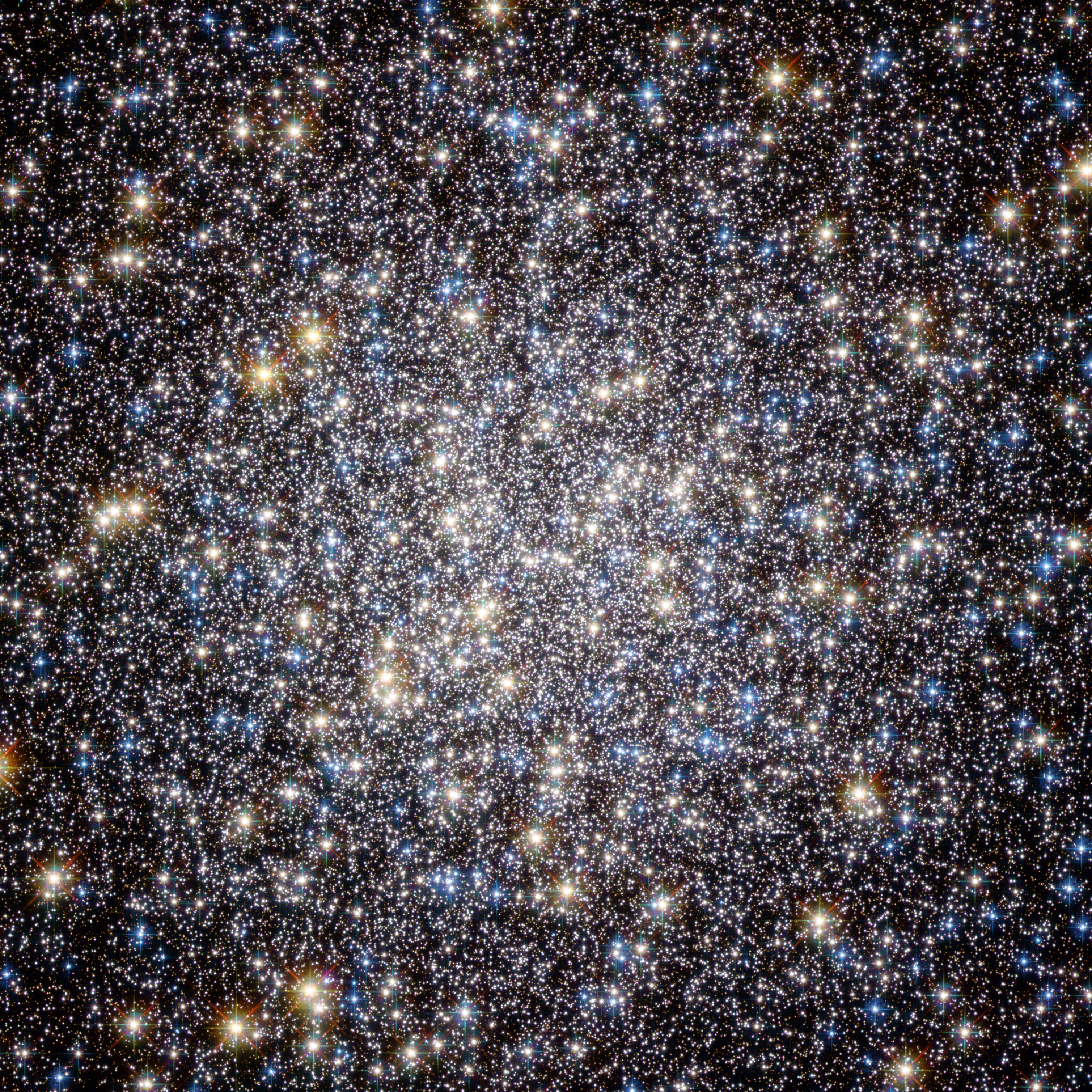
Image credit: ESA/Hubble & NASA. This Hubble image resolves individual stars across M13's bright core and into the outer halo, showing the extraordinary stellar density of the cluster's center.
Also Known As
M13, Messier 13, NGC 6205
Constellation
Hercules
Object Type
Globular cluster
Best Viewing
Spring and summer in the Northern Hemisphere
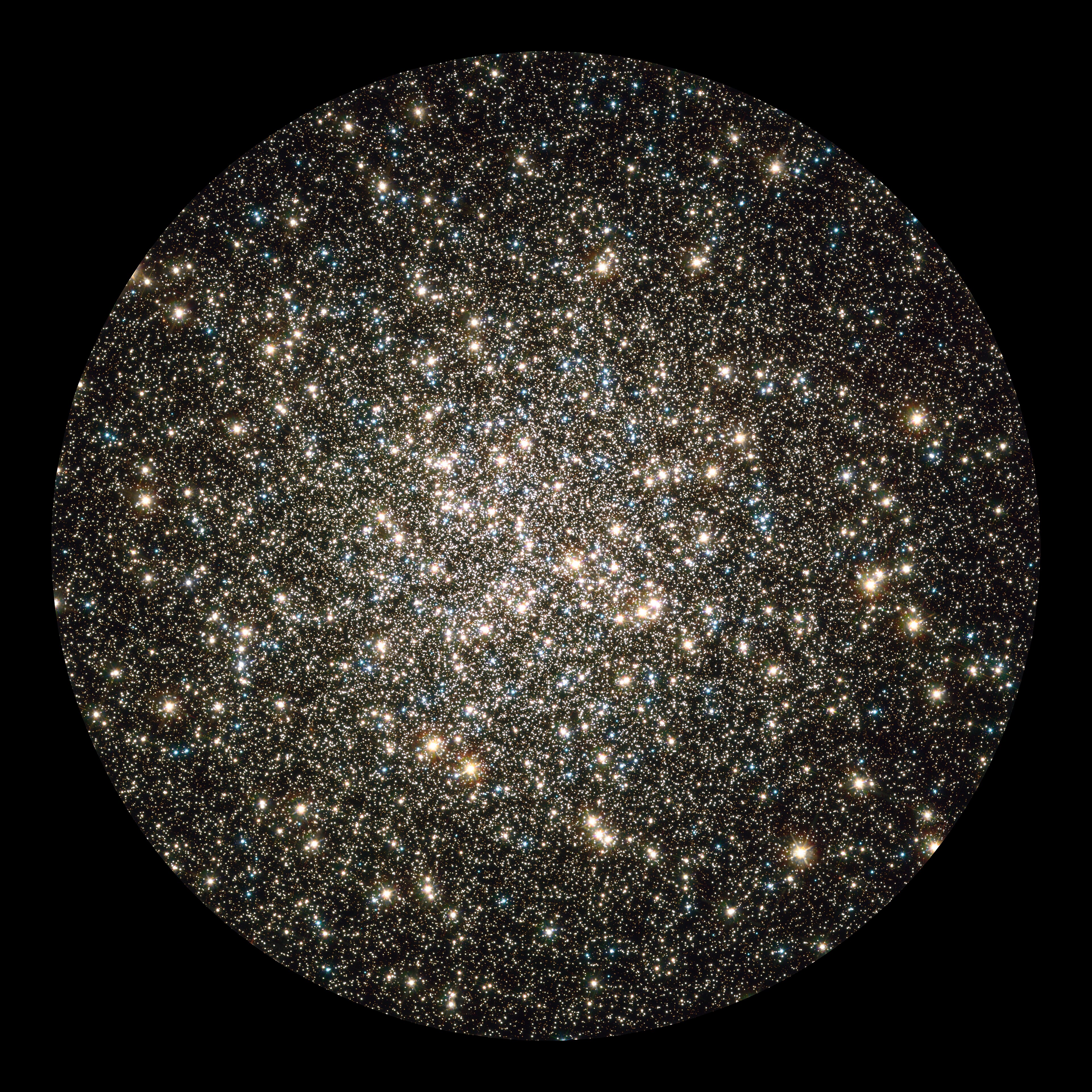
A sphere of 300,000 stars — ancient and tightly bound
A globular cluster is a gravitationally bound sphere of stars, typically old, densely packed, and orbiting the galaxy as a unit. The Hercules Cluster contains roughly 300,000 stars in a volume just 145 light-years across. Our own Sun is a relatively isolated star; a Sun-like star near M13's center would have hundreds of neighboring stars within a single light-year — an environment so densely populated that planetary systems would be constantly disrupted by gravitational encounters.
M13 is 11.65 billion years old, making its stars among the oldest in the Milky Way. They formed in the early universe, before the Milky Way's disk had fully assembled. The cluster carries that ancient origin with it in every orbit around the galaxy, passing through the disk roughly every few hundred million years.
Three views of M13
Hubble Detail
The sharpest available view of M13, resolving individual stars across the core and halo. The core is so dense that Hubble can barely separate individual stars there.
From the Ground
A ground-based image of M13 showing the graduated increase in stellar density from the outer halo toward the crowded core. Each point of light is a star comparable to or older than our Sun.
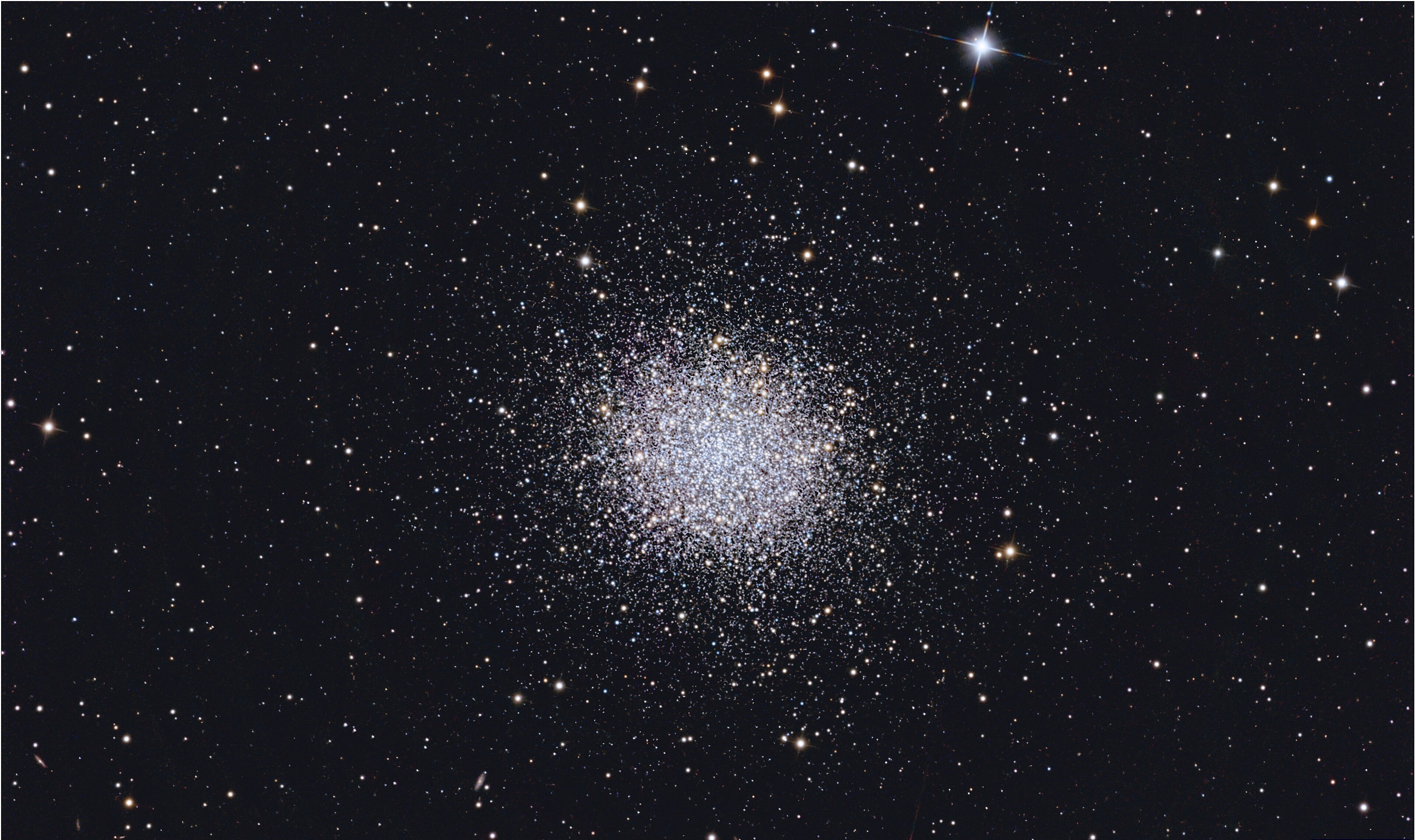
Ground-Based View
A wide-field ground-based image showing M13 in its broader sky context in Hercules. From the ground, the cluster is an unresolved fuzzy ball; space-based imaging separates the individual stars.
Discovered by Halley, cataloged by Messier, and addressed by humanity
Edmond Halley — better known for the comet that bears his name — discovered M13 in 1714. He described it as "a little patch, but it shows no star." In 1764, Charles Messier added it to his catalog as the 13th entry. As telescopes improved, the "little patch" revealed itself to be an immense congregation of stars.
The most unusual chapter in M13's history came in November 1974. Scientists at the Arecibo Radio Observatory in Puerto Rico directed the world's most powerful radio telescope at the Hercules Cluster and broadcast a 1,679-bit binary message into space. The Arecibo Message encoded, in binary, a representation of the numbers 1–10, the atomic numbers of key elements, the DNA double helix structure, a figure of a human, a diagram of the Solar System, and the Arecibo telescope itself.
The message will take approximately 25,000 years to reach M13 — by which point the cluster will have moved from its current position. The broadcast was less a practical attempt at contact and more a demonstration of what the Arecibo telescope could do. But it is still the clearest deliberate signal humanity has ever sent into the cosmos.
The best summer globular in the northern sky
The Hercules Cluster is one of those objects that scales beautifully with increasing aperture. In binoculars it appears as a round, diffuse glow — unmistakably not a star, but unresolved. A 4-inch telescope starts to hint at granularity. A 6-inch scope on a good night begins to resolve stars at the edges. An 8-inch or larger scope on a dark night starts to resolve stars across the outer halo, and the cluster becomes something genuinely spectacular.
The core remains dense and tightly packed even in larger telescopes — the stellar density is so high that individual stars in the center cannot be cleanly separated at moderate magnification. But the outer stars sparkling against the round glow is an unforgettable image, and M13 always rewards more aperture, more magnification, and darker skies.
Finder trick
In Hercules, find the Keystone — a lopsided square of four stars. M13 sits on the western side of the Keystone, about one-third of the way between the two western stars.
Aperture helps
Unlike extended objects that suffer from a larger field of view, M13 rewards aperture. The more light-gathering power you have, the more stars you resolve across the ball.
Dark skies
M13 is surprisingly bright for a globular — it can be glimpsed by naked eye from a very dark site. Under suburban skies, a 4-inch is enough to confirm it as non-stellar.
New to stargazing? See how to observe the night sky, and if you're choosing gear, the no-hype telescope buying guide.
Stars that should not be young, but appear to be
Globular clusters present a puzzle in the form of blue straggler stars. These are hot, blue stars that appear significantly younger than the rest of the cluster — an impossible result if all the cluster's stars formed together at the same time roughly 11 billion years ago. The leading explanation is stellar mergers: in M13's densely packed environment, two stars can approach closely enough to merge, producing a single more massive, hotter star that mimics the appearance of a younger object. Gravitational interaction rates in globular cluster cores are high enough to make these mergers relatively common over billions of years.
The stellar density in M13's core is staggering compared to the Sun's local neighborhood. Near the Sun, the closest star system (Alpha Centauri) is 4.2 light-years away. In M13's core, the average separation between stars is a fraction of a light-year. Any planetary systems in that region would experience gravitational perturbations from passing stars on timescales far shorter than what the outer solar system is used to.
Finding the Hercules Cluster in the summer sky
M13 is best placed in the evening sky from April through August. Find the constellation Hercules by looking between Vega (bright, high overhead in summer) and Arcturus (bright orange star to the southwest). The Keystone asterism is the central four stars of Hercules. M13 sits on the western edge of that Keystone, visible as a round glow in binoculars and as a resolvable cluster in a telescope.
Best setup
Binoculars confirm it easily. A 6-inch or larger telescope on a steady, dark night starts to resolve individual stars across the halo. Higher magnification (150–200×) helps on good nights.
Best season
June and July are peak months for M13 from Minnesota and most Northern Hemisphere latitudes. It is high in the sky by midnight in June and well-placed by 10 PM in July.
Primary sources: ESA/Hubble M13 image (potw1011a), NASA Messier 13 guide, NAIC Arecibo Message reference, and Britannica Hercules Cluster reference.
M13 is a city of three hundred thousand suns older than the Earth itself — and the direction in which we once sent a single hopeful hello, trusting that something this ancient might be worth speaking to.
Stories in the stars
M13 sits in the Keystone of Hercules, the kneeling hero of the twelve labours. See the full constellation and the wider tapestry on the Greek mythology hub.
More astronomy notes
Continue through the astronomy section for beginner-friendly notes, image credits, viewing tips, history, and the stories behind the night sky.
Astronomy · Andromeda Galaxy · Ring Nebula · Polaris · Interests