The Poisoned Pawn
Some pawns are traps wearing the mask of free material. The Poisoned Pawn — most famously in the Sicilian Najdorf — looks undefended, but taking it hands White a devastating initiative. Win a pawn, and you might never get your queen home. Bobby Fischer built a World Championship campaign on it.
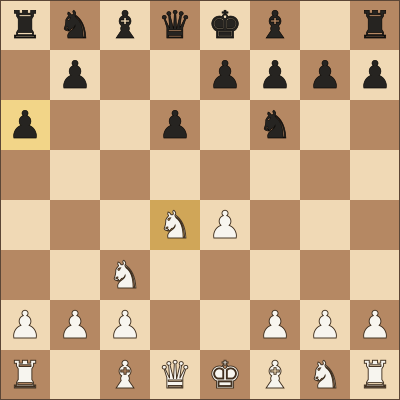
The Poisoned Pawn arises from the Sicilian Najdorf. White offers the b2 pawn as bait; Black's queen wins it but wanders deep into enemy territory while White's pieces mobilize around it — chess's most famous piece-activity-for-a-pawn imbalance.
Main Line
Sicilian Najdorf: 1.e4 c5 2.Nf3 d6 3.d4 cxd4 4.Nxd4 Nf6 5.Nc3 a6 6.Bg5 e6 7.f4 Qb6 8.Qd2 Qxb2
ECO Code
B97 — Sicilian Defense, Najdorf Variation, Poisoned Pawn Variation
The Idea
Black wins the b2 pawn but allows White to harry the queen — trading material for a development and initiative lead
Famous Practitioners
Fischer and Tal (Black), Spassky (White), Bronstein and Topalov (Black)
What makes a pawn "poisoned"?
A poisoned pawn is one that looks like a free capture but carries hidden venom. Taking it is legal and wins material — but triggers a positional or tactical crisis that usually outweighs the material gain. The player who grabs the pawn may find their queen misplaced, their development ruined, or a structural weakness created that proves fatal later.
The term entered chess vocabulary through the Sicilian Najdorf specifically, where Black's queen captures on b2 in a way that has been analyzed for decades without a final verdict. But poisoned pawns appear throughout the game. The concept is simple and ruthless: material is not free — every capture has a consequence, and some consequences are catastrophic.
The fundamental trade-off
When Black grabs the pawn, the question is always the same: does the extra material outweigh the time and positional cost? In the Najdorf, Black's queen ventures to b2 — far from the kingside, deep in enemy territory. White gains several tempi to complete development and build pressure, potentially trapping the queen. Black must survive the attack a pawn up, then convert. It is chess on a razor's edge.
Sicilian Najdorf: 8...Qxb2
The most famous poisoned pawn in chess arises from the Sicilian Najdorf, ECO code B97, after:
After 7.f4, White has a powerful center and the bishop on g5 pins Black's knight. The b2 pawn sits unguarded. Black's queen reaches out with 7...Qb6, eyeing it. White plays 8.Qd2 — not defending the pawn, but setting a trap. If Black takes 8...Qxb2, White answers 9.Rb1 and the queen has only one square: 9...Qa3.
The Najdorf structure behind the Poisoned Pawn. White's bishop is poised on g5 and the b2 pawn is left hanging as bait. After 8.Qd2 Qxb2 9.Rb1, the Black queen is forced to a3, offside, while White's attack ignites.
9.Rb1 — White springs the trap
After 9.Rb1, Black's queen has only one legal square: 9...Qa3. White then chooses among savage continuations. The most theoretical is 10.f5, attacking immediately, or 10.Bxf6 gxf6 11.Be2 followed by castling and Rb3 to harass the queen further. Either way, White's pieces flow toward the kingside while Black's queen is marooned on the queenside.
Black's counterplay
Despite the danger, Black is not simply losing. The extra pawn is real, and grandmasters have shown that Black can survive — and win — with precise play. The queen on a3 stays active, and Black's pieces must be mobilized quickly to generate their own threats. The resulting positions are among the most complicated in all of opening theory.
How Bobby Fischer weaponized the Poisoned Pawn
Bobby Fischer's relationship with the Poisoned Pawn is one of chess history's most compelling stories. As White, Fischer favored 6.Bc4 — the Fischer-Sozin Attack — against the Najdorf; 6.Bg5 was primarily what he faced from the Black side, and he knew the Poisoned Pawn inside out. When he took the Black side in the 1972 World Championship against Boris Spassky, he needed a weapon to destabilize Spassky's preparation — and he chose the Poisoned Pawn.
Fischer had studied the line exhaustively, finding improvements Soviet analysts had missed. In Game 7 of the match he played 8...Qxb2 against Spassky and held the draw against the best preparation in the world. It was a watershed: Fischer demonstrated the poisoned pawn was sound at the highest level, and the variation became a major theoretical battleground.
The irony of preparation
There is a famous paradox in Fischer's use of the line. He had spent years analyzing it from White's side, developing attacking ideas against it. When he switched to playing it as Black, that same deep knowledge of White's resources made him uniquely equipped to know exactly what Black could and could not survive.
The same trap in different disguises
The Najdorf is the most celebrated poisoned pawn, but the concept appears throughout chess. Any time a pawn looks free yet triggers a queen adventure or a structural crisis, the same poisoned dynamic is at work.
French Winawer — the g7 pawn
The French Winawer produces its own version. After 1.e4 e6 2.d4 d5 3.Nc3 Bb4 4.e5 c5 5.a3 Bxc3+ 6.bxc3 Ne7 7.Qg4, Black plays 7...Qc7 to guard g7. In some lines White grabs it anyway with 8.Qxg7 Rg8 9.Qxh7 — two pawns won, but the queen is trapped on h7 while Black's rook and knight generate pressure. The material was real, but Black's compensation has been validated for decades.
Ruy Lopez — the h-pawn
In various Ruy Lopez positions, a pawn on h3 or h6 becomes poisoned when the opponent has a bishop that can take it with tempo. After ...Bxh3, White's queen must recapture, dragging it into a passive role. The "poisoned h-pawn" is a known tactical motif.
Queen's Gambit structures
In Queen's Gambit positions after 1.d4 d5 2.c4, Black's ...dxc4 is sometimes described as grabbing a "poisoned pawn" — White lets it go and uses the open c-file and central space for compensation. Some subvariations sharpen into genuine poisoned-pawn dynamics where Black's queen becomes overextended.
Poisoned Pawn — FAQ
Is the Poisoned Pawn Variation sound for Black?
Yes, at the grandmaster level it is considered sound. Fischer, Tal, and more recently Topalov and other top players have used it successfully. It requires precise preparation — small inaccuracies can lose quickly — so for club players without deep study it carries more risk than it is worth.
Why doesn't White just defend the b2 pawn?
White deliberately allows the capture — that is the trap. The move 8.Qd2 develops the queen and connects the rooks while inviting Black to take. A passive defense like 8.Nb3 would let Black avoid the capture and reach a normal Najdorf. White's willingness to sacrifice b2 is what gives the line its character.
What is the best response for White after 8...Qxb2?
9.Rb1 is essentially forced and universally played. After 9...Qa3, White's main tries are 10.f5 (the most attacking), 10.Bxf6 gxf6 11.Be2 (positional), and 10.e5 dxe5 11.fxe5 Nfd7 12.Ne4. Each leads to a very different game.
Can Black avoid the trap by not playing 8...Qxb2?
Absolutely. After 7...Qb6 8.Qd2, Black can retreat the queen, play 8...Qxd4, or simply continue with 8...Nc6 or 8...Be7 and ignore b2. The Poisoned Pawn is a deliberate, voluntary choice — Black takes it knowing exactly what follows.
How does the Poisoned Pawn connect to en passant?
Both are about pawn captures with hidden consequences. En passant is a rule — a legal capture with strict preconditions. The Poisoned Pawn is a strategic concept — a capture that is legal but double-edged. Both reward players who understand the underlying mechanics and punish those who grab material without calculating.
- Chess Informant / ECO B97 classification (Najdorf, Poisoned Pawn Variation).
- Nunn, J. et al. Nunn's Chess Openings. (Najdorf chapter.)
- Kasparov, G. (2003–2006). My Great Predecessors, Vol. IV. Everyman Chess. (Fischer–Spassky 1972, Game 7.)
- Fischer, R. (1969). My 60 Memorable Games. Simon & Schuster.
Pawn Mastery — Part 2 of 7
The Poisoned Pawn lives inside the Sicilian Najdorf. Read the full Sicilian guide, revisit Part 1, or continue the Pawn Mastery series with pawn promotion.
Continue to Part 3: Pawn Promotion → · The Sicilian Defense →