
Pawn Promotion
Every pawn carries the seed of a queen. The moment a pawn crosses the board and reaches the opponent's back rank, it transforms — immediately and unconditionally — into any piece its owner chooses. This single rule is the engine that drives most endgames: the race to promote, the effort to stop it, and the calculation of who queens first.
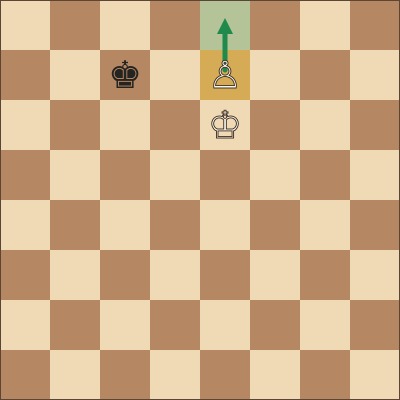
A pawn's journey ends here: White's pawn on e7, escorted by its king, is one step from the eighth rank (highlighted). On the next move it becomes a queen — converting a passed pawn is one of the most satisfying tasks in chess.
When It Happens
A pawn reaches the 8th rank (White) or 1st rank (Black) by advancing or capturing onto that rank
The Choices
The pawn must immediately become a queen, rook, bishop, or knight — it cannot stay a pawn
Multiple Queens
Legal. A player can have two or more queens at once — there is no limit
Notation
e8=Q (queen), e8=R (rook), e8=N (knight), e8=B (bishop)
How promotion works
Pawn promotion is one of the defining rules of modern chess. A pawn that reaches the far end of the board does not simply stop — it is immediately replaced by a piece of the promoting player's choice. The new piece takes effect on the same move; the transformation is instantaneous. In practice, a pawn on the 7th rank — one square from promotion — represents a ticking clock for the opponent.
When a pawn reaches the rank furthest from its starting position, it must be exchanged as part of the same move for a new queen, rook, bishop, or knight of the same colour. The player's choice is not restricted to pieces previously captured.
Key points players often miss
The pawn does not have to promote to the piece it replaced — you can have two queens, three rooks, or any combination. The new piece is active immediately: if a pawn promotes to a queen and that queen gives check on the same move, the opponent must respond. Promotion can also happen via diagonal capture onto the 8th rank.
White pawn on e7, one step from the back rank, with the king on e6 in support. On the next move, e8=Q (or any other piece) transforms the pawn. The highlighted e8 square is the destination.
Promotion as the engine of the endgame
Most chess endgames are ultimately about promotion. Once the pieces are traded down, the surviving pawns determine the result. A player with a passed pawn — one with no opposing pawns blocking its path — has a long-term advantage that becomes a win if the pawn reaches the 8th rank. The strategic implication is clear: in the middlegame, players create passed pawns specifically to threaten future promotion. Understanding promotion is not an endgame-only skill; it shapes decisions from the earliest middlegame.
The rule of the square
To tell whether a king can catch a passed pawn before it promotes, picture a square with the pawn and its queening square as one edge. If the opposing king can step into that square on its next move, it catches the pawn; if not, the pawn promotes. This single visualization decides countless king-and-pawn endings with no deep calculation.
King and pawn vs. king
The most basic endgame — king and pawn vs. bare king — is entirely about promotion. If the stronger side escorts its pawn to the 8th rank without the enemy king intercepting, it wins. If the enemy king reaches the queening square, it is usually a draw (rook pawns being a special, often-drawn case). Mastering K+P vs. K is the entry point to all endgame play.
Always promote to a queen — except when you shouldn't
The queen is the strongest piece in chess, and almost every promotion should be to a queen, which combines rook and bishop and often ends the game on the spot. The only exceptions — underpromotion to a knight, rook, or bishop — arise in specific positions where the queen would cause stalemate or where a knight fork wins immediately. Those are covered in Part 4.
Opposition and the king's role
The king must actively participate in promotion. In pure king-and-pawn endings, winning technique requires the stronger king to take the "opposition" — standing directly in front of its own pawn, one rank ahead — forcing the enemy king to give way step by step until the pawn can advance safely. A pawn that marches without king support is often caught, even when its path looks clear.
The moments that changed history
The history of chess is filled with promotions that electrified audiences. In the 1956 "Game of the Century," the 13-year-old Bobby Fischer's queenside pawn advance against Donald Byrne built toward a queen sacrifice in which the threat of queening was the decisive weapon. Mikhail Tal regularly created passed pawns as part of his sacrifices — the material was temporary, but the passer, advancing while the opponent wasted tempo, was permanent. Endgame virtuosos like Capablanca and Reuben Fine treated promotion as a solved problem: given a passer and correct technique, the win was a matter of execution.
The Réti endgame study
Richard Réti's famous 1921 study demonstrates promotion in its purest strategic form. The position looks lost for White — the Black pawn seems poised to queen while the White king is too far away. Yet the king maneuvers diagonally, simultaneously threatening to catch the Black pawn and escort its own pawn forward. The resolution — a draw achieved by the king's geometrically efficient march — is one of the most beautiful demonstrations of promotion strategy ever composed.
Converting a passed pawn to a win
Support the pawn with the king
The most common beginner error is advancing the pawn too early, without the king in support. A lone pawn on the 5th rank with the king far behind is vulnerable — the enemy king simply walks up to block it. Bring the king forward first, build a cage around the advance path, and only then push. The king leads; the pawn follows.
The outside passed pawn
Create an outside passer on one wing to decoy the enemy king, then invade with your own king on the other side to harvest pawns and promote a different one. The decoy may never queen — but it wins the game by keeping the enemy king occupied far from the real action.
The Lucena and Philidor positions
In rook endgames — the most common endgame type in practice — promotion appears as the Lucena and Philidor positions. The Lucena (rook and pawn vs. rook, pawn on the 7th) is the standard winning method, using "bridge building" to shelter the king from checks and escort the pawn home. The Philidor is the defensive counterpart: a draw saved by restraining the enemy pawn on the 6th rank. Both hinge entirely on whether promotion can be achieved or stopped.
The pawn race — when both sides have passers, the side that queens first and checks or mates immediately usually wins. Counting moves is the critical skill.
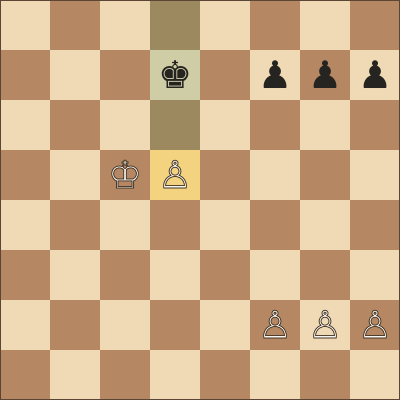
The king's escort — a pawn rarely promotes alone. Clearing the path, taking the opposition, and blocking the enemy king matters as much as the pawn's advance.
The new queen — after promotion the former pawn becomes chess's most powerful piece. A checkmate delivered on the promotion move itself is not unusual.
Pawn Promotion — FAQ
Can I refuse to promote a pawn?
No. Promotion is mandatory. When a pawn reaches the 8th rank it must immediately become a queen, rook, bishop, or knight. The only choice is which piece — a pawn cannot remain on the 8th rank as a pawn.
Can I have more than one queen?
Yes. There is no rule limiting the number of queens. Promote a second pawn and you have two queens; in theory you could have nine. The same applies to rooks, bishops, and knights.
Does a promoted rook have castling rights?
No. A rook created by promotion is not the original rook, so it has no castling rights even on a1, h1, a8, or h8. Castling requires the original, unmoved rook.
What happens if I promote and the new piece gives check?
The promotion and the check happen on the same move — the piece appears and is immediately giving check or checkmate, and the opponent must respond on their next move. Promote-to-checkmate is one of chess's most satisfying finishes.
In online chess, how do I choose the promotion piece?
Most platforms (Chess.com, Lichess) show a selector when the pawn reaches the back rank. If you are low on time they may auto-queen to prevent time losses. Check your settings — many let you set a default piece or an always-queen mode for blitz.
- FIDE Laws of Chess, Article 3.7e (promotion).
- Dvoretsky, M. Dvoretsky's Endgame Manual (king-and-pawn endgames).
- Fine, R. & Benko, P. Basic Chess Endings.
- Réti, R. Masters of the Chess Board (the 1921 study).
Pawn Mastery — Part 3 of 7
Almost every promotion is to a queen — but not all. Part 4 covers the rare and beautiful art of underpromotion, where a knight or rook beats the queen.