
The Passed Pawn
A passed pawn is a pawn that no opposing pawn can stop — none stands in front of it on its file or either adjacent file. It is chess's most tangible long-term endgame advantage. Passers don't always win by themselves, but they define the structure of almost every pawn endgame. As Philidor put it, "pawns are the soul of chess" — and the passed pawn is the soul's most ambitious expression.
In the endgame the passed pawn becomes the primary objective. Creating one, supporting its advance, and preventing the opponent's are the three pillars of pawn endgame strategy.
Definition
A pawn with no opposing pawn in front of it or on the adjacent files — a clear path to promotion
Why It Matters
A permanent, structural advantage. The opponent must commit resources to stop it — often conceding elsewhere
Outside Passer
A passer far from the action that decoys the enemy king while your king harvests pawns on the other wing
Connected Passers
Two adjacent passed pawns that defend each other's advance — one of the endgame's most lethal advantages
Geometry before calculation
Before counting move sequences, experienced players apply the Rule of the Square: draw a diagonal from the pawn to its promotion square, then form a square using that diagonal. If the defending king can step into that square on its turn, it catches the pawn. If not, the pawn queens no matter how hard the king tries. It lets you analyze a passed-pawn race in seconds instead of calculating ten moves deep.
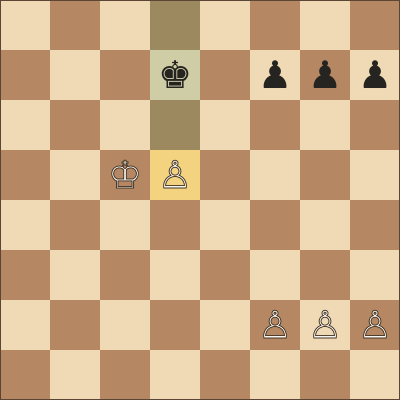
White's passed pawn on d5, the enemy king too far to intervene. Draw the square ahead of the pawn: if the defending king cannot step inside on its move, the pawn promotes. Here the king is shut out — White queens.
Find the pawn's square and its promotion square. Draw a square of that size ahead of the pawn. If it is the defender's move and their king is NOT inside that square, the pawn promotes; if it IS inside, the king catches it. If it is the attacker's move, push the pawn one square first, then apply the rule to the new, smaller square.
Three ways to make a passer
The pawn breakthrough
With three connected pawns facing three, a breakthrough is often available: advance the central pawn to attack, then the flank pawn, forcing a trade that frees one pawn to run. The classic sacrifice creates a passer that cannot be stopped — but it requires precise calculation, since not every three-vs-three has one.
Majority exploitation
A pawn majority on one wing — three against two, say — can usually produce a passer: advance the three, force trades, and one pawn slips past the blockade. This is the fundamental reason an extra pawn so often wins a pawn-only endgame.
Pawn-chain liquidation
In positions with interlocked pawn chains, attacking from the side can force the exchanges that create a passer. Breaking a d4-e5-f4 chain against d5-e6-f5 with a well-timed a4-a5 or g4-g5 forces trades — and whoever emerges with the passed pawn takes the endgame advantage.
The decoy that wins endgames
An outside passed pawn sits far from the main group of pawns. Its value is not in promoting — it is in distracting. When your a-pawn is passed and the real battle is on the kingside, the enemy king must race to stop the a-pawn while your king feasts on the kingside pawns. You trade the a-pawn's threat for material on the other side of the board, and win there.
1) Push the outside passer to force the enemy king to address it. 2) March your king toward the main pawn group while the enemy king is occupied. 3) Either queen the outside pawn or capture the now-undefended pawns elsewhere. The outside passer converts a flank advantage into a winning king march on the opposite wing.
Connected passed pawns
Two adjacent passers are one of the most powerful advantages in any endgame. They advance together, each protecting the other, and usually promote at least one regardless of the enemy king's position. Connected passers on the sixth rank give even a rook serious trouble; on the seventh they are almost always winning against a rook unless the defending king is ideally placed.
Defense against the passer
Stopping a passer means blockade — a piece directly in front of it. The ideal blockaders are the knight and the king, which sit in front and are hard to dislodge. A rook blockades awkwardly, tied to passive defense; a bishop on the right color works in specific positions. This is the heart of "the bug," covered in Part 7.
The king as blocker
In king-and-pawn endings the defending king is the primary blockader. The key is to get it directly in front of the pawn — not beside, not behind. A king in front of even an advanced pawn often draws, using the opposition to deny the pawn the square it needs.
The rook behind the passer
In rook endgames, both sides want their rook behind the passed pawn. The attacker's rook gains scope as its own pawn advances; the defender's rook controls the whole file and captures the pawn if it advances unsupported. "Rook behind the passer" is one of the most reliable rules in endgame theory.
The pawn's journey — a passer in the endgame is a countdown. Every advance brings it closer to queening, and the opponent must stop it or be overwhelmed.
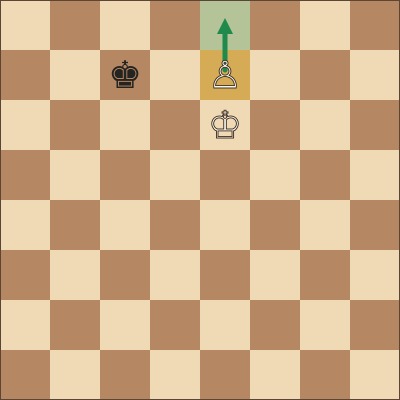
King escort — escorting the passer home with the king is the most fundamental endgame technique: when to advance the king, when to push the pawn.
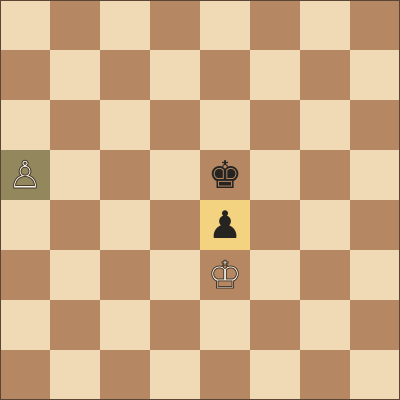
The defense — a king or knight planted in front of the passer locks it in place, while play is decided elsewhere on the board.
The Passed Pawn — FAQ
Is a passed pawn always a winning advantage?
Not automatically. It is a powerful long-term asset, but it must be supported and advanced correctly. Blockaded passers can be neutralized, and a passer with the king far away may be caught. It gives you something to play for; it does not guarantee the result.
What is a protected passed pawn?
A passed pawn additionally defended by another pawn, so it can never be captured for free. It is far more dangerous than an unprotected passer because the opponent cannot simply sacrifice a piece to remove it — they would have to capture twice.
How do you create a passed pawn from an equal structure?
The two main methods are the pawn breakthrough (forcing trades to free one pawn) and majority exploitation (more pawns on one flank, advanced to create a passer). Timing matters — push when your king supports the advance and the enemy king is too far to blockade.
Can a rook pawn become a passed pawn?
Yes, but converting it is harder because the queening square sits in the corner. A defending king that reaches the corner can often draw — a lone a-pawn on a7 with the enemy king on a8 is typically drawn even a pawn down.
- Silman, J. Silman's Complete Endgame Course. Siles Press.
- Dvoretsky, M. Dvoretsky's Endgame Manual (pawn-endgame chapters).
- Müller, K. & Lamprecht, F. Fundamental Chess Endings.
- Philidor, F.-A. L'Analyse du jeu des Échecs (1749).
Pawn Mastery — Part 6 of 7
If creating a passer is the attack, stopping one is the defense. The final part of the series covers "the bug" — the technique of locking an enemy pawn in king-and-pawn endings.