
Chess Gambits
A gambit is chess's first deal: surrender material now for something less tangible but potentially more powerful — time, development, central control, and pressure. The word comes from the Italian gamba (leg), the idea of "tripping up" the opponent. A gambit is the intentional sacrifice of a pawn (sometimes more) in the opening, betting that the resulting position more than pays for it.
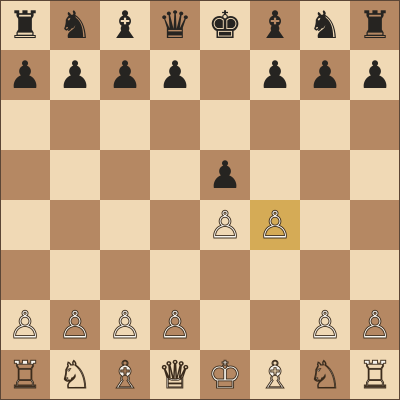
The King's Gambit (2.f4, highlighted) is the archetype: White offers the f-pawn to deflect Black's e5 pawn, open the f-file, and attack. The opening pawn sacrifice is chess's oldest psychological weapon — accept and face an initiative, or decline and let the gambiteer set the structure.
Definition
A pawn (or piece) sacrifice in the opening designed to obtain a positional or dynamic advantage in return
What You Get
Faster development, open lines, central control, attacking initiative, and pressure
Famous Examples
Queen's Gambit, King's Gambit, Evans Gambit, Smith-Morra, Danish, Budapest
Risk Level
Varies — the Queen's Gambit is sound; the King's Gambit is sharp; some are dubious but dangerous in practice
The three things a pawn buys
Pieces need open lines, central squares, and time. A gambit trades a permanent resource — material — for temporary advantages that, converted efficiently, exceed the value of the pawn. The three core returns are development, center control, and tempo.
Development
Every tempo the opponent spends recapturing and holding the pawn is a tempo not spent developing. Sacrifice on c4, let Black spend two moves keeping it (...dxc4, ...b5, ...c6), and you may have two or three more pieces in play. In open positions, a development lead like that creates attacks an extra pawn cannot answer.
Center & initiative
Gambits often offer a flank pawn to seize the center — the c-pawn in the Queen's Gambit lets d4 stand unchallenged. And a gambit poses problems immediately: even when the defense is sound, finding it requires precise play. At club level the burden of defending an initiative is enormous.
A gambit is not a blunder. A true gambit has been analyzed and is believed to give sufficient compensation. An unsound sacrifice gives material without enough in return — simply a mistake. "Gambit" carries a presumption of correctness, though even famous ones (the King's Gambit) have been questioned once computers found new defenses.
The world's most recognized opening
The Queen's Gambit is not a true gambit in the sacrificial sense — if Black plays 2...dxc4, White can usually recover the pawn. It is a positional pawn offer: White gives up c4 temporarily for central space and the open c-file. If Black tries to hold it with ...b5 and ...c6, White's central control and piece activity more than compensate.
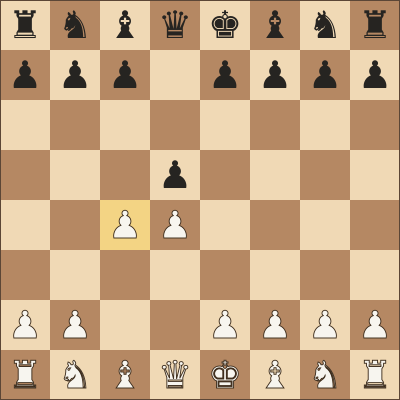
The Queen's Gambit: 2.c4 (highlighted) is offered. Black accepts with 2...dxc4 (Queen's Gambit Accepted) or declines with 2...e6 (QGD) or 2...c6 (Slav). The pawn is bait — White's real prize is the centre.
After 2...dxc4 (the Accepted), White develops rapidly with Nf3 or e3 and regains the pawn at leisure. The majority of elite games decline with 2...e6 (the Classical QGD) or 2...c6 (the Slav), reinforcing the centre and accepting a solid, slightly cramped position that has anchored Black's repertoire for over a century.
Romantic chess's defining weapon
The King's Gambit is one of the oldest and sharpest openings in chess. White offers the f-pawn to deflect Black's e5 pawn, open the f-file for attack, and accelerate toward the kingside — at the cost of weakening f4 and exposing the king. If Black accepts with 2...exf4, White plays 3.Nf3, controlling the centre and preparing to castle and attack.
The King's Gambit: 2.f4 (highlighted) offers the f-pawn to blow open the kingside. Accepted with 2...exf4, it leads to the sharpest play in classical chess; declined with 2...Bc5 or 2...d5, to quieter waters.
It was the weapon of Morphy, Anderssen, and the Romantic-era attackers, and in the modern age Boris Spassky was its great exponent. Bobby Fischer's famous 1961 essay "A Bust to the King's Gambit" argued that 2...exf4 3.Nf3 d6! gives Black a safe edge — yet Fischer himself won a brilliant King's Gambit as White in 1963. Read the full guide in the dedicated King's Gambit series.
The gambit repertoire
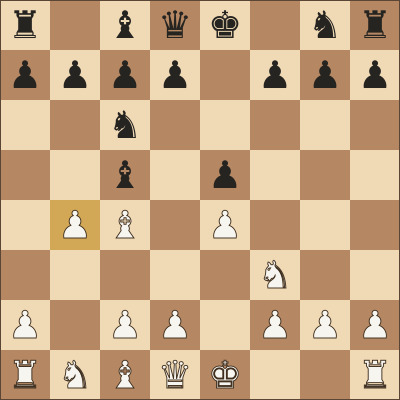
The Evans Gambit (4.b4, highlighted) — Morphy's favorite, revived by Kasparov. White gives the b-pawn to deflect Black's bishop and build a big centre with c3 and d4.
Evans Gambit — 1.e4 e5 2.Nf3 Nc6 3.Bc4 Bc5 4.b4
The Evans offers the b4 pawn to deflect Black's bishop and gain time for c3 and d4. The most feared gambit of the Romantic era and Morphy's weapon of choice, it was revived by Kasparov in the 1990s and still bites — see the Italian Game variations.
Smith-Morra Gambit — 1.e4 c5 2.d4 cxd4 3.c3
A popular club weapon against the Sicilian. After 3...dxc3 4.Nxc3, White trades a pawn for a big development lead, a strong e4 centre, and the open c- and d-files. It requires real theoretical knowledge on both sides.
Danish & Budapest
The Danish Gambit (1.e4 e5 2.d4 exd4 3.c3 dxc3 4.Bc4) offers two pawns for raking bishops on c4 and b2 — objectively dubious but dangerous. The Budapest (1.d4 Nf6 2.c4 e5) is Black's counter-gambit, sacrificing a pawn at once to knock White out of familiar Queen's-pawn territory.
The decision when you're offered a gambit pawn
Accepting
Taking the pawn forces the opponent to prove their compensation. It requires comfort defending an initiative — you may need to return the pawn at the right moment. Accept without knowing the theory, and a prepared gambiteer can build an attack fast.
Declining
Declining lets you develop normally, keep the position stable, and often transpose into familiar setups. The downside: if the gambit was sound, the gambiteer keeps a solid centre plus a tempo.
Counter-gambiting
Some defenses answer a gambit with their own sacrifice. The Falkbeer Counter-Gambit against the King's Gambit (1.e4 e5 2.f4 d5) ignores the offered pawn and strikes at White's centre at once. Counter-gambits demand the same tactical nerve — you accept imbalance and seize the initiative yourself.
Chess Gambits — FAQ
Should I play gambits as a beginner?
Yes, with reservations. Gambits produce open, tactical, exciting games and teach you how to attack. The King's Gambit, Evans, and Smith-Morra are great learning vehicles. Expect a stronger opponent to defend well sometimes — the early goal is to learn to generate pressure, not to win every game.
What if my opponent just holds the gambit pawn and doesn't attack?
That is the core challenge. If the opponent consolidates the extra pawn, they have a material edge for the endgame. The gambiteer must generate enough initiative or compensation before the endgame arrives; if the attack stalls with nothing else to show, the extra pawn usually decides a long game.
Is the Queen's Gambit a real gambit?
Technically yes — White offers a pawn Black can take. But it is not a true sacrifice, because White almost always recovers the c4 pawn. Unlike the King's Gambit, where the f-pawn is a genuine investment, the Queen's Gambit pawn comes back within a few moves. The name is traditional rather than precise.
Are gambits more popular at lower or higher levels?
Sharp speculative gambits are more common at lower levels. At grandmaster level most have been analyzed exhaustively and the defender finds precise moves, so the Queen's Gambit and solid systems dominate. Below that, gambits thrive because players are not memorizing 20-move refutations.
- Fine, R. The Ideas Behind the Chess Openings.
- Kasparov, G. My Great Predecessors, Vols. I–II.
- Fischer, R. "A Bust to the King's Gambit" (American Chess Quarterly, 1961).
- Modern Chess Openings (MCO-15).
Pawn Mastery — Part 5 of 7
Gambits are about the opening pawn. The last two parts turn to the endgame pawn — first the passed pawn, then "the bug" technique for locking one down.