
Pawn Underpromotion
Almost every pawn promotion becomes a queen. Almost. A small category of positions demands something rarer: a knight, rook, or bishop instead. Choosing the "lesser" piece is called underpromotion — one of chess's most counterintuitive and brilliant ideas, seen in tournament play, endgame studies, and even World Championship games.
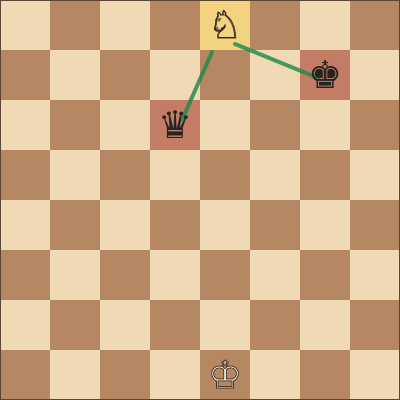
Why the knight? Its L-shaped leap attacks squares a freshly promoted queen on the same square cannot. Here a pawn promotes to a knight on e8, checking the king and forking the queen — the queen promotion would do neither.
What It Is
Promoting a pawn to any piece other than a queen — usually a knight, sometimes a rook or bishop
Most Common Reason
Stalemate avoidance — a queen would stalemate (a draw), while a rook or knight wins outright
Second Reason
Tactics — a knight's unique leap delivers an immediate fork or mate the queen cannot
How Often
Rare. Most club players never face one; elite play sees a handful a year across all events
Why a queen can be the wrong choice
Stalemate is the most common reason to underpromote. In certain endings — typically rook-pawn positions or a cornered king — promoting to a queen removes all of the opponent's legal moves without giving check. The result is stalemate: an automatic draw regardless of material. A player about to win instead draws, simply because they chose the most powerful piece.
If your pawn promotes to a queen and the resulting position leaves the enemy king with no legal moves AND not in check, the game is immediately drawn by stalemate. The queen's broad scope is exactly the problem — it covers too many squares and inadvertently cages the enemy king.
Rook promotion to the rescue
Rook pawns (a- and h-pawns) are the classic source of promotion stalemates. With a pawn on a7, the enemy king near a8, and your king escorting, queening on a8 covers a7, b7, b8, and a8 while the king has no escape — stalemate. The winning move is often a8=R: the rook controls the file and rank without the suffocating coverage, leaving the king one square but still delivering a winning checkmate with king support.
When a knight beats a queen on promotion
The knight is the most tactically interesting target because its movement is unlike any other piece. A knight on the promotion square immediately attacks up to eight squares in an L-shape — squares a queen on the same square would not attack at all. This creates a narrow but real category of positions where promoting to a knight gives check and forks a key piece at once. The opponent must answer the check, and the forked piece falls.
A pawn promotes to a knight on e8 (highlighted). The knight checks the king on g7 and simultaneously attacks the queen on d6 — a royal fork. A queen promotion on e8 would give neither check nor fork; only the knight wins the material.
The Saavedra position
The most famous underpromotion study in chess history is the Saavedra position, composed in 1895 and named for the priest Fernando Saavedra who found the win. White has a pawn about to promote — but the obvious queen leads to a draw, because Black has a rook check and a skewer or stalemate resource. The winning move is the stunning c8=R!. The rook, of all pieces, threatens a back-rank mate the Black rook cannot stop without surrendering itself. The rook wins where the queen only draws — one of endgame composition's masterpieces precisely because it is so anti-intuitive.
Underpromotion in famous games
Underpromotion has appeared at every level, from amateur games to World Championship matches. The common thread is always the same: calculation reveals that the obvious queen fails, and the correct piece is something else.
Nezhmetdinov vs. Chernikov, 1962
Rashid Nezhmetdinov, one of the great attacking players of the 20th century, executed a famous knight underpromotion that delivered check and forked a rook, winning the exchange in a position the queen would have only drawn. His games are a masterclass in the concrete calculation that makes underpromotion possible to spot.
Endgame composition
The most elegant underpromotions live not in tournaments but in composed studies. Composers like Troitzky, Réti, and Rinck built entire studies around the motif — long forced sequences ending with a knight or rook promotion as the only win. They train players to question the assumption that the queen is always best.
The rarest case: bishop underpromotion
Bishop underpromotion is rarest of all, occurring almost only in studies. A bishop always operates on one color, set by the promotion square — and a composer might require a bishop that covers exactly those squares to dodge a stalemate or land a unique mate. In a real game, though, the rook and knight cover the two practical reasons to underpromote.
Underpromotion — FAQ
How do I know when to underpromote?
Ask two questions. (1) Does queen promotion cause stalemate — does the new queen leave the enemy king with no legal moves and not in check? (2) Does knight promotion deliver an immediate check that also forks a valuable piece? If the queen is safe and forks nothing critical, promote to a queen. Underpromotion is a specific tactical decision, not a general strategy.
Why would a rook be better than a queen on promotion?
Because the queen can cover too many squares and cause stalemate. In rook-pawn endings a queen on a8 may box the enemy king with no check, drawing. A rook covers fewer squares, leaves the king one move, and still wins — the Saavedra position, where c8=R wins and the queen only draws, is the classic example.
Can underpromotion to a bishop ever be correct?
In tournament play, almost never; in composed studies, occasionally. A bishop underpromotion can avoid stalemate while covering a needed diagonal, but the same result is usually achievable with a rook or knight. It is mostly a curiosity of composition.
Does online chess allow underpromotion?
Yes. On Chess.com and Lichess a selector appears with all four piece choices when the pawn reaches the back rank. In timed games most platforms auto-queen if you run out of time before selecting, so in a time scramble click your underpromotion quickly.
- The Saavedra position (1895) — standard endgame-study literature.
- Dvoretsky, M. Dvoretsky's Endgame Manual.
- Nezhmetdinov, R. Super Nezh (selected games).
- Troitzky & Réti endgame studies (underpromotion motifs).
Pawn Mastery — Part 4 of 7
From the rarest promotion to the boldest sacrifice. Part 5 turns to gambits — giving up a pawn on purpose to seize the initiative.