The Bug
In rare king-and-pawn endgames, a desperate player finds a saving idea that looks impossible at first: locking the opponent's most dangerous pawn completely in place using nothing but a king and pawns. This maneuver — informally called "the bug" — doesn't capture the pawn and doesn't move it. It simply freezes it. The threatening pawn becomes as good as dead.
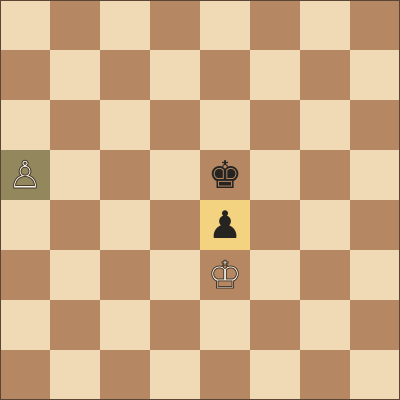
King-and-pawn endgames are chess at its most elemental — and most treacherous. Here White's king sits in front of Black's e4 pawn (highlighted), freezing it solid, while White's own passer on the a-file is free to run. Small geometrical nuances separate saves from losses.
What It Is
A defensive technique that uses king and pawn placement to completely block — "kill" — an enemy pawn's advance
The Goal
Neutralize a dangerous passer without sacrificing material, by permanently occupying the squares it needs
Named For
The pawn is "bugged" — frozen in amber, unable to move without being captured, no longer a threat
Rarity
One of chess's most obscure endgame ideas — but the pattern sharpens pawn-endgame intuition broadly
Freezing a pawn in place
The mechanics are simple: a pawn cannot advance if its square is occupied, and it cannot capture if there is nothing to capture. Station the defending king directly in front of the opponent's most dangerous pawn, with the surrounding structure preventing any supporting pawn from helping, and the pawn is immobilized. It is not captured or removed — it simply ceases to be a threat.
Black's passed e4 pawn looks threatening, but White's king sits on e3 directly in front of it (highlighted). The pawn cannot advance (the king blocks it) and cannot capture (nothing to take). Meanwhile White's a-pawn runs free. The e-pawn is frozen — "bugged."
1) The defending king must reach the square directly in front of the dangerous pawn before it advances past. 2) The pawn must have no way to advance through a capture — nothing adjacent to take that clears the king's square or promotes by force. 3) The surrounding pawn structure must prevent the opponent from using other pawns to dislodge the blocking king.
How to execute the bug
Timing the king march
The critical element is timing. The king must arrive in front of the dangerous pawn before it reaches that square. One move late and the pawn is already past; one move early and the king may be pushed aside before the lock solidifies. Exact move-counting is required to know if the march is fast enough.
Pawns as anchors
A king alone blockades only temporarily — the enemy king can try to dislodge it. The most durable bugs use a supporting pawn on an adjacent file that shelters the blocking king. When the king has a square to step to if pushed, the lockout becomes permanent rather than temporary.
Adjacent pawns as the lock mechanism
Often the defender's own pawn is the key. A defending pawn on the file beside the locked pawn can sit alongside it, forming a vise: two pawns side by side with the attacker's pawn between them. The locked pawn cannot capture either neighbor (they belong to the defender) and its forward square is held by the king. It has nowhere to go.
Saving a lost position through lockout
The bug's value is defensive: it rescues positions that look lost. A player down material who applies it converts a losing endgame into a draw — the opponent's "winning" pawn becomes a permanent fixture rather than a weapon, and the rest of the board often settles into mutual blockade or a draw by repetition.
When the locked pawn is the key
The bug works best when the locked pawn is the opponent's only realistic winning weapon. If the attacker has another passer or an active king that creates threats independently, the bug only delays defeat. The defender must recognize that the locked pawn is the critical element — freeze it, and the position draws.
The defending king's dual role
Once the lock is established, the king need not stay glued to the blockading square forever. If the lock is truly stable, the king can sometimes venture off to support other pawns or create counterplay. Judging whether the lock is permanent or needs constant vigilance is part of the technique's depth.
How to break out of a locked position
From the attacker's side — if your pawn has been bugged — the task is to disrupt the blockade, which is hard, because a well-built bug has no immediate break. You must look for indirect methods.
Zugzwang
Zugzwang — where any move worsens your position — can force the blocking king off its square. If you can reach a position where the defender has only losing moves, the king must abandon the blockade. This often needs precise king triangulation: moving in a triangle to lose a tempo and hand the move to the opponent.
A second threat
If the locked pawn can't advance, create a second threat elsewhere. Force the defending king to choose — stop one pawn or the other, but not both. This two-pronged attack is how great endgame players crack apparently impenetrable defenses.
Pawn sacrifices to open lines
Sacrificing an adjacent pawn to force a capture or trade can shatter the bug's structure. If the defender's anchor pawn is removed by a forced trade, the king may be exposed. Concrete calculation is required — not every sacrifice works, and many only deepen the draw.
King precision — in king-and-pawn endings a single square of king placement can be the margin between a win and a draw. The bug lives or dies on it.
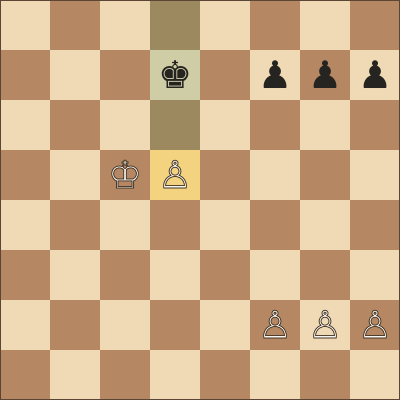
The frozen pawn — what looks like a winning passer becomes a liability once it is bugged: it cannot advance, capture, or be supported.
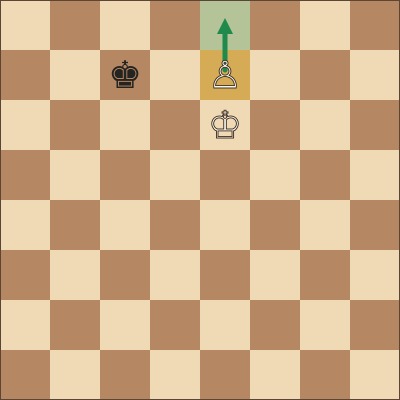
Drawing technique — the bug extracts draws from lost positions by neutralizing the opponent's only path to promotion.
The Bug — FAQ
Is "the bug" an official chess term?
No — it is an informal name for the pawn-locking technique. Endgame manuals describe it under broader topics like pawn blockade, king blockade, or pawn lock. The name is evocative — the pawn is "bugged," frozen in place — even though it is not standardized.
How is the bug different from a simple pawn blockade?
A standard blockade has a piece in front of a pawn temporarily. The bug is more extreme: the pawn is permanently removed as a threat, usually because the surrounding structure makes the block impossible to break without sacrificing material. The blocked pawn has genuinely no path forward.
Can the bug occur with pieces on the board?
It most often refers to king-and-pawn endings, but the idea — permanently blockading a dangerous pawn with king and pawn placement — applies in richer endgames too. A knight blockading a passer, supported by a king, can create a similar frozen structure.
How do I know when to attempt the bug?
Look for three things: your king can reach the square in front of the dangerous pawn in time; your pawn structure gives the blocking king shelter or support; and the opponent has no easy second decisive threat elsewhere. If all three hold, calculate the king march exactly and verify the blockade — it may be your only saving chance.
- Dvoretsky, M. Dvoretsky's Endgame Manual (king-and-pawn blockades).
- Müller, K. & Lamprecht, F. Fundamental Chess Endings.
- Averbakh, Y. Chess Endings: Essential Knowledge.
You've finished the Pawn Mastery series
From the en passant rule to the bug, you've covered the pawn from every angle. Put it to work in the opening guides — every opening is really a fight to reach a favorable pawn structure.