
Italian Game Variations
The Italian splits into a handful of famous lines — the calm Giuoco Piano, the swashbuckling Evans Gambit, the counterattacking Two Knights Defense, and the legendary Fried Liver Attack. This guide walks through each with board diagrams and the key moves that define them.
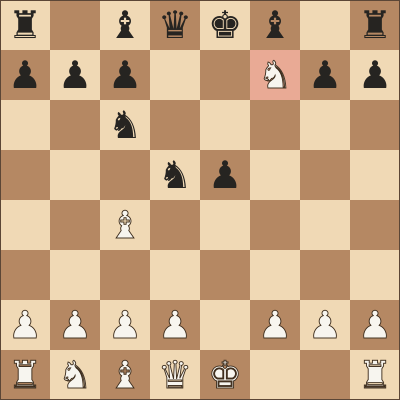
The Italian Game's most famous moment: the Fried Liver Attack, where White's knight crashes into f7 (highlighted). It is the headline act of the Two Knights Defense — but the Italian's variations run from this fire all the way to the quietest positional grinds.
The Giuoco Piano (3...Bc5)
The classical heart of the Italian. Black develops symmetrically, the bishop on c5 mirroring White's bishop on c4. For most of chess history White continued 4.c3, preparing the central break d4. After 4...Nf6 5.d4 exd4 6.cxd4 Bb4+ the game opens up into sharp, classical play that has been analyzed since the 1700s.
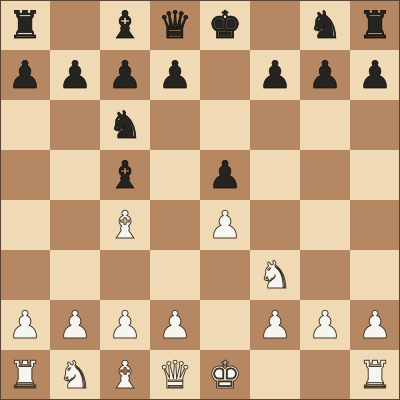
The Giuoco Piano after 3.Bc4 Bc5. Both bishops occupy their best diagonals. White's central pawn break with c3 and d4 is the classical plan; the slow d3 build-up (the Pianissimo) is the modern one — see Part 3.
The Evans Gambit (4.b4)
One of the great romantic gambits. White offers the b-pawn to deflect Black's bishop and gain a tempo for c3 and d4, building a powerful centre. After 4...Bxb4 5.c3 Ba5 6.d4, White has a big pawn centre and open lines toward the Black king in return for the pawn. Invented by Captain William Davies Evans in 1827 and feared throughout the 19th century, it was spectacularly revived by Kasparov, who beat Anand with it in 1995.
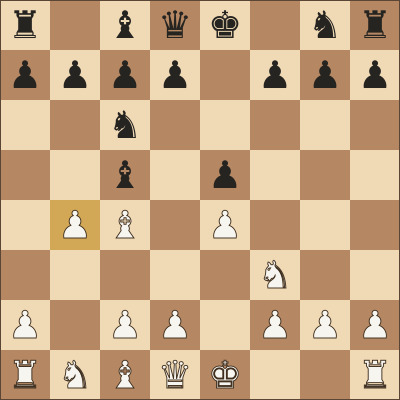
The Evans Gambit, 4.b4 (highlighted). The pawn is bait: after ...Bxb4 5.c3 White gains time to play d4 and seize the centre. Black's safest path is to grab the pawn and give it back later with ...d6 and ...Bb6.
The Two Knights Defense (3...Nf6)
Black declines to mirror White and instead counterattacks e4. This is the fighting choice and the gateway to the sharpest Italian lines. White's most aggressive reply is 4.Ng5, attacking f7 a second time. Black must react precisely with 4...d5 5.exd5, and now the road forks: the solid 5...Na5 sidesteps the fireworks, while 5...Nxd5 walks straight into the Fried Liver.
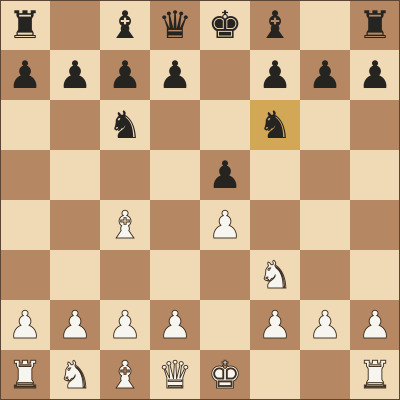
The Two Knights Defense, 3...Nf6 (highlighted). Black ignores symmetry and hits e4. The critical 4.Ng5 leads to forcing play; Black's reliable answer is 4...d5 5.exd5 Na5, the Polerio Defense, giving back a pawn to neutralize the attack.
The Fried Liver Attack (6.Nxf7)
Also called the Fegatello (Italian for "dead as a piece of liver"), this is the most famous attacking idea a beginner ever learns. After 5...Nxd5, White plays 6.Nxf7, sacrificing the knight. Black must take with 6...Kxf7, and now 7.Qf3+ forks the king and the d5 knight, dragging the monarch up the board with 7...Ke6 forced. White continues 8.Nc3, piling onto d5. Black is a piece up but the king is stranded in the centre — and at club level White scores heavily.
After 6.Nxf7 — the Fried Liver. The knight (on the highlighted f7 square) is sacrificed: Black must play 6...Kxf7, then faces 7.Qf3+ Ke6 8.Nc3, with the king dragged into the open. Thrilling to play, and the perfect lesson in the value of the initiative over material.
How to meet it
The practical answer is not to allow it. With 5...Na5 (the Polerio / Knorre line), Black hits the c4 bishop and refuses to recapture on d5, accepting a pawn deficit for fast development and a safe king. Engines confirm Black is fine. The wild 4...Bc5 (the Traxler Counterattack) is the other option — Black ignores the threat to f7 entirely and aims for ...Bxf2+, producing some of the most chaotic positions in all of opening theory.
Italian Variations — FAQ
How does Black defend against the Fried Liver Attack?
The cleanest way is to avoid it with 4...d5 5.exd5 Na5 (the Polerio Defense), giving back a pawn for activity and a safe king. If Black allows 6.Nxf7 Kxf7, precise defense (7.Qf3+ Ke6 8.Nc3 Nb4) holds — but it is hard to find over the board, which is why the Fried Liver wins so many club games.
Is the Evans Gambit sound?
Yes, for any level short of elite engine prep. White gets time, a strong centre, and attacking chances for the pawn. Black's safest path is to accept and return the pawn at the right moment with ...d6 and ...Bb6. Kasparov used it at the top level as recently as 1995.
What is the Traxler Counterattack?
The Traxler (Wilkes-Barre) is 4.Ng5 Bc5 — Black ignores the threat to f7 and aims for ...Bxf2+. It leads to chaotic, double-edged play and is beloved by attacking club players, though White is theoretically a little better.
What is the Giuoco Pianissimo?
The Giuoco Pianissimo (the very quiet game) is the modern main line: after 3...Bc5, White plays 4.c3 and d3 instead of an early d4, building slowly with Nbd2, Bb3, and Re1. It is the favorite of Carlsen and Caruana. Full coverage is in Part 3.
The Giuoco Piano — the classical, balanced main line where both sides develop the bishops and fight for the centre with c3 and d4.
The Evans Gambit — a pawn for time and a big centre. Romantic-era dynamite, revived by Kasparov against Anand in 1995.
The Fried Liver — 6.Nxf7, the knight sacrifice that exposes Black's king. The most famous beginner attack in chess, and a lesson in initiative.
- Emms, J. (2010). Starting Out: The Italian Game. Everyman Chess.
- Pinski, J. (2005). Italian Game and Evans Gambit. Everyman Chess.
- Kasparov–Anand, Riga 1995 (the famous Evans Gambit win).
- ECO classification C50–C59. Online: Lichess opening explorer (Two Knights / Fried Liver filter).
Every opening belongs to a family — browse the three theme clusters: Romantic & Attacking Gambits · Flank & Hypermodern Systems · Solid Defenses.
From fire to finesse — the modern Italian
The romantic gambits are only half the story. Part 3 covers how today's elite play the Italian: the slow Giuoco Pianissimo with c3 and d3, where Carlsen and Caruana grind out wins from quiet positions.