
The Danish Gambit
Two pawns, gone by move five — and in return, two bishops on the great diagonals staring straight at Black's king. The Danish Gambit is the romantic era distilled: 1.e4 e5 2.d4 exd4 3.c3, and let the attack decide.
Accepted: 3…dxc3
Declined: 3…d5
(the modern antidote)
3.c3 and Bc4 + Bxb2
put both bishops on
f7/g7 diagonals with tempo.
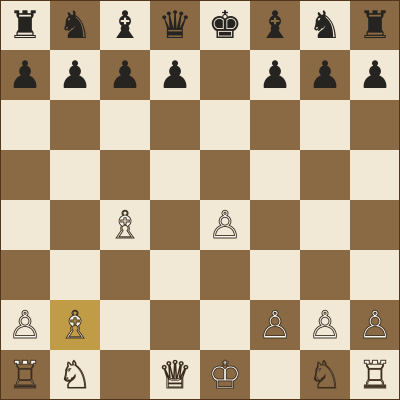
If the Evans offers one pawn and the King's Gambit offers one, the Danish doubles down: after 1.e4 e5 2.d4 exd4 3.c3, White is ready to sacrifice two pawns to place both bishops on the a2–g8 and a1–h8 diagonals, converging on f7 and g7. There is no subtlety here and that is the charm — it is attack or bust. The Danish was a romantic-era favourite and it remains one of the best ways to learn the value of initiative, open lines, and rapid development. Just know the honest verdict going in: against the accurate 3…d5, Black returns a pawn and stands at least equal. Play it for the attack and the fun, not because it refutes anything.
The Accepted Main Line: the Two-Bishop Sacrifice
The full romantic vision. Black accepts both pawns — 3...dxc3 and 4...cxb2 — and White recaptures with 5.Bxb2, completing the setup: a bishop on c4 eyeing f7, a bishop on b2 raking the long diagonal toward g7 and the Black king. White is two pawns down but every piece points at the enemy king, and development flows with Nf3, 0-0, Nc3, Qb3 and Rad1. At club level and in fast time controls this is genuinely dangerous; against imprecise defence the attacks play themselves.
The Modern Antidote: 3…d5!
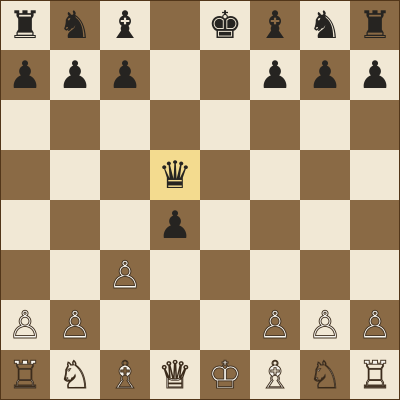
The honest refutation. Rather than greedily taking everything, Black strikes back in the centre with 3...d5, returning a pawn to kill the attack before it starts. After 4.exd5 Qxd5, Black's queen is active and the position is roughly symmetrical — White has no gambit and no advantage. This is why the Danish is not seen at the top level: a prepared opponent simply declines. But you will still meet plenty of players who grab the pawns — and that is where the fun begins.
Where the Danish Fits
The Danish belongs to the great family of Romantic & Attacking Gambits — kin to the King's Gambit (a pawn on the f-file) and the Evans Gambit (a pawn on the wing). All three share one creed: give material, seize the initiative, and attack. They are the openings of Morphy's era and the spirit Tal carried into the 20th century.
Why learn it
Nothing teaches attacking chess faster than a gambit you have to justify with initiative. The Danish drills development, open lines, and the killer instinct — skills that transfer to every opening you play.
Know the verdict
Play it for the experience and the practical bite, not because it is objectively best. Against 3...d5 there is no advantage — so enjoy the games where your opponent can't resist the pawns.
Frequently Asked Questions
The Danish Gambit arises after 1.e4 e5 2.d4 exd4 3.c3 — White offers one and often two pawns (after 3...dxc3 4.Bc4 cxb2 5.Bxb2) to place both bishops on the long diagonals aiming at Black's king. It is a classic romantic-era attacking gambit, prized for its directness and its brilliancies.
Not objectively — against the accurate 3...d5! Black returns a pawn and reaches at least equality, so White gets nothing. But as a practical and club-level weapon it is dangerous and fun: many opponents accept both pawns and walk into a fierce attack. Play it for the initiative and the learning, not as a refutation.
The cleanest antidote is 3...d5! — instead of grabbing pawns, Black strikes in the centre. After 4.exd5 Qxd5, Black returns a pawn, activates the queen, and defuses White's attack, reaching a comfortable, roughly equal position. Declining the gambit this way is why it isn't seen at the elite level.
Because in the fully accepted line (3...dxc3 4.Bc4 cxb2 5.Bxb2) White gives up two pawns to develop both bishops with tempo onto the a2–g8 and a1–h8 diagonals, both converging on Black's kingside. The twin bishops are the whole point of the gambit.
It's excellent for learning attacking chess — it teaches development, open lines, and initiative in the most direct way possible. Just pair it with an understanding of the 3...d5 defence so you know its limits. As a first attacking weapon and a blitz surprise, it's hard to beat for pure enjoyment.