
The Evans Gambit
One of the most glorious attacking ideas in chess — 4.b4!? Offer a wing pawn to hijack a tempo, build a big centre with c3 and d4, and hurl everything at f7. Captain Evans invented it in 1827; Morphy and Anderssen made it immortal; Kasparov revived it in 1995.
Main line: C52
Compromised Def.: C52
Declined (4…Bb6): C51
4.b4 deflects the bishop,
then c3 + d4 build a
centre and open lines at f7.
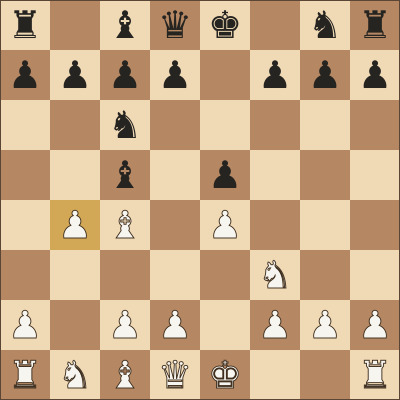
The Evans Gambit is the purest expression of romantic chess: material means nothing, time and initiative mean everything. With 4.b4, White offers the b-pawn for a single tempo — if Black grabs it with ...Bxb4, White plays c3 (hitting the bishop again) and d4, building a powerful centre with tempo. In a handful of moves White has two centre pawns, both bishops raking toward f7, and a lead in development that can be worth far more than the sacrificed pawn. For 150 years the Evans was the ultimate test of whether you could defend under fire — and Kasparov's 1995 win over Anand proved it still bites at the very top.
The Main Line: 5.c3 Ba5 6.d4
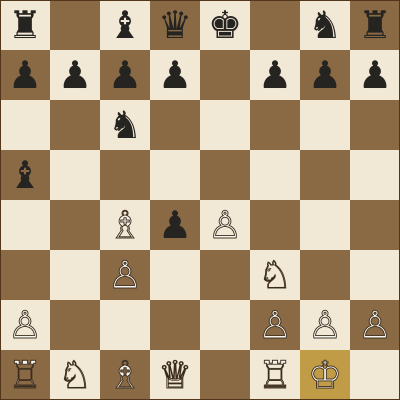
The classical treatment. After 4...Bxb4, White gains a tempo with 5.c3, then strikes with 6.d4. Black usually grabs on d4, and after 7.0-0 White has sacrificed a pawn for a massive lead in development, a strong centre, and both bishops aimed at Black's king. The main continuations run 7...dxc3 (greedy) or 7...Nge7 / 7...d6 (consolidating). Black's task is to survive the opening storm and reach an endgame where the extra pawn tells.
The Compromised Defence
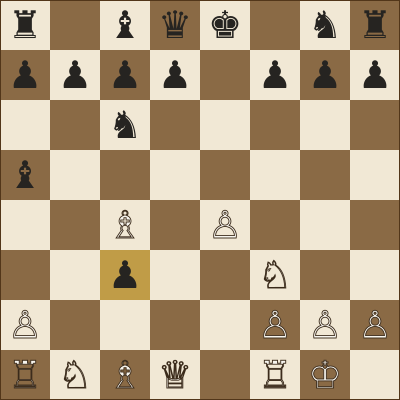
The critical, greedy test: Black grabs a third pawn with 7...dxc3. In return White gets a huge initiative — 8.Qb3 hitting f7, Nxc3, Ba3 and Rad1 pour pieces at the exposed Black king. This is the line the romantics dreamed of: two pawns down (soon one), but with an attack that has scored countless brilliancies. Modern theory holds it as roughly balanced with precise defence, which is exactly why it's so much fun to play from either side.
Kasparov's Revival — and Anand's 5…Be7
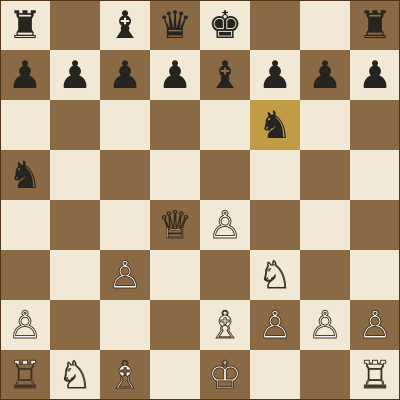
In 1995 Garry Kasparov stunned the chess world by wheeling out the 19th-century Evans Gambit against Viswanathan Anand — and winning a brilliant 25-move miniature. Anand met it with the modern 5...Be7 (retreating the bishop to safety and preparing ...Na5 to trade White's prized light-squared bishop), returning the pawn to blunt the attack rather than clinging to it — and still lost to Kasparov's deep preparation. Kasparov's point: even at the top, a romantic gambit backed by concrete preparation is a real weapon.
The Romantics Who Loved It
Morphy & Anderssen
The giants of the romantic era wielded the Evans as a matter of course — rapid development, open lines, and sacrifices at f7 were the language they spoke. Their games remain the model for how to play the White side.
Kasparov, the Modern Revivalist
Kasparov's 1995 win over Anand with the Evans proved that deep preparation can breathe new life into a 170-year-old gambit — a bridge between the romantic past and the engine age.
The Evans lives inside the Italian Game family (both begin 3.Bc4 Bc5) and sits at the heart of the Romantic Gambits cluster alongside the King's Gambit and the Danish Gambit.
Frequently Asked Questions
The Evans Gambit arises after 1.e4 e5 2.Nf3 Nc6 3.Bc4 Bc5 4.b4 — White sacrifices the b-pawn to deflect Black's bishop and gain a tempo, then builds a strong centre with c3 and d4 and attacks toward f7. It is one of the most famous attacking gambits in chess, invented by Captain William Davies Evans in 1827.
Yes, with the caveat that Black has sound defences. White gets real compensation — a lead in development, a strong centre, and attacking chances — for the pawn. With accurate defence (often returning the pawn, as in the modern 5...Be7 lines Anand tried against Kasparov) Black equalizes, but the practical pressure is enormous, especially at club level.
Kasparov used the Evans Gambit against Anand in 1995 to demonstrate that a well-prepared romantic gambit is still dangerous at the elite level. Backed by deep home analysis, he won a brilliant game and sparked renewed interest in the opening. It showed that initiative and preparation can outweigh a pawn even against the world's best.
The Compromised Defence is 4...Bxb4 5.c3 Ba5 6.d4 exd4 7.0-0 dxc3 — Black grabs a third pawn. In return White gets a raging initiative with Qb3, Nxc3, and Ba3 hitting the exposed king. It is the sharpest test of the Evans and has produced some of chess's most famous attacking games.
Black's soundest approach is to return the pawn at the right moment rather than cling to it — for example with the modern 5...Be7 and ...Na5 to trade White's strong bishop, or by accepting and then giving back material to reach a safe endgame. Greedy defences like the Compromised Defence are playable but demand precise calculation.